
Investment demand plays a pivotal role in shaping real estate prices due to its substantial influence on market dynamics. Investors, both domestic and international, often view real estate as a lucrative asset class, leading to increased capital inflow into the housing market. This heightened demand from investors can significantly drive up property prices, especially in markets with limited supply or high desirability. Moreover, investor activity can create a competitive environment, often outpacing the purchasing power of traditional homebuyers. This competition not only elevates prices but can also lead to rapid price escalations in sought-after areas, further exacerbating affordability issues.
Additionally, investor-driven demand tends to be more sensitive to economic indicators and policy changes, making the real estate market susceptible to greater volatility. Consequently, the level of investment demand is a critical factor in determining the trajectory of real estate prices, profoundly impacting the overall housing market’s stability and accessibility.
What is an Investor?
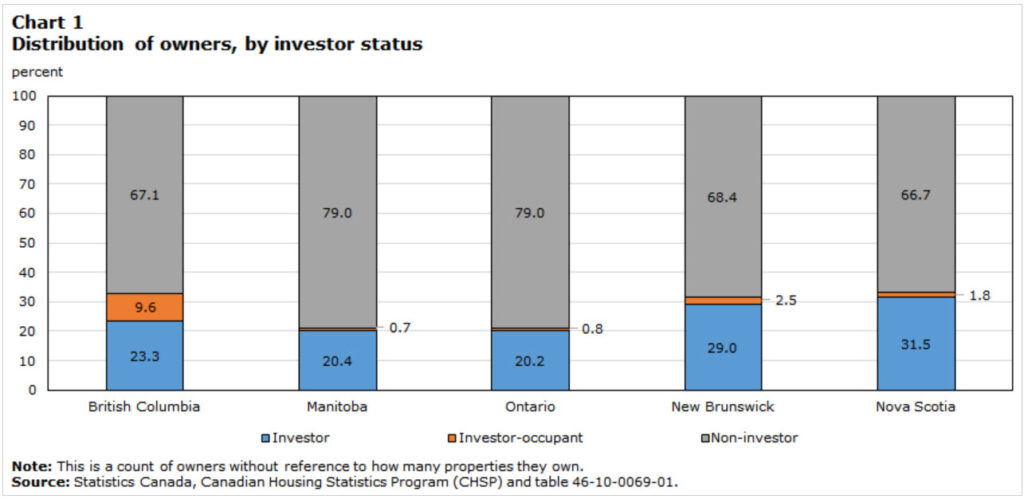
Statitics Canada has divided home ownership into three categories: investors, investor-occupants, and non-investors. It defines an investor as “an owner who owns at least one residential property that is not used as their primary place of residence. Individual owners who own a single property in the same province as where they reside are not considered investors, so long as it is not a property with multiple units.”
Specifically, the following owners are considered to be investors:
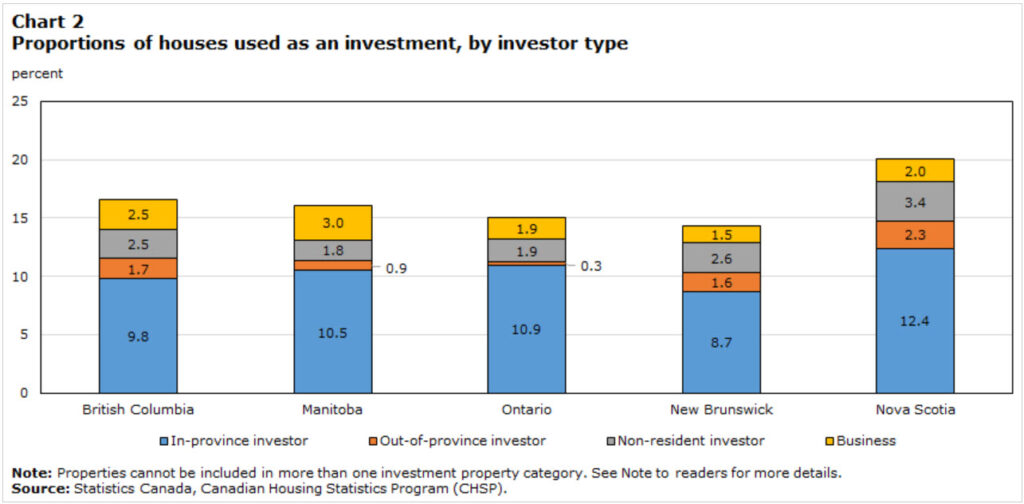
- A business or government that owns at least one residential property, excluding Canadian non-profit organizations. Given the predominance of businesses in this category, they will simply be referred to as “business” in what follows.
- An individual owner who is not resident in Canada, referred to as a “non-resident investor” below.
- An individual owner who lives outside the province where they own residential property, referred to as an “out-of-province investor” in the province of the non-principal residence.
- An individual owner who lives in the province and owns two or more residential properties, or owns a property with multiple residential units who does not occupy that property. These individuals will be referred to as “in-province investors”.
From this perspective, here are 10 reasons why investment demand is a significant factor in real estate prices:
Increased Demand
Investors purchasing real estate add to the overall demand for properties. In markets with a high level of investment activity, this additional demand can drive up prices, especially if the supply of available properties is limited.
Market Speculation
Investors often buy properties with the expectation that their value will increase over time. This speculative buying can inflate real estate prices, particularly in markets perceived as having strong growth potential. Speculation can lead to rapid price increases, as investors are willing to pay more, anticipating future gains.
Rental Market Influence
Many investors purchase properties to rent them out. This can impact both the rental and sales markets. In areas with a high concentration of rental properties, the demand for buying homes may increase, driving up prices. Conversely, if investors flood the market with rental properties, it could lead to a decrease in rental rates, which might affect the perceived value of investment properties.

Foreign Investment
In many regions, foreign investors play a significant role in the real estate market. They often have substantial purchasing power and can drive up prices, especially in major cities and luxury property markets. This type of investment can significantly impact local real estate prices and affordability.
Economic Impact
Investment in real estate can stimulate local economies through construction, renovation, and property management activities. This economic stimulation can increase the desirability of an area, leading to higher property values.
| In percent | British Columbia | Manitoba | Ontario | New Brunswick | Nova Scotia |
| In-province investor who owns 2 properties in different regions | 1.1 | 0.4 | 1.2 | 0.5 | 0.7 |
| Out-of-province investor | 1.1 | 0.5 | 0.2 | 1.0 | 1.5 |
| Other types of investor | 17.4 | 12.1 | 15.0 | 8.2 | 13.3 |
Portfolio Diversification
Real estate is often seen as a stable investment compared to more volatile assets like stocks. This perception can attract more investors, especially in times of economic uncertainty or when other investment returns are low.
Impact on Supply
Large-scale investment in real estate, especially by institutional investors, can affect the supply of available properties. For example, if investors are buying up a significant portion of new housing stock, it can reduce the supply available to individual homebuyers, pushing up prices.
Leverage and Access to Capital
Real estate investors often have access to capital and the ability to leverage their investments through mortgages and other financing methods. This access to capital can enable them to outbid other buyers, contributing to higher property prices.
Long-Term Holding Strategies
Some investors buy properties with the intention of holding them for a long time, reducing the turnover of available real estate and contributing to a tighter market with higher prices.
Renovation and Improvement
Investors often improve or renovate properties, which can increase their value and, by extension, the value of neighboring properties. This can contribute to an overall increase in real estate prices in the area.
In summary, investment demand affects real estate prices by increasing overall demand, influencing market speculation, impacting the rental market, attracting foreign investment, stimulating local economies, offering a stable investment option, affecting supply, leveraging capital, employing long-term holding strategies, and through property improvement and renovation. These factors collectively can have a significant impact on real estate market dynamics and pricing.











