… How the Canadian Financial System is Fixed to Favour Chartered Banks
If you’ve ever felt like the big banks are always one step ahead in the mortgage market—leading on rates, staying open when others pull back, and somehow winning business even when their products aren’t always the best fit—you’re not wrong. This isn’t luck. And it’s not just brand recognition.
It’s structure.
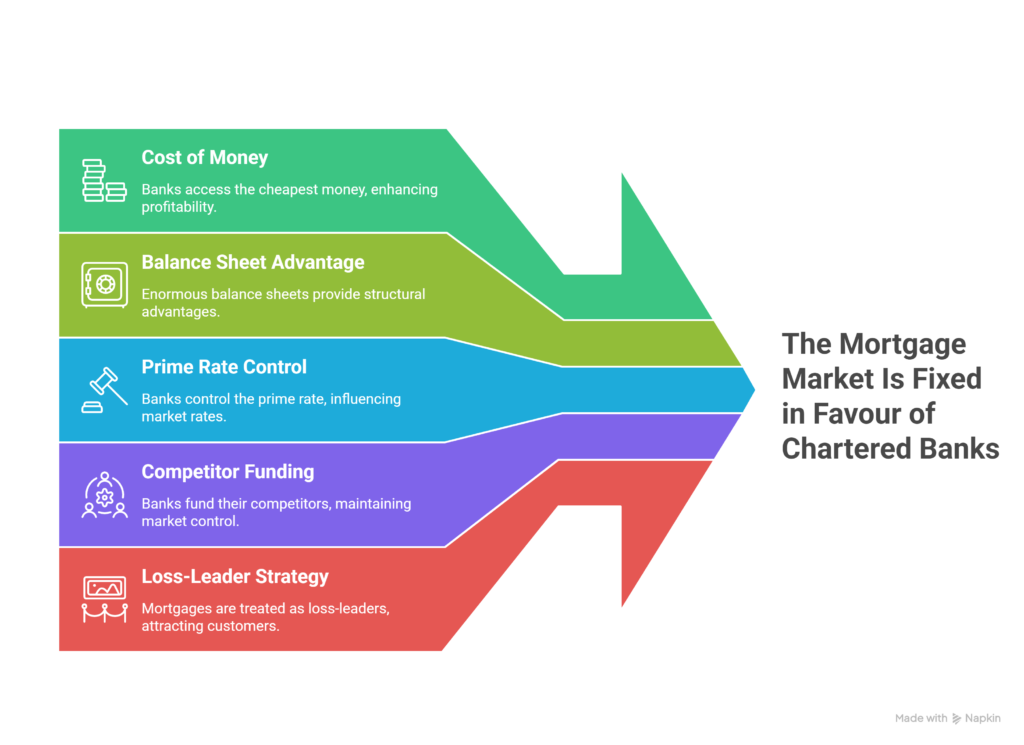
Canada’s mortgage system is built in a way that quietly but consistently favours chartered banks. They don’t just compete for mortgages at the consumer level; they control the funding, benchmarks, liquidity, and psychology that shape the entire marketplace. From the cost of money itself, to the Prime rate, to the funding of their own competitors, banks operate upstream—while everyone else competes downstream.
Most borrowers never see this layer. Realtors feel it when deals suddenly get harder. Clients feel it when rates move overnight or products disappear. But very few people ever have it explained clearly.
That’s exactly what we’re going to do here—plain language, no fluff, no bank talking points. By the end of this article, you’ll understand why banks always seem to have an edge, how they use it, and how you can make smarter decisions once you know how the system actually works.
What I’ll Talk About in This Article
Here’s what I’m going to walk you through:
Why funding cost is the real battleground in mortgages
How chartered banks access the cheapest money in Canada
Scale, Balance Sheets, and Staying Power
How Prime is quietly controlled by banks
How banks indirectly fund their own “competitors”
The impact of banks’ multi-billion dollar marketing machine
Why banks can undercut on rate and still win
What this means for realtors trying to protect deals
What this means for clients trying to choose the right mortgage
Why Funding Cost Is the Real Battleground
Every mortgage starts in the same place: the lender’s cost of money.
If it costs a lender more to access capital, they must charge more for the mortgage—or accept far more risk. The cheaper the funding, the more room a lender has to price aggressively, offer flexibility, and survive market volatility.
This is the foundational advantage chartered banks hold—and it never really disappears.
How Banks Access the Cheapest Money in Canada
Banks don’t need to hunt for money. They already sit on it.
Chequing accounts, savings accounts, and GICs provide banks with massive pools of ultra-cheap, stable retail deposits. Much of this money costs banks little to nothing compared to wholesale or institutional borrowing.
In practical terms, your mortgage is funded by someone else’s idle cash earning almost nothing.
No monoline lender, alternative lender, or private lender can replicate this advantage at national scale.
Scale, Balance Sheets, and Staying Power
Canada’s major banks operate on enormous balance sheets, which gives them structural advantages that are hard to overstate.
They can:
- Hold mortgages on their own books without immediate securitization
- Internally warehouse loans at very low cost
- Absorb short-term losses or margin compression
Banks can afford to play the long game. Most other lenders can’t.
Prime Rate: The Quiet Control Lever
Here’s a detail most borrowers never hear.
Prime is not a government rate.
It’s set by the banks.
While it closely tracks the Bank of Canada overnight rate, Prime itself is a bank-defined benchmark. The major banks move it together, and it becomes the reference point for vast portions of the lending system.
Most non-bank lenders:
- Borrow using Prime-based warehouse lines
- Pay Prime plus a spread
So when Prime moves—or when spreads widen—their funding costs rise immediately. Banks, funding largely through deposits, are far less exposed.
How Banks Fund Their “Competitors”
This is where the system gets quietly circular.
Many non-bank lenders rely on:
- Warehouse lines of credit
- Securitization facilities
- Institutional capital markets
And much of that funding is provided—directly or indirectly—by the banks themselves.
When markets tighten, banks protect their balance sheets first. Liquidity gets repriced, covenants tighten, and credit availability shrinks. That pressure flows downstream to non-bank lenders almost instantly.
That’s why you’ll sometimes see:
- Rates jump overnight
- Products vanish mid-deal
- Approval rules tighten suddenly
It’s not random. It’s funding reality.
The Multi-Billion Dollar Marketing Machine
On top of all of this sits another enormous advantage: the banks’ multi-billion dollar marketing engine. Canada’s chartered banks spend staggering amounts every year on advertising, sponsorships, naming rights, digital reach, and brand reinforcement. They sponsor professional sports, put their names on arenas, dominate TV and radio, flood online search results, and maintain constant physical presence through branches and signage.
Over time, this creates familiarity and perceived safety—“everyone banks there, so it must be the best option.” That brand gravity pulls borrowers toward banks long before a true comparison ever happens. Smaller lenders may offer better structures or smarter products, but they simply can’t compete with decades of brand saturation and trust conditioning. In many cases, banks win the mortgage conversation before it even starts—not because they’re always the best fit, but because they’re the most familiar name in the room.
Why Banks Can Win on Rate (Even When It Hurts)
Banks don’t need mortgages to be their primary profit centre.
A mortgage is often:
- A low-margin product
- Or even a strategic loss leader
Banks expect to earn money elsewhere in the relationship—investments, credit cards, insurance, lines of credit, business banking. That ecosystem allows them to price mortgages aggressively in ways other lenders simply can’t sustain.
A Real-World Story: When the Market Shifts
I once worked with a client who had an excellent approval with a non-bank lender at a very sharp rate. Then the bond market moved, liquidity tightened, and funding costs jumped.
Within days:
- The lender repriced
- The product was pulled
- The deal had to be restructured
Meanwhile, the banks were still lending, still quoting, still open.
The borrower didn’t change. The funding environment did.
How Realtors and Clients Can Put This to Use
For clients:
- Don’t judge a mortgage solely by the lowest rate
- Ask where the lender’s money comes from
- Think beyond the initial term
For realtors:
- Align deals with lenders that remain consistent under stress
- Understand which approvals are most likely to stick
- Reduce fallout by respecting funding stability
Strong funding leads to smooth closings.
Where I Come In as Your Mortgage Agent
This is why a mortgage agent adds real value.
My role isn’t just to compare rates. It’s to:
- Understand lender funding models
- Anticipate market stress
- Match borrowers with the right lender for their situation
- Balance rate, penalties, flexibility, and long-term strategy
Sometimes the answer is a bank. Sometimes it isn’t.
The value is knowing the difference.
Allen’s Final Thoughts
Chartered banks control the Canadian mortgage business through structural advantages, not coincidence. They have the cheapest money, the deepest balance sheets, influence over funding benchmarks, indirect control over competitor liquidity, and a marketing machine that shapes behaviour before comparisons even begin.
That advantage doesn’t disappear.
But the best mortgage isn’t about who has the cheapest funding—it’s about who has the right mortgage for you. Sometimes it means a chartered bank, and if so which chartered bank, because they are all different.
That’s where experience, strategy, and context matter. And that’s exactly how I help clients and realtors every day—by explaining how the system really works and building mortgage solutions that hold up in the real world, not just on paper.