A house foundation is the structural base that supports a home, distributing its weight evenly and providing stability against shifting soil, moisture, and environmental conditions. In Canada, where climate and soil composition vary widely, the choice of foundation depends on factors such as frost depth, groundwater levels, terrain, and construction costs. Foundations are essential for structural integrity, insulation, and moisture protection, ensuring a home remains safe and durable over time. Whether a property has a full basement, crawl space, slab-on-grade, or pier foundation, appraisers assess its quality, condition, and longevity, as foundation issues can significantly impact property value, mortgage eligibility, and long-term maintenance costs. A well-built foundation adds strength and value to a home, while foundation problems can lead to costly repairs and reduced marketability.
Pier and Beam Foundation (Post Foundation)
Pile Foundation (Deep Foundation)
Basement Foundation
A basement foundation is one of the most common foundation types in Canada, particularly in regions with cold climates and deep frost lines. Designed to extend below the frost line (typically 6 to 10 feet deep), basements help prevent structural shifting caused by freezing and thawing cycles while also providing additional living space, storage, and insulation benefits.
Homes with basement foundations are especially popular in areas where land costs justify maximizing usable square footage below ground, making them a valuable asset for homeowners.
From an appraisal perspective, a well-maintained basement can significantly enhance property value and market desirability, whereas issues like moisture intrusion, foundation cracks, or poor construction can lead to costly repairs and lower home appraisals.
Basement Foundation
Depth: 6 to 10 feet below ground
Construction: Excavated space with concrete or cinder block walls.
Pros:
- Additional living/storage space.
- Insulation helps with temperature control.
- Higher home resale value.
Cons:
- Expensive to build.
- Prone to flooding if not properly waterproofed. May require a sump pump.
Best For:
- Homes in colder climates (Ontario, Alberta, etc.) where the frost line is deep.
- Properties needing extra storage or livable space.
Types of Basement Foundations:
- Full Basement – Entire footprint of the home.
- Walkout Basement – Built on a slope, allowing access to ground level.
- Lookout Basement – Partially above ground with windows.
Crawl Space Foundation
A crawl space foundation is a common choice for homes in moderate climates, flood-prone areas, or regions with high water tables, where a full basement may not be practical. Elevated 1 to 5 feet above ground, a crawl space provides access to plumbing, electrical, and HVAC systems while offering some protection against moisture and soil movement.
These foundations are often found in coastal regions, older homes, and areas with unstable soil, where raising the home helps prevent water damage. While a well-ventilated and insulated crawl space can enhance a property’s durability, issues like poor drainage, mould, or structural settling can reduce home value.
From an appraisal perspective, a well-maintained crawl space foundation can support long-term stability, while neglected moisture issues may lead to costly repairs and impact mortgage eligibility.
Crawl Space Foundation
Depth: 2 to 5 feet above ground
Construction: Concrete or cinder block walls, raised 2-5 feet above ground.
Pros:
- Elevates the home, reducing flood risk.
- Allows easy access to plumbing and electrical.
- Less expensive than a full basement.
Cons:
- Requires proper ventilation to prevent moisture buildup and mould.
- Not usable as a living space.
Best For:
- Areas with high moisture or flood risk (coastal areas).
- Homes needing elevation but without the cost of a full basement.
Slab-on-Grade Foundation
A slab-on-grade foundation is a common choice for homes in warmer climates, areas with high water tables, and regions where frost depth is minimal. This type of foundation consists of a thick concrete slab poured directly onto the ground, eliminating the need for a basement or crawl space.
It is particularly beneficial in cost-effective construction, energy efficiency, and flood-prone areas, as it minimizes excavation costs and reduces the risk of moisture intrusion from below. Slab foundations are often found in southern parts of Canada, modern suburban developments, and homes designed for accessibility, as they provide a stable, low-maintenance base with no steps or stairs.
From an appraisal standpoint, a well-built slab-on-grade foundation can enhance durability and efficiency, but homes without a basement may have lower storage space and resale appeal in regions where basements are preferred.
Slab-on-Grade Foundation
Depth: 6 to 8 inches above ground
Construction: Thick concrete slab poured directly on the ground.
Pros:
- Affordable and quick to build.
- Requires little maintenance.
- Resistant to pests (no crawl space).
Cons:
- No access to plumbing and utilities (embedded in concrete).
- Poor insulation in colder climates.
Best For:
- Warm climates (Southern Ontario, BC, etc.).
- Homes on stable, well-draining soil.
- Affordable housing developments.
Pier and Beam Foundation (Post Foundation)
A pier and beam foundation, also known as a post foundation, is a raised foundation system commonly found in coastal areas, flood-prone regions, and properties with unstable or expansive soil conditions.
Instead of a continuous concrete slab or basement, concrete or wooden piers are strategically placed to support beams that hold the home above the ground. This design allows for better ventilation, easier access to plumbing and electrical systems, and improved flood resistance. Homes with pier and beam foundations are often seen in older construction, cottages, and remote properties where excavation for a traditional foundation is impractical.
From an appraisal perspective, these foundations can be a practical and cost-effective solution, but they require proper maintenance to prevent issues like shifting, moisture damage, or pest intrusion, which can affect a home’s value and structural integrity.
Pier and Beam Foundation (Post Foundation)
Depth: Varies, usually 2-6 feet
Construction: Concrete or wood posts (piers) support beams that hold the house above ground.
Pros:
- Can be used on uneven or weak soil.
- Easy to repair plumbing and electrical.
- Allows airflow under the home, reducing moisture issues.
Cons:
- Can shift over time in unstable soil.
- Susceptible to pests if not properly sealed.
Best For:
- Coastal or flood-prone areas (BC, Maritimes).
- Homes in regions with shifting soils.
- Cabin-style homes and cottages.
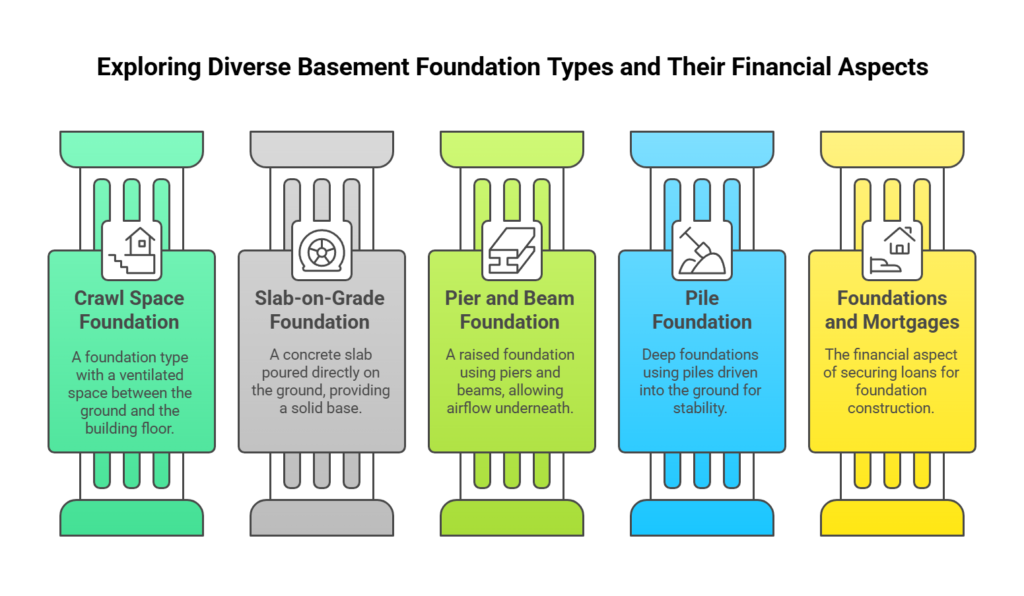
Pile Foundation (Deep Foundation)
A pier and beam foundation, also known as a post foundation, is a raised foundation system commonly used in coastal regions, flood-prone areas, and properties with unstable or expansive soil conditions where traditional basements or slabs may not be practical.
This type of foundation consists of concrete or wooden piers that support horizontal beams, elevating the home above the ground. The added height provides protection against moisture, flooding, and shifting soils, while also allowing easier access to plumbing, electrical, and HVAC systems. Pier and beam foundations are frequently found in older homes, cottages, and remote properties, where excavation for a full basement is either unnecessary or cost-prohibitive.
From an appraisal perspective, while these foundations can offer durability and flexibility, they must be well-maintained to prevent structural shifting, moisture intrusion, or pest issues, all of which can impact a home’s long-term value and financing eligibility.
Pile Foundation (Deep Foundation)
Depth: 10 to 50+ feet (drilled deep into the ground)
Construction: Steel, concrete, or wood piles driven deep into the ground.
Pros:
- Provides maximum stability for weak soil.
- Used for large or heavy structures.
- Resistant to shifting and settlement.
Cons:
- Expensive to build.
- Requires specialized equipment.
Best For:
- Homes built on unstable, sandy, or clay-heavy soil.
- Coastal areas or flood zones.
- Large, custom-built homes or high-rise structures.
Foundations and Mortgages
Upon appraisal, certain foundation types are preferred. Lenders refuse to lend on certain foundation types.
Most Preferred
The most preferred foundation type is the drilled concrete basement foundation:
- Strongest structural integrity – Provides stability against soil shifting and frost heaving.
- Added livable space – Increases property value with extra square footage for storage or finished living areas.
- Better insulation & energy efficiency – Helps regulate indoor temperature in extreme climates.
- Easier financing & resale value – Lenders and buyers prefer full basements due to durability and functional space.
A well-maintained, poured concrete basement foundation is the most desirable and valuable foundation type in Canada. It performs well in cold climates and adds usability to a home, making it ideal for financing and long-term appreciation.
Least Preferred
Lenders generally refuse to lend on any type of wood foundation, otherwise known as PWF foundations (Permanent Wood Foundations):
Prone to rot & moisture damage – Even when treated, wood is vulnerable to water intrusion.
High maintenance & shorter lifespan – Requires continuous inspection and treatment to prevent deterioration.
Difficult resale & lower property value – Buyers may be hesitant due to the perceived risk.
Lender restrictions – Many lenders refuse to finance homes with wood foundations unless they meet strict engineering standards.
PWF foundations are often viewed as high-risk, and buyers may struggle to secure a mortgage without substantial proof of structural integrity.
Other Considerations
Crawl Space Foundations – Acceptable if properly built with good ventilation, insulation, and moisture protection.
Slab-on-Grade Foundations – Preferred in warm climates or flood-prone areas, but may reduce property value in colder regions.
Pier & Beam Foundations – Often financed but require inspection to ensure no shifting, moisture damage, or pest issues.
Beware: Dug Wells with No Proper Foundation Support – Unstable and challenging for financing.
Beware: Old Rubble or Stone Foundations – May pose issues due to structural deterioration and lack of modern waterproofing.
From an appraisal and lender perspective, a poured concrete basement foundation is the most valuable and preferred option in Canada, while wood foundations (PWF) are the most difficult to finance due to higher risk factors. Homes with unconventional, outdated, or deteriorating foundations may struggle with both appraisal value and mortgage approval.
Summary
House foundations serve as the structural base of a home, ensuring stability, insulation, and moisture protection. In Canada, foundation types vary based on climate, soil conditions, and construction costs, with some being more desirable than others in terms of property value and mortgage eligibility. Basement foundations are the most preferred due to their structural integrity, added living/storage space, and insulation benefits, making them a high-value asset in cold climates. Crawl space foundations provide elevation against moisture and flooding but require proper ventilation to prevent mould and decay. Slab-on-grade foundations are common in warmer regions and areas with high water tables, offering a cost-effective and low-maintenance option. Pier and beam foundations are useful in coastal or unstable soil areas, but require maintenance to prevent shifting and moisture intrusion. Pile foundations are deep and highly stable, making them ideal for large, custom-built homes on unstable or flood-prone land.
From a mortgage lending perspective, the most preferred foundation type is a drilled concrete basement, as it provides the best structural reliability, financing ease, and resale value. Conversely, Permanent Wood Foundations (PWF) are the least desirable, as they are prone to moisture damage, high maintenance costs, and structural deterioration, making them difficult to finance. Older rubble or stone foundations may also present appraisal concerns due to deterioration and lack of modern waterproofing. While crawl space and slab-on-grade foundations are generally acceptable, lenders may require inspections for pier & beam homes to ensure no shifting, pest damage, or moisture issues. In appraisal terms, a well-maintained foundation enhances home value, while poorly maintained or high-risk foundations can lower marketability, financing options, and overall desirability in the real estate market.