In today’s real estate market, many Canadian homebuyers don’t know about the benefits of a cash-back realtor. Imagine getting a part of the agent’s commission for every property deal. This is what cash-back home buying offers, making homes more affordable in Canada. By picking a cash-back real estate agent, you get a financial bonus lowering the cost of your dream home.
It might sound too good to be true, but working with a cash-back realtor is a real strategy in Canada’s housing market. It’s simple: a part of the realtor’s commission goes back to you, the buyer. As home prices rise, even a small cash-back amount can save you a lot. It’s a way to get a share of the big fees involved in selling a home.
The Benefits of Choosing a Cash Rebate Realtor
Comparing Traditional and Cash-Back Real Estate Agents
When Does Cash-Back Not Work Well
Why Cash-backs Likely Are Short-Lived
Negotiating Your Cash-Back Amount
Cash-backs and Mortgage Underwriting
What Is a Cash-Back Realtor?
A cash-back commission realtor is a real estate agent who gives back some of their commission. This money is usually given back at closing. It can get you a lot of money when you’re buying to help with closing costs and your down payment.
How Cash-Back Real Estate Services Work
Cash-back real estate services work in a simple way. After the property deal is done, the realtor gets their commission. Then, they give some of it back to you. The amount you get back depends on what you agreed on with the realtor.
The Legality of Cash-Back in Canadian Real Estate
In Canada, cash-back rewards from real estate agents are legal. They help make the real estate market more competitive. Rules from provincial real estate boards make sure everything is done right and fair. This knowledge shows that cash-back realtors in Canada are legal and work within the rules.
The Benefits of Choosing a Cash Rebate Realtor
Entering the Canadian real estate market comes with many perks when you choose a cash rebate realtor. Cash-back real estate services boost your buying power and make buying a property more enjoyable.
- Financial Incentives: The biggest plus of cash rebate realtor services is the money you get back when you buy a property. This could be thousands of dollars, which you can use for new furniture, moving costs, or to pay down your mortgage.
- Limited Services: Realtors who offer real estate cash-back usually do not show clients homes but focus on putting together the Agreement of Purchase and Sale and negotiating the price on behalf of the buyer. Buyers do their own house hunting using the many online resources available today.
- Better Negotiation Leverage: Knowing you’ll get cash-back gives you an edge in negotiations as you may be able to make a larger offer. This can help you get better deals, knowing you have a rebate waiting for you.
Choosing a cash rebate realtor means more money and let’s you find the house that is right for you. It makes your real estate journey in Canada more rewarding as you do a lot of the leg work yourself. Think about these benefits when picking your realtor to get the most out of the real estate market.
Comparing Traditional and Cash-Back Real Estate Agents
Choosing the right real estate agent is crucial when buying or selling property. It can greatly affect your finances and experience. By looking at traditional agents and cash-back realtors, you’ll see how different fees and services impact your real estate journey.
Traditional realtors look for homes on behalf of their clients. They set up tours of homes and take their clients out to look at 5 homes in an evening or weekend, for example. They will call the listing brokerages, arrange and juggle the appointments to see the houses, get the lock box numbers, locate the homes, provide feedback to the listing agent, arrange the home tours in a logical order to avoid crisscrossing around town, do research on the homes and the area, and much more. This service is very time-consuming and takes a lot of resources.
Cash-back realtors allow you to do the ‘leg-work’ yourself. You can use online resources to find the homes and their addresses, visit them and the surrounding area at your leisure, and even see the house during an open house and talk to the listing agent. When you have found a home you want to make an offer on, you contact a cash-back agent.
When Does Cash-Back Not Work Well
Using a cash-back agent works best when the market is a buyer’s market and there are a lot of homes for you to choose from. You can take your time finding the home that’s right for you because homes are not being snapped up as soon as they hit the market or even before they are listed.
The cash-back approach may not work well in the event of multiple offers simply because of the speed of the transactions that go multiple offer. The cash-back approach is inherently slower because the agent the buyer is using wasn’t part of the house hunting process.
The cash-back approach also does not work well when you don’t know the area you are house hunting in very well. When working with a traditional buyer-broker agent, the agent takes the time to get to know you, your needs, and your dislikes and may introduce you to homes you never thought of. By not using a traditional buyer-broker approach to your house hunting, you could be missing out on possibilities you were not aware of including things about the area you should be warned of. The cash-back approach puts the onus on you to find the right house.
Commissions and Cash-back
Comparing realtor fees shows a big difference between traditional and cash-back agents. Traditional agents charge a commission, usually 3% to 6% of the home’s sale price in Canada. On the other hand, cash-back realtors give a part of this commission back to the buyer.
A real estate transaction in Canada typically involves a listing agent who represents the seller and a buyer-broker agent who represents the buyer. Both buyers and sellers sign agency agreements with the agent to codify this relationship.
Let’s say the listing agent and seller negotiate a 5% commission, typically 2.5% would be offered to the buyer-broker agent to induce them to bring their clients to the home. Often, buyer-broker agents do more work in the real estate transaction than do listing agents. Frequently, buyer-broker agents take their clients on many home tours and frequently clients view more than 50 homes before making an offer. Often, clients decide not to buy a resale but decide on a new property, and the buyer-broker agent gets nothing for all their hard work, time, and money.
The buyer-broker really earns their 2.5%. However, if much of that work can be done by the client, and the client only contacts a buyer-broker agent to be a cash-back agent for them, then this arrangement works for the buyer realtor and the buyer because the agent is assured of being compensated for their work and the buyer can manage the home hunting themselves. Such agents often split the commission (2.5%) with the buyer, or cash-back a percentage of the commission, and limit the service they provide to putting together the offer and negotiating the price.

Example Cashback
Let’s say a house is sold for $1 million dollars, the 5% commission would come to $50,000.
$25,000 goes to the listing agent.
$25,000 goes to the selling or buyer-broker agent. A percentage of this amount or even half (whatever is negotiated) could be given to the buyer at closing. The percentage of cash-back depends on:
- What is negotiated
- Amount of service to be provided by the buyer’s agent
- The size of the commission (usually determined by house price and or listing agreement with higher house prices offering a large cash-back)
Factors Behind Cash-Backs?
While legal and arguable something that has always been technically available, it has only been relatively recently that cash-backs have come into vogue due to the following:
- Access to Information
- Changing Buyer Behaviour
- Agent Competition
Access to Information
Years ago, buyers didn’t have access to the vast amount of online information about homes that they have today, so they had to heavily rely on buyer-broker agents (buyer agents) to provide that information. Today, buyers have access to much more information via online resources and websites.
Changing Buyer Behaviour
With all this information at their disposal, many buyers want to search for homes themselves and take control of the process. Often, people don’t want to be ‘sold’ and can feel uncomfortable working with certain realtors. Buyers want to go at their own pace; they don’t want to feel pressure.
Agent Competition
When looking for homes, people frequently go to open houses where they will meet listing agents. If they express interest in buying the home, the first question the listing agent will ask is if they have a realtor (because if they do rules prevent the listing agent from working with them). If they say they don’t, the listing agent will offer to be their agent as well to help them buy the home. This is called Dual Agency.
Dual agency is when an agent represents both the buyer and the seller. It usually allows the listing agent to get both the buyer and the seller commission or double up the commission. The problem with dual agency is that it is a pure conflict; you can’t represent the buyer’s and the seller’s interests at the same time because the seller wants the most for the home and the buyer wants to pay the least. Often to entice the seller into a dual agency agreement, the agent will offer to lower their commission from say 5% to 4%. This agent would not offer cash-back to the buyer because the agent would have to disclose the relationship and the cash-back to the seller and the seller would refuse because the money from the cash-back comes out of the seller’s pocket.
To compete with listing agents trying to double up their commission using dual agency, a cash-back realtor will offer the savvy buyer ‘cash-back’, put together an offer that is in the buyer’s interest, and negotiate on behalf of the buyer against the seller.
So that’s where the cash-back realtor can come in, prevent dual agency, take away the listing agent’s ability to double-up, put together an offer that puts the buyer’s interests first, negotiate the price for the buyer, and give the buyer part of the commission.
Why Cash-backs Likely Are Short-Lived
While cash-backs are relatively new in regards to their recent popularity, I argue they are likely to be short-lived for the following reasons:
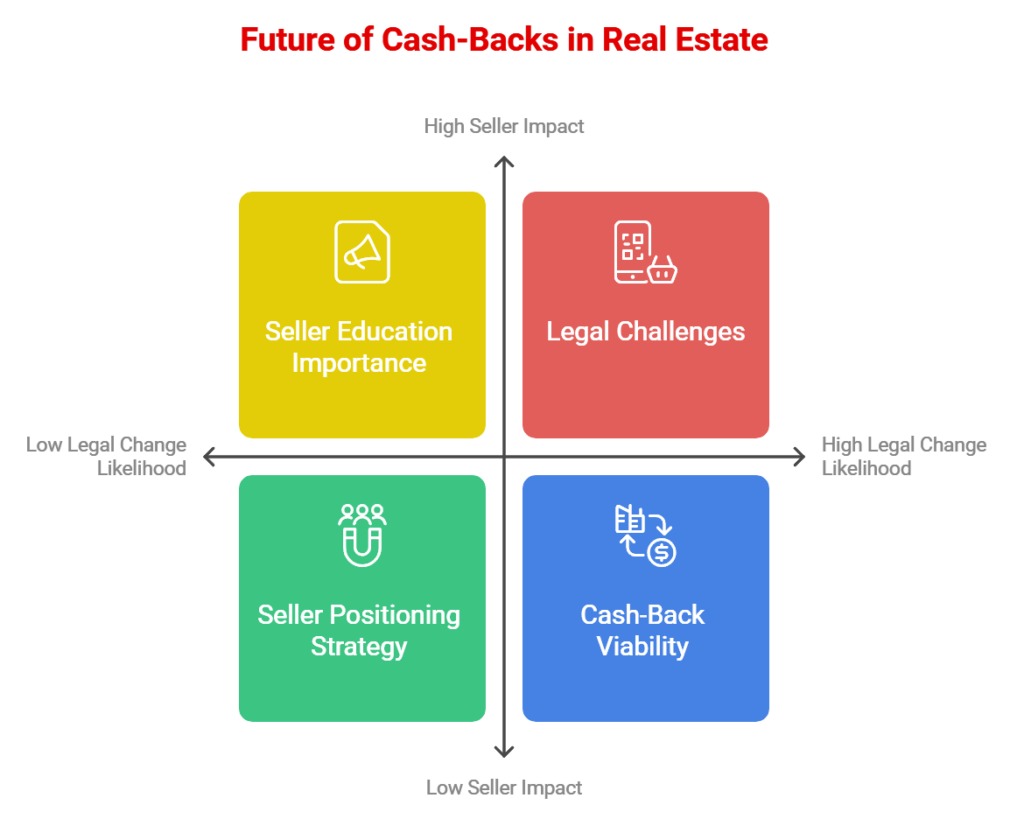
- Anticipated Legal Changes
- Seller Education
- Seller Positioning
Anticipated Legal Changes
The way real estate is practised in Canada and the United States is very similar. It has always been the convention that the seller pays not only the listing agent for listing and marketing the home but also the buyer agent for bringing buyers to the house. However, recent lawsuits in the United States have challenged this convention under the premise that the seller should not be paying for the buyer’s agent because the buyer’s agent is working for the buyer against the seller. They argue the buyer should be paying for their agent. These suites have been successful in the United States. Similar suits are before the courts in Canada.
Cash-backs come out of the buyer agent’s commission, paid for by the seller. If the seller no longer provides compensation to the buyer’s agent, then there will be no more cash-backs.
Seller Education
Sellers need to know that they are the one’s who are paying for the cash-back and that a cash-back is basically the same as handing free money over to the buyer. But since the amount of cash-back is negotiated between the buyer agent and their client, the seller will not know how much of a cash-back they have handed to the buyer.
A savvy seller could put a clause in the listing agreement that states commission to the buyer broker agent is limited to 2.5% less any cash-back offered or negotiated with the buyer broker. This would force the buyer broker agent to disclose the cash-back.
Seller Positioning
In a competitive market, there is always a competitive balance between what is offered in terms of home and what is asked in terms of price. If a seller is OK with cash back, the seller may be better advised to instead lower the price of the home by the amount of the cashback to make the home appear as a better offer in the marketplace. It would not only lower the commission payable but also the provincial tax on the commission as well.
Negotiating Your Cash-Back Amount
When you team up with a realtor, knowing how to negotiate cash-back is essential. Let’s discuss how to talk about cash-back with your realtor. I’ll also explain the terms that can affect your rebate.
- Discussing Terms Early On
- Realtor Limitations on Cash-backs
- Compensation Structures
Discussing Terms Early On
Start talking about cash-back early with your realtor. Being open about your desire for cash-back sets clear expectations. It also helps you understand how your realtor handles rebates.
Ask about any rules or limits for getting cash-back. Find out if these rules can change based on the property or sale price. Remember, as a client interviewing realtors you are a price maker, not a price taker, so you can set the terms, not take the terms. There are more realtors than there are deals out in the market.
Negotiate cash-back terms in writing.
Realtor Limitations on Cash-backs
It’s important to understand that not all realtors offer cash-backs and what the reasons can be behind not offering cash-backs.
Real estate agents work for a real estate brokerage. The brokerage policies may not allow their agents to offer cash-backs. There are reasons for this, such as the brokerage wanting to position themselves as full-service or not wanting to be perceived as a discount brokerage.
Compensation Structures
Different brokerages have different compensation structures or splits with their sales representatives. From brokerages are almost more like landlords and charge their sales representatives large desk fees but high commission splits. Other brokerages have a lower commission split (say 60/40) but do not charge their agents desk fees. And other brokerages have other arrangements like set fees to compensate sales representatives. Compensation structures may impact the availability of cash-backs.
Next, does the cash-back come completely out of the sales representatives’ part of the split with the brokerage or does the brokerage give up part of their split to facilitate the cash-back. For example, let’s say the commission is $25,000 on a 60/40 split. The brokerage gets $10,00 and the sales representative gets $15,000, if half the commission ($12,500) goes cash-back to the buyer, the sales representative could be left only with $2,500 for their work.
At another brokerage with a high desk fee and a high commission split, the sales representative could have a 90/10 split where the agent gets $22,500. Such an agent would be much more amenable to a cash-back than an agent on a 60/40 split at another brokerage.
Understanding what is happening behind the scenes can help you appreciate why cash-backs may not always be available.
Taxes and Your Cash-Back
You didn’t think a cash-back was tax-free money, did you? When you get cash-back from a realtor in Canada, there are cash-back tax implications. Getting cash-back seems great, but you must report it as income on your taxes. Remember, it’s not a discount on a house, it is part of the commission, and we tax commission income in Canada. Knowing how cash-back is treated helps you follow the law and enjoy the benefits of real estate.
How much of your cash-back you end up giving back to the government in income tax depends on your marginal tax rate. For that, go see your accountant, but if you lose half of your cash-back to the CRA, well, welcome to Canada.
Cash-backs and Mortgage Underwriting
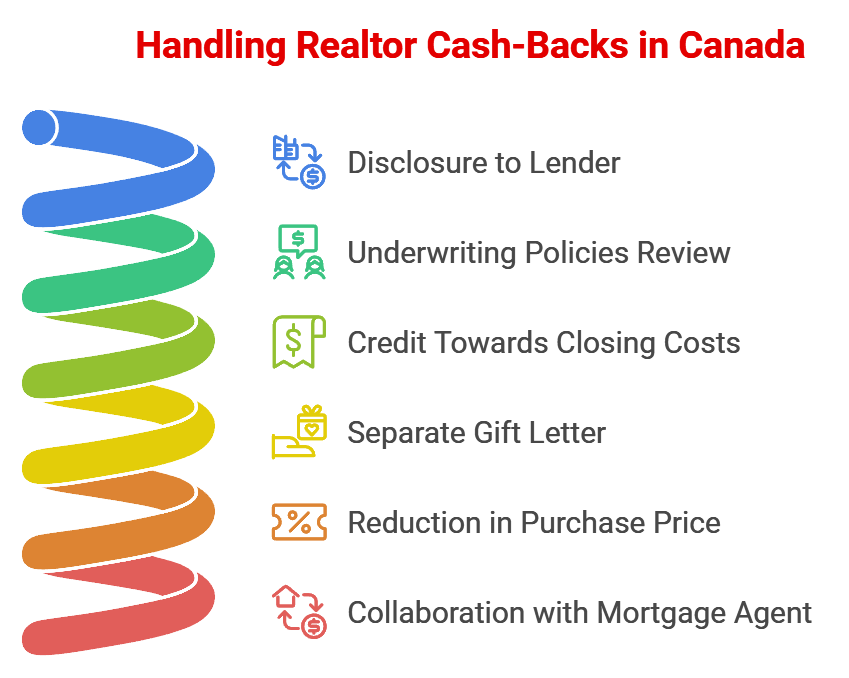
If a buyer in Canada is receiving a cash-back from their realtor at closing, lenders typically view this as an unusual transaction because it’s essentially a rebate on commission. This type of cash-back can be subject to specific underwriting rules to ensure that it doesn’t impact the overall risk assessment. Here’s how it might be handled:
- Disclosure and Transparency
- Underwriting Policies
- Credit Towards Closing Costs
- Separate Gift Letter
- Reduction in Purchase Price or Incentive
Disclosure and Transparency
The cash-back needs to be disclosed to the lender upfront. Full transparency is key since undisclosed incentives could be seen as attempting to inflate affordability or as misrepresentation.
Underwriting Policies
Each lender has different policies regarding cash-backs. Some lenders may reduce the mortgage amount by the cash-back amount, or they may request an explanation as to how it will be used. They typically won’t allow it as a direct part of the down payment or to increase the borrower’s loan eligibility.
Credit Towards Closing Costs
Some lenders might allow the cash-back to cover closing costs, as long as it doesn’t influence the minimum down payment requirement or inflate the applicant’s borrowing power. This approach can make it easier for underwriters to process without the cash-back affecting the loan itself.
Separate Gift Letter
In some cases, the lender may require that the buyer submits a gift letter if the cash-back is categorized as a gift. However, this is rare and usually applies only if the cash-back is from a family member rather than a realtor.
Reduction in Purchase Price or Incentive
To avoid issues, some lenders may suggest treating the cash-back as a price reduction or credit in the purchase agreement. This can help underwriters view it as a straightforward incentive rather than part of the mortgage financing.
Each lender’s approach may vary, so confirming with the lender is crucial to avoid disruptions in the application. The buyer and realtor should work closely with the mortgage agent to disclose the cash-back properly and understand the lender’s specific requirements around this.
Key Takeaways
- Working with a cash-back realtor can put money in your pocket when buying a home.
- Cash-back home buying is becoming more popular in Canada’s real estate market.
- Choosing a cash-back real estate agent means getting financial benefits from the realtor’s commission.
- Cash-back depends on many factors and not all realtors offer cash-back.
- Cash-back is available to the buyer, not the seller, who provides the money for the cash-back
- Understanding cash-back realty services and their limitations can make buying a home more affordable and rewarding
- Cash-back is commission income that is taxed at your marginal tax rate