Optimizing payment frequency for a fixed-rate mortgage can significantly impact the overall interest you pay and how quickly you pay off your mortgage. Here’s how to do it effectively:
Understand Different Payment Frequencies
Align Payments with Your Pay Schedule
What Makes Payments Accerlerated?
Understand Different Payment Frequencies
- Monthly Payments: The standard payment frequency, with 12 payments per year.
- Bi-Weekly Payments: Half of the monthly payment made every two weeks. This results in 26 half-payments or 13 full payments per year, leading to one extra full payment annually.
- Accelerated Bi-Weekly Payments: You pay the same amount as a bi-weekly payment but calculated as if it were a monthly payment divided by two. This slightly higher amount results in more significant principal reduction.
- Weekly Payments: A quarter of the monthly payment made every week. Like bi-weekly, this can also be accelerated.
Choose Accelerated Options
- Accelerated Bi-Weekly or Weekly: Opt for accelerated bi-weekly or weekly payments. These options effectively result in an extra month’s payment each year, reducing your principal faster and saving on interest.
Align Payments with Your Pay Schedule
- Payment Timing: If you get paid bi-weekly, aligning your mortgage payments with your pay schedule can make budgeting easier and ensure you always have funds available for your mortgage payment.
Budget for the Extra Payment
- Financial Planning: Incorporate the effect of the extra annual payment into your budget. Even though each payment is smaller, the total amount paid annually will be higher with accelerated options.
Payment Frequency Table
| Payment Type | Payments Per Year | Extra Payment? | Faster Payoff? |
|---|---|---|---|
| Monthly | 12 | No | No |
| Semi-Monthly | 24 | No | No |
| Bi-Weekly (Standard) | 26 | Usually No | Slight impact |
| Accelerated Bi-Weekly | 26 | Yes (1 extra annually) | Yes |
| Weekly (Standard) | 52 | No | Slight impact |
| Accelerated Weekly | 52 | Yes (1 extra annually) | Yes |
When you’re structuring a mortgage, the payment frequency isn’t just a scheduling choice — it directly affects how fast you pay down principal and how much interest you ultimately pay.
Let’s break each one down clearly.
Weekly Payments
You make 52 payments per year (once per week).
- Your monthly payment is converted into a weekly equivalent.
- Because you’re paying more frequently, you reduce principal slightly faster.
- Over time, this can shave a bit of interest off the mortgage.
This is usually a non-accelerated structure unless specifically labeled otherwise.
Bi-Weekly Payments (Standard)
You make 26 payments per year (every two weeks).
- Your monthly payment is divided in half.
- 12 monthly payments = 24 half-payments
- But bi-weekly gives you 26 half-payments
That equals the same as 13 monthly payments per year — but only if it’s accelerated (see below). Standard bi-weekly typically equals 12 monthly payments per year just spread differently.
Standard bi-weekly mainly helps with budgeting if you’re paid every two weeks.
Accelerated Bi-Weekly Payments
This is where the magic happens.
You take your regular monthly payment and divide it by two — but instead of making 24 half-payments, you make 26 half-payments per year.
That equals:
13 full monthly payments per year instead of 12
So you’re making one extra full mortgage payment every year without really feeling it.
What does that do?
- Reduces principal faster
- Cuts years off your amortization
- Saves substantial interest over time
On a typical 25-year mortgage, accelerated bi-weekly can reduce amortization by about 2–4 years, depending on rate and amount.
Semi-Monthly Payments
You make 24 payments per year (twice per month).
- Usually paid on fixed dates (e.g., 1st and 15th)
- Monthly payment divided into two equal parts
- Total paid per year = exactly 12 monthly payments
This does not accelerate repayment.
It’s purely a cash flow alignment tool.

What Makes Payments Accelerate?
What makes a mortgage payment “accelerated” is not the calendar frequency.
It’s the math behind how the payment amount is calculated.
The defining feature is this:
You are paying the equivalent of 13 monthly payments per year instead of 12.
That extra payment is what accelerates principal reduction.
Let’s break it down clearly.
The Core Concept
Take your normal monthly payment.
Example:
- Monthly payment = $3,000
Standard Monthly
You pay:
- $3,000 × 12 = $36,000 per year
That’s your baseline.
Standard Bi-Weekly (Not Accelerated)
A true non-accelerated bi-weekly payment is calculated like this:
- Annual payment = $36,000
- Divide by 26 payments
- $36,000 ÷ 26 = $1,384.62 every two weeks
You still pay:
- $1,384.62 × 26 = $36,000 per year
No acceleration. Just different timing.
Accelerated Bi-Weekly
Now we calculate differently:
- Monthly payment ÷ 2
- $3,000 ÷ 2 = $1,500 every two weeks
But you still make 26 payments per year.
So now you pay:
- $1,500 × 26 = $39,000 per year
That equals:
- 13 full monthly payments instead of 12
That extra $3,000 per year goes straight toward principal, which:
- Reduces amortization
- Cuts total interest
- Builds equity faster
That is what makes it “accelerated.”
Accelerated Weekly
Same principle.
- Monthly payment ÷ 4
- But you make 52 payments per year
You end up making the equivalent of 13 monthly payments annually.
Again, the acceleration comes from the extra annual payment, not the weekly schedule itself.
Semi-Monthly vs Bi-Weekly (Common Confusion)
- Semi-monthly = 24 payments per year (2 per month)
- Bi-weekly = 26 payments per year (every 2 weeks)
Only accelerated versions create the equivalent of 13 monthly payments.
Why This Matters Strategically
Acceleration works because mortgage interest is calculated on the outstanding principal balance.
By reducing principal earlier and more often, you:
- Pay interest on a smaller balance
- Shorten amortization
- Increase equity growth speed
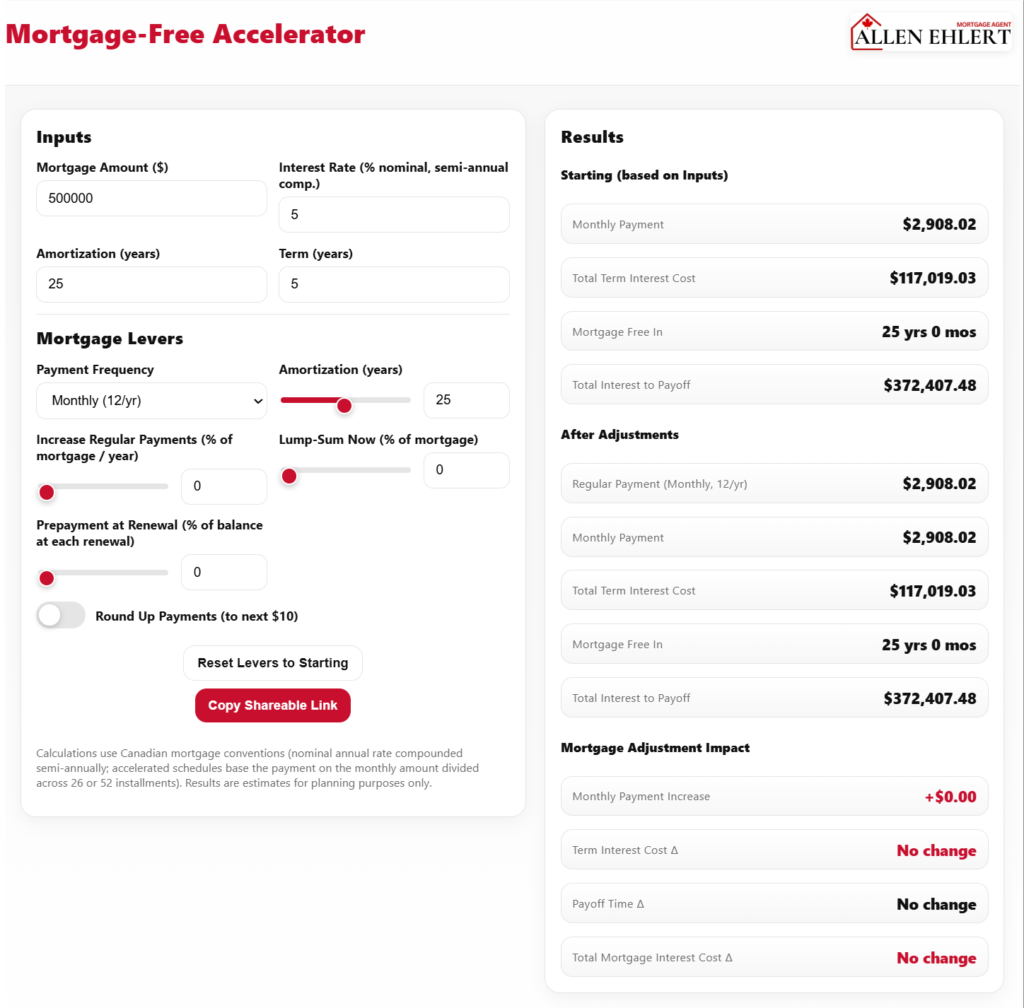
On a typical 25-year amortization, accelerated bi-weekly often cuts off 2–4 years.
Evaluate Your Cash Flow
Cash Flow Analysis: Ensure that your cash flow can comfortably handle the chosen payment frequency. Accelerated payments should not strain your monthly budget.
Consider Your Financial Goals
Debt Reduction Strategy: If your goal is to pay off your mortgage faster and save on interest, accelerated payments are a great strategy.
Long-Term Financial Planning: Consider how mortgage payments fit into your broader financial plan, including retirement savings, investments, and other debts.
Review and Adjust as Needed
Regular Reviews: Periodically review your mortgage and financial situation. If your financial circumstances change, you may need to adjust your payment frequency.
Consult with Your Lender
Mortgage Terms: Before changing your payment frequency, check with your lender to ensure your mortgage terms allow for such changes without penalties.
Implementation: Ask your lender how to implement the change in payment frequency.
Professional Mortgage Advice
Mortgage Agent: Consult me for personalized advice, especially if you’re unsure how changing your payment frequency aligns with your overall financial strategy.
Optimizing your payment frequency can be a powerful tool in managing your mortgage more effectively. Accelerated payment options, while slightly increasing your annual payment amount, can lead to substantial interest savings and a quicker path to being mortgage-free. Always ensure that any changes align with your overall financial health and long-term goals.