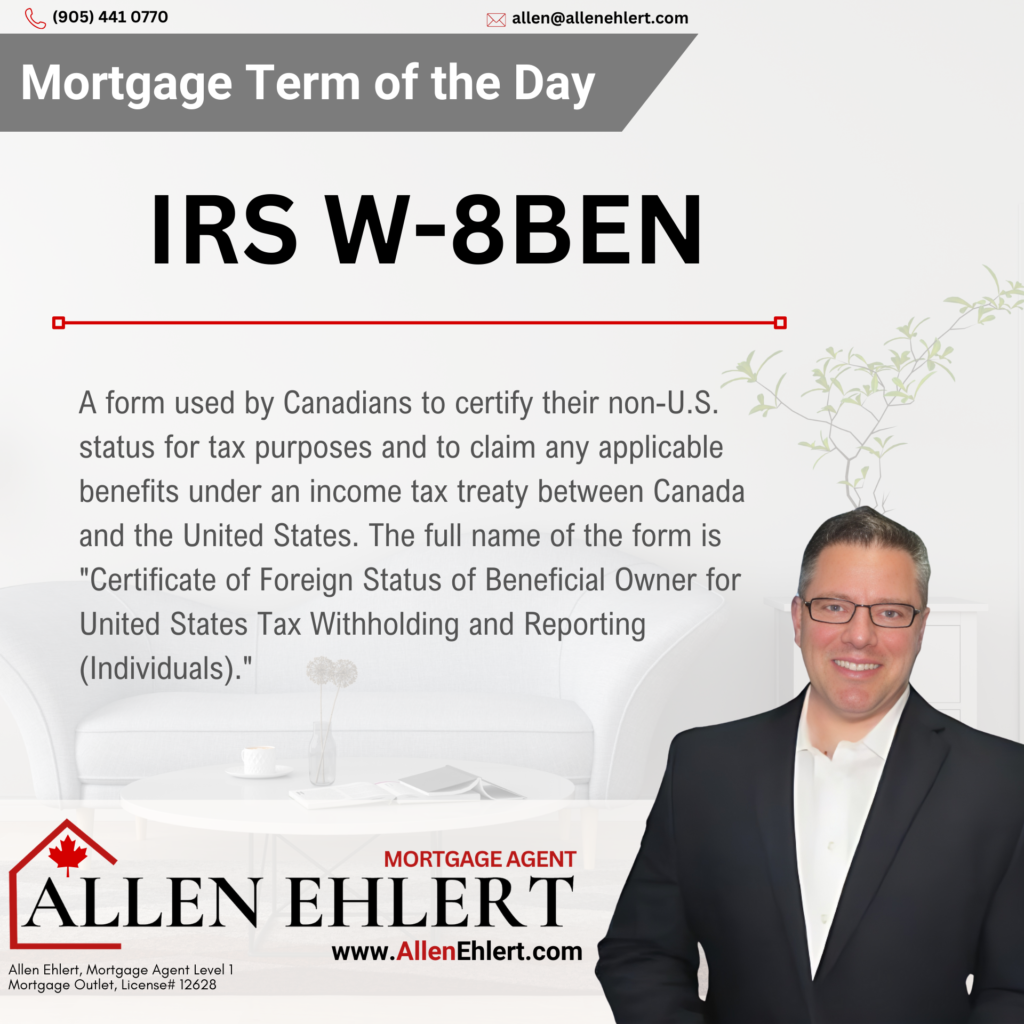
The IRS Form W-8BEN is a form used by foreign individuals to certify their non-U.S. status for tax purposes and to claim any applicable benefits under an income tax treaty between their country of residence and the United States. The full name of the form is “Certificate of Foreign Status of Beneficial Owner for United States Tax Withholding and Reporting (Individuals).”
Relation to Mortgages in Canada
Key Points About Form W-8BEN
- Non-U.S. Status Certification
- Claiming Tax Treaty Benefits
- Avoiding Double Taxation
Non-U.S. Status Certification
The W-8BEN form is used by individuals who are not U.S. citizens or residents to confirm their foreign status. This helps U.S. payers or withholding agents determine the appropriate level of tax withholding on income such as dividends, interest, royalties, or other income from U.S. sources.
Claiming Tax Treaty Benefits
Many countries, including Canada, have tax treaties with the United States that provide reduced withholding rates or exemptions for certain types of income. By submitting Form W-8BEN, an individual can claim these benefits, reducing the amount of U.S. tax withheld on their income.
Avoiding Double Taxation
The form is particularly important for avoiding double taxation. For instance, Canadian residents who earn income from U.S. sources can use the W-8BEN to ensure they are taxed at the treaty rate rather than the higher standard U.S. withholding rate.
Relation to Mortgages in Canada
While Form W-8BEN is primarily a tax document related to income earned from U.S. sources, it can have indirect implications for Canadian residents involved in cross-border real estate transactions or holding mortgages in the U.S. Here’s how it relates:
- Relation to Mortgages in Canada
- Income From U.S. Real Estate
- Cross-Border Property Ownership
- Tax Efficiency in Mortgage Planning
- Impact on Refinancing or Selling U.S. Property
- Foreign Investment in U.S. Real Estate

Income From U.S. Real Estate
If a Canadian resident owns U.S. real estate and earns rental income, they may need to submit a W-8BEN to the U.S. payer (such as a property management company) to ensure the correct amount of U.S. tax is withheld on that income. This is crucial for managing the cash flow needed to cover mortgage payments on the U.S. property.
Cross-Border Property Ownership
For Canadian residents who own or are considering purchasing U.S. real estate with a mortgage, the W-8BEN can help reduce the tax burden on income generated from the property. This is especially relevant if the property is rented out and generates income that would be subject to U.S. withholding tax.
Tax Efficiency in Mortgage Planning
Submitting a W-8BEN and claiming the appropriate treaty benefits can improve tax efficiency, freeing up more funds that can be used for mortgage payments, property maintenance, or other investments. By ensuring that they are not overtaxed on U.S. income, Canadian property owners can better manage their overall financial obligations, including mortgage commitments.
Impact on Refinancing or Selling U.S. Property
When refinancing or selling U.S. property, the income from the transaction might also be subject to U.S. tax withholding. Filing a W-8BEN can help ensure that any tax is withheld at the appropriate treaty rate, minimizing the financial impact on the individual’s Canadian tax obligations and mortgage planning.
Foreign Investment in U.S. Real Estate
For Canadians investing in U.S. real estate through mortgages, understanding the implications of U.S. withholding tax and properly filing a W-8BEN can significantly impact the financial returns from such investments. It ensures compliance with U.S. tax laws while optimizing tax liabilities under the Canada-U.S. tax treaty.
Summary
The IRS Form W-8BEN is a crucial tax document for Canadian residents who earn income from U.S. sources, including those involved in cross-border real estate investments. For Canadians holding U.S. mortgages or owning U.S. real estate, filing a W-8BEN ensures they can claim tax treaty benefits and avoid excessive U.S. tax withholding, which can have significant implications for cash flow and mortgage management. Proper use of the W-8BEN form helps optimize tax efficiency, allowing Canadian investors to better manage their cross-border real estate investments and associated mortgages.