…. The Small Town Eastern Ontario Mortgage Investment Entity
If you’ve ever had a client whose deal fell apart at the eleventh hour — credit bruised from a rough patch, self-employment income that doesn’t translate neatly onto a T4, or a gorgeous rural property that the big banks just won’t touch — you already know the sinking feeling. The financing falls through, the deal dies, and everyone walks away frustrated. But here’s the thing: a “no” from a chartered bank isn’t always the end of the road. Sometimes, it’s just a detour — and that detour runs straight through the world of private lending.
PMB Professional Mortgage Brokers Inc., run by the father-daughter team of Ken and Melissa Reinhardt out of Port Perry, Ontario, has been quietly solving exactly these kinds of problems since 1978. With 60 combined years of mortgage lending experience and a direct connection to their own pool of investor funds, PMB occupies a unique corner of the market east of Toronto — and if you’re financial professional, realtor, or a borrower operating in that geography, understanding what PMB offers could change the trajectory of loans you thought were dead on arrival.
In this article, I’m tod discuss how PMB works, what they lend on, how the numbers stack up, and — most importantly — how you can put this information to work right now.
Here’s what I’ll cover:
What Makes PMB Different from Other Private Lenders
The Servicing Area: PMB’s Backyard East of Toronto
Property Types PMB Will Actually Fund
Loan-to-Value, Loan Sizes, and What “75%” Really Means in Practice
Rates, Terms, and the Flexibility Factor
Fees: What You’re Looking At on Both Sides of the Table
How the Submission Process Actually Works
A Real-World Scenario: When Everything Goes Sideways Four Days Before Closing

What Makes PMB Different from Other Private Lenders
Most private lenders you’ll encounter in Ontario are either Mortgage Investment Corporations (MICs) with institutional layers of management, administrators acting on behalf of distant investors, or syndicators assembling deals piecemeal. PMB is none of those things. They are a Mortgage Investment Entity (MIE) — meaning they lend and manage their own portfolio of investor funds directly. (see “The Mortgage Investment Entity Client”, “Mortgage Investment Entities”, or “Investing in Mortgage Investment Entities”). There’s no call centre. There’s no portal maze. There’s no loan committee that meets on the third Thursday of each month to rubber-stamp decisions.
You’re dealing with Ken and Melissa. That’s it.
As Melissa puts it, “We manage the file with you from the first phone call to approval to discharge, and everything in between.” That kind of direct access is genuinely rare in the private space, and for agents and realtors trying to close deals under pressure, it’s worth its weight in gold. When you need an answer fast, you call Melissa. You don’t leave a voicemail for a processor who reports to a manager who escalates to an underwriter.
This also means PMB can exercise real judgment and flexibility — something institutional private lenders often can’t. Every deal is a conversation, not a checkbox exercise.
The Servicing Area: PMB’s Backyard East of Toronto
PMB is proudly regional, and that’s actually a competitive advantage rather than a limitation. Their servicing area covers Durham Region, Kawartha Lakes, Peterborough County, and Northumberland County, with selective coverage extending into Haliburton and Muskoka. Think of it as everything between Pickering to the west and Trenton to the east, stretching north to cottage country.
If you’re a realtor or agent working in Oshawa, Whitby, Ajax, Pickering, Port Perry, Lindsay, Peterborough, Cobourg, Port Hope, Bowmanville, Fenelon Falls, or anywhere in that swath of Ontario, PMB’s territory is your territory.
Here’s something critically important that Melissa stresses: PMB does not scale back their advances for rural properties. A lot of private lenders get skittish when a property has a well and septic, lake water, a holding tank, or is off-grid. They’ll slash the LTV or decline outright. PMB doesn’t do that. They understand the rural and cottage market intimately because they live and work in it. They’ll assess that hobby farm in Kawartha Lakes or that island cottage in Haliburton on its actual merits — not through the nervous lens of an urban lender who’s never driven north of Highway 7.
Practical tip for realtors: If you’re listing or selling a property in the rural or cottage corridor east of Toronto and your buyer’s financing falls through because of property type, keep PMB in your back pocket. Their comfort with non-traditional property types can turn a dead deal into a done deal.
Property Types PMB Will Actually Fund
This is where PMB genuinely shines, because their appetite for property types goes well beyond what most private lenders — and certainly most institutional lenders — will touch.
Here’s what’s on the table:
Suburban and rural residential properties — the everyday stuff, from subdivision homes in Whitby to century farmhouses outside Norwood.
Agricultural and hobby farms — and here’s the kicker: PMB uses the full acreage and outbuildings in their assessment, not just the house and 10 acres. If your client has a 50-acre hobby farm with a barn, a workshop, and a beautiful home, they don’t artificially strip the value down to a postage stamp. That’s a meaningful distinction.
Waterfront properties — whether it’s a principal residence on a lake, a family cottage, or a secondary home. Waterfront adds complexity that scares off a lot of lenders. PMB has decades of experience valuing it accurately.
Islands and water-access-only properties — yes, really. If the only way to reach the property is by boat, PMB will still consider it. Try getting that past a conventional lender.
Land — from vacant lots to building lots to large acreage. Raw land financing is notoriously difficult, and PMB is one of the few private lenders in this corridor willing to engage with it seriously.
Owner-occupied rentals — the classic scenario where the homeowner lives upstairs and rents the basement (or vice versa). Note the important nuance here: PMB does not deal with straight rental properties, whether long-term or short-term (no Airbnb investment plays, in other words). It must be owner-occupied.
Practical tip for mortgage agents: When you’re pre-screening a deal for PMB, the first questions are always: (1) Is it within their geography? (2) Does the property type fit? If both answers are yes, you’re already in the game.
Loan-to-Value, Loan Sizes, and What “75%” Means in Practice
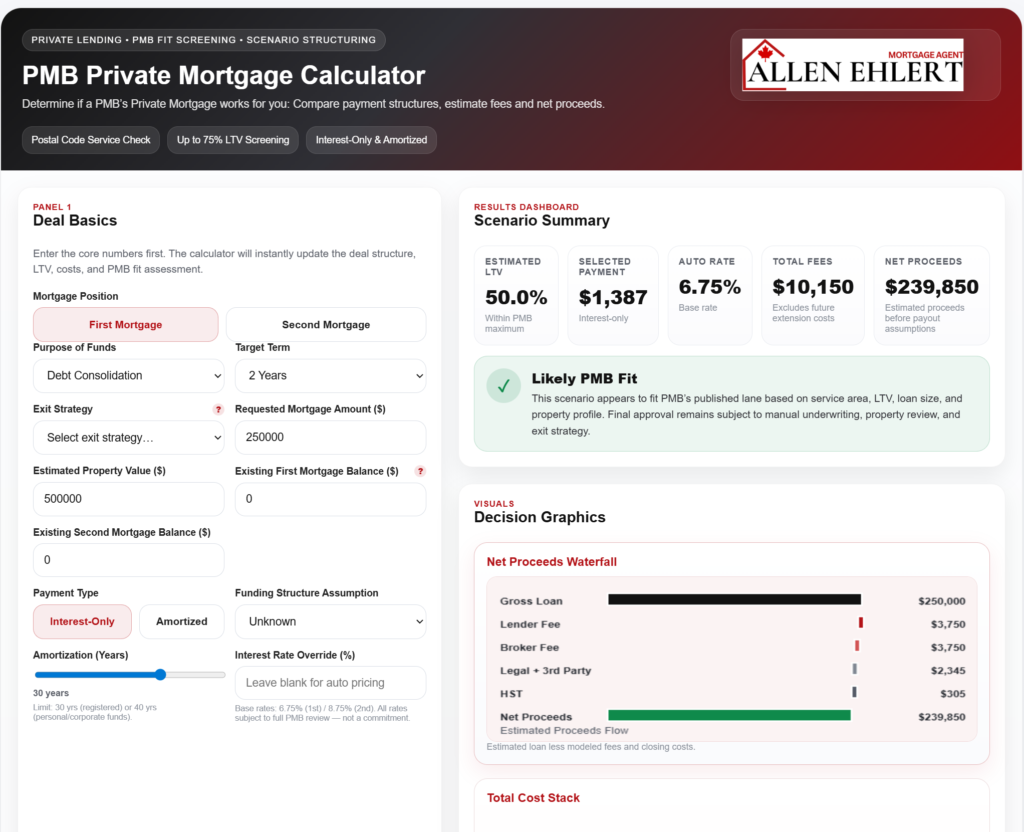
PMB advances up to 75% LTV on both first and second mortgages. Their minimum loan amount is $75,000 and the maximum is $1,000,000 (the cap is set by their E&O insurance coverage — $1 million per occurrence — which is also a reassuring sign of how they manage risk professionally).
Now, 75% LTV doesn’t mean every deal automatically gets 75%. The actual advance depends on three factors: location, marketability, and condition. A well-maintained home in a well-serviced Durham Region suburb is going to come in at a different advance percentage than a remote, deferred-maintenance cottage in the Haliburton highlands. PMB is transparent about this, and it’s the right way to do it — blanket LTV numbers that ignore property realities help nobody.
One thing that genuinely sets PMB apart in this area: they inspect every property they mortgage, at no cost to the borrower. Whether they attend alongside the appraiser, walk the property with the client, or do a drive-by of the neighbourhood, they always go out to look. This isn’t just due diligence — it actually speeds the process. PMB isn’t making decisions from a desk based on Google Maps. They know these properties, these roads, and these communities.
Practical scenario for realtors: Your client wants to purchase a 15-acre hobby farm with a renovated farmhouse in Peterborough County. Their bank declined because of the acreage and rural location. With PMB, that same property — properly appraised and in good condition — could potentially qualify for a first mortgage up to 75% of its appraised value. Instead of losing the deal, you’re closing it.
Rates, Terms, and the Flexibility Factor
Private mortgage rates are higher than institutional rates — that’s a given — but the context matters enormously. Here’s the PMB rate structure:
First mortgages from 6.75% (based on LTV, condition, and marketability of the property, combined with the strength of the borrower).
Second mortgages from 8.75% (placed behind approved first mortgages).
These are starting points, not ceilings. A strong borrower with a low LTV on a well-located property is going to be at the bottom of that range. A more complex scenario will be priced accordingly.
Now here’s where PMB’s philosophy on terms becomes really interesting — and really different. A lot of private lenders offer one-year terms and then either discharge you (leaving your client scrambling) or renew at higher rates with fresh legal fees. PMB explicitly rejects that model. As Melissa explains it: “We want to see you succeed.”
PMB’s typical term is two years — closed for the first year, open thereafter with two months’ written notice. This is intentional. It gives borrowers time to stabilize their situation, repair credit, pay off CRA arrears, sort out whatever brought them to private lending in the first place, and ultimately graduate back to conventional financing. That extra year without renewal fees or fresh legal costs is often exactly what a client in a tough spot needs to get back on their feet.
Other term structures include:
One to three-year terms — available based on the client’s situation and exit strategy. The shortest closed term they’ll offer is six months (at a slightly higher rate), for situations where the exit can genuinely be achieved quickly.
Open after the closed period — with two months’ written notice required, and no penalty if that notice is given. Clean and fair.
Annual principal prepayment privilege — this one’s situational. It’s not in every commitment, but PMB will build it in where it makes sense. For example, if a self-employed client with strong cash income expects to be able to put down $20,000 to $30,000 per year against the principal, PMB can structure that in. They’ll discuss it with you before the commitment is issued and tailor it to the client’s actual situation.
Repayment options — both interest-only and amortized payments are available, based on what works for the client. PMB can amortize up to 30 years using registered plans through Olympia Trust, or stretch to 40 years using personal or corporate investor funds. This kind of amortization flexibility can meaningfully reduce monthly payments for clients who are cash-flow-constrained.
Interest-due-on-maturity — think of it as a private-lending equivalent of a reverse mortgage. PMB doesn’t advertise this widely, but it exists and is approved case-by-case. For the right situation — say, a senior on a fixed income who needs access to equity but can’t sustain monthly payments — it can be a genuinely helpful tool.
Practical tip for mortgage agents: When you’re presenting a PMB mortgage to a borrower, don’t frame it as “a last resort.” Frame it as “a bridge with a plan.” Help your client see the two-year term not as a penalty, but as a runway — time to fix the credit, stabilize the income, and earn their way back to better rates. That reframing changes the conversation entirely.
Fees: What You’re Looking At on Both Sides of the Table
Transparency on fees is important, so let’s lay it all out clearly.
Lender fee: First mortgages start at 1.5% of the mortgage amount. Second mortgages start at 3%. These are the fees PMB charges on behalf of their investor clients.
Your brokerage fee: As an agent, your fee is presented separately as a brokerage fee — and PMB’s guideline is that your fee can match theirs, but cannot exceed it. So on a first mortgage at 1.5%, you can charge up to 1.5%. On a second at 3%, you can charge up to 3%. Check with your brokerage for any internal guidelines on this.
One critically important procedural note: PMB strongly recommends — and this comes from hard experience — that your Letter of Direction for your brokerage fee be addressed to PMB’s lender’s lawyer, not the borrower’s lawyer. Why? Because PMB can guarantee disbursement through their lawyer at closing. They cannot guarantee the borrower’s lawyer will disperse your fee. Melissa mentioned seeing scenarios where agents were left unpaid at closing because the borrower’s lawyer dropped the ball. Protect yourself. Address your Letter of Direction to the lender’s lawyer.
Legal fees: The base legal fee is $1,595, plus title insurance, disbursements, and HST. All transactions are title insured. On purchases, the buyer’s lawyer arranges the title insurance policy. On refinances, the lender arranges it.
Practical example: On a $300,000 first mortgage at 1.5% lender fee and 1.5% brokerage fee, your client is looking at $4,500 in lender fees, $4,500 to your brokerage, and approximately $1,595 plus disbursements in legal costs — all of which typically come off the advance at closing. Make sure your clients understand this structure upfront so there are no surprises on closing day.
The Appraisal Story
PMB doesn’t maintain an approved appraiser list with a handful of names, but they do have one clear requirement: local appraisers only. A Toronto appraiser coming to value a property in Kawartha Lakes doesn’t know that market the way a Peterborough or Lindsay-based appraiser does. Local knowledge matters in appraisal, and PMB insists on it.
The designation requirements are standard: CRA (Canadian Residential Appraiser) for residential properties up to 10 acres, and AACI (Accredited Appraiser Canadian Institute) for everything else — agricultural properties, larger acreages, complex rural situations.
Once you’ve reached the commitment stage, PMB will provide you with contact information for local appraisers in the relevant area. They’ll help you find the right person for the job.
Here’s a smart tactical move Melissa recommends for mortgage professionals: order a broker’s copy of the appraisal, here’s why. If PMB receives the appraisal and it’s not satisfactory — whether the value comes in low, the condition report raises flags, or something else — you’ll have your own copy in hand and can continue shopping the market for your client without having to pay for a reliance letter or transmittal fee. You just use your broker’s copy. It’s a small detail that can save you significant time and money if a deal doesn’t come together as hoped.
On low-LTV deals: PMB may waive the appraisal requirement entirely if the advance is sufficiently below the estimated value. In those cases, they’ll still conduct their property inspection at no cost, but may only require a copy of an impact statement or a GeoWarehouse report from a realtor. They’ll need something in the file that supports an approximate value, but it doesn’t have to be a full appraisal.
How the PMB Submission Process Works
One of PMB’s genuine strengths is process efficiency. Here’s how mortgage agents can bring a deal to PMB:
- Start with a phone call or email. Give Melissa or Ken the property address and “the short story” — where the client is coming from financially, what the current situation is, and where they’re going (the exit strategy). This is the part PMB calls “Everybody Has a Story” — borrowed affectionately from Canadian artist Amanda Marshall. The exit strategy is key: are they waiting to sell another property? Repairing credit to refinance with a bank? Settling a CRA debt to get back on stable footing? PMB needs to understand the arc of the situation to build the right solution.
- Once the property is confirmed within their servicing area and the scenario makes sense, submit the full proposal package. You can do this by email, Filogix, or Lendesk. Your package should include (but isn’t limited to): the application, credit bureaus, a Purview report, verification of identification, property tax statement, existing mortgage statements if applicable, and the APS if it’s a purchase.
- Receive a Letter of Interest. PMB will complete their underwriting and issue a conditional approval — typically one page — outlining the proposed terms. This is your “green light to proceed” document.
- Commitment issuance. Once your client is ready to move forward, PMB can issue a full commitment the same day if you let them know in the morning. The commitment runs 8 to 10 pages. Read it in full before presenting it to your client. Call Melissa with questions — she encourages it.
- Closing. Standard closing timeline is about two weeks to accommodate both lawyers’ schedules. Rush closings are possible (PMB has pulled off a 4-day close), but rush fees apply. Plan ahead where you can.
Repayment mechanics: Investor funds deployed through registered plans (RSPs, RIFs, TFSAs via Olympia Trust) are repaid by pre-authorized debit. Personal or corporate investor funds require post-dated cheques — so if your client doesn’t have a chequebook, now’s a good time to order one.
A Real-World Scenario: When Everything Goes Sideways
Here’s a scenario that illustrates exactly why having PMB in your toolkit matters.
Imagine your client — let’s call them the Nguyen family — is buying a rural property in Northumberland County. Semi-rural, older farmhouse, about 12 acres with a workshop. They’ve been pre-approved by their bank, the deal is firm, and everyone is coasting toward closing. Then, four days out, the committed lender pulls the mortgage. Maybe the appraisal came in lower than expected. Maybe an underwriting condition wasn’t met. Whatever the reason, the deal is suddenly in freefall.
Their realtor calls me in a panic. The vendor is not extending the closing date. The Nguyens risk losing their deposit.
I call PMB.
Melissa pulls the address, confirms it’s in their area, gets the story from me, and within hours she delivers a Letter of Interest. The next morning, the commitment arrives. The Nguyens accept it that afternoon. Both lawyers work through the weekend. The deal closes on time.
This is not a hypothetical. This is the kind of scenario PMB has navigated in real life — Melissa referenced a four-day purchase close in her presentation to our brokerage (Mortgage Outlet), and situations like this are exactly why a direct private lender with no internal committees and no bureaucratic lag is invaluable in a crunch.
The lesson for realtors: when a deal is in jeopardy because of financing, the first call you make should be me, your mortgage agent. The first call I make may be to a private lender who can actually move fast. For deals east of Toronto, that private lender is PMB.
Allen’s Final Thoughts
Private mortgages can get a bad reputation they don’t always deserve. Yes, the rates are higher than a bank. Yes, the fees are real. But for the right client in the right situation, a private mortgage isn’t a burden — it’s a bridge. It’s the instrument that keeps a purchase alive, stops a power of sale, clears the CRA debt that’s been hanging over someone’s head, or buys a family the time they need to get their financial house in order.
PMB is particularly well-suited to the geography and property types east of Toronto — including a lot of the rural, waterfront, agricultural, and cottage properties that conventional lenders won’t touch. Their direct access to investor funds means real speed, real flexibility, and real conversations with the people making decisions. Their emphasis on two-to-three-year terms — rather than one-year flip-and-squeeze structures — reflects a genuine philosophy of helping borrowers succeed rather than profiting from their difficulty.
As your mortgage agent, my job is to match every client to the right financing solution for their situation — and that sometimes means thinking beyond the Big Six banks. When a client’s situation points to private lending, I want to make sure we’re accessing the best private option available. For clients in Durham Region, Kawartha Lakes, Peterborough County, Northumberland County, or the cottage country north, PMB is a lender I trust and work with directly.
Here’s what I can do for you, whether you’re a borrower, realtor, or financial professional:
If you’re a borrower, I can assess your situation honestly — including whether private financing makes sense for you — and walk you through the numbers so you understand exactly what you’re signing and why. I’ll help you think through the exit strategy so that the private mortgage is a temporary stepping stone, not a permanent fixture.
If you’re a realtor, I can be your financing resource on complex deals. Got a rural property that’s scaring away conventional lenders? An agricultural deal that needs someone who understands acreage? A buyer whose credit needs a year to recover? Let’s talk before the deal dies. I would rather have the conversation early and find a solution than get a call four days before closing when everyone is in crisis mode.
Private mortgages done right are about problem-solving. And PMB — with nearly five decades of experience, deep local knowledge, and a direct line to their own funds — is very good at solving problems.
Reach out anytime. That’s what I’m here for.