… Position, Priority, and the Power—and Peril—of Layered Debt
Second mortgages sit in one of the most misunderstood corners of Canadian real estate finance. They’re powerful, flexible, and sometimes exactly the right tool. They’re also easy to misuse, easy to misunderstand, and unforgiving when structured poorly.
If you work in finance, real estate, or lending—or you’re a homeowner being advised by one of those professionals—you need to understand not just what a second mortgage is, but how mortgage position, lender policy, and legal priority quietly control what’s possible… and what can go very wrong.
Let’s get into it!
Mortgage Position: What It Is and Why It Matters
What a Second (or Third) Mortgage Is
Who Offers Second Mortgages and in What Forms
Chartered Banks vs Monolines vs Alternative vs Private Lenders
How Collateral Mortgages Impact Second Mortgages
What Needs to Be Done to Get a Second Mortgage
The Limits and Costs of Second Mortgages
What Happens If You Skip First-Lender Permission
Second Mortgages vs Other Refinance Strategies
Mortgage Position: What It Is and Why It Matters
Mortgage position is about priority on title, not intent, not fairness, and not what you “meant” to do.
When multiple mortgages are registered against a property, they are ranked by legal priority:
- First position gets paid first
- Second position gets paid only after the first is fully satisfied
- Third position waits behind both
This order controls:
- Who gets paid in enforcement
- Who carries the most risk
- Who has leverage in negotiations
- Who sets the rules
Position is established at registration and reinforced through legal agreements—not by handshake, assumption, or borrower preference.
What a Second (or Third) Mortgage Is
A second mortgage is any mortgage registered behind an existing first mortgage. A third mortgage sits behind both.
They are not inherently risky or predatory. They are simply junior claims on the same asset.
What changes as you move down the stack:
- Risk increases
- Interest rates rise
- Terms shorten
- Lender flexibility drops
- Exit planning becomes critical
A second mortgage doesn’t replace the first. It layers on top of it.
Who Offers Second Mortgages and in What Forms
Second mortgages exist in several common structures:
- Fixed-term second mortgages
- Interest-only second mortgages
- Short-term bridge-style seconds
- Home equity loans in second position
- HELOCs in second position (less common)
They are offered by different parts of the lending ecosystem, each with very different rules.
Chartered Banks vs Monolines vs Alternative vs Private Lenders
This is where many professionals—and clients—get tripped up.
Chartered banks
- Prefer to hold both first and second positions
- Rarely allow external seconds
- Often use collateral charges
- Risk-averse on priority sharing
Monoline lenders
- Focus on first mortgages
- Most allow seconds behind their own first mortgage, some allow seconds behind another lender’s first, but many do not
- Tend to restrict additional encumbrances
- Policy-driven, not discretionary
Alternative (B) lenders
- More flexible on structure
- More open to second mortgages, so easier to get but that ease comes with higher rates
- Still require first-lender consent (postponement agreement)
- Focus on equity, income reasonableness, and exit
Private lenders
- Most common source of second and third mortgages (so easiest to get but most expensive)
- Equity-driven underwriting
- Shorter terms, higher rates
- Very sensitive to title position and consent
- Need a strong exit strategy
The further you move from prime, the more structure matters more than credit score.
How Collateral Mortgages Impact Second Mortgages
Collateral mortgages change the game.
Unlike standard charges, collateral mortgages are often registered for:
- 125%–150% of property value
- Future advances
- Multiple obligations
This means:
- Even if the balance is low, the registered charge may fully occupy title
- The first lender can advance more funds later
- Second lenders face dilution risk
Without a postponement agreement, a second mortgage behind a collateral charge is often legally weak or practically unenforceable.
This is why collateral mortgages quietly shut down many second-mortgage strategies.
What Needs to Be Done to Get a Second Mortgage
At a minimum, a legitimate second mortgage requires:
First, confirmation of available equity based on appraised value (usually 80% loan to appraised value but may be as low as 65% depending on property and lender policy)
Second, review of the first mortgage type and charge
Third, first-lender consent, often via a postponement agreement
Fourth, a second lender willing to accept the risk
Fifth, a clear exit strategy
This is not a checkbox exercise. It’s coordination between:
- Lenders
- Lawyers
- Borrower expectations
- Policy constraints
The Limits and Costs of Second Mortgages
Second mortgages come with trade-offs:
- Higher interest rates
- Shorter terms
- Setup and legal fees
- Lender fees
- Renewal or exit pressure
Loan-to-value limits are tighter, and not all equity is considered usable.
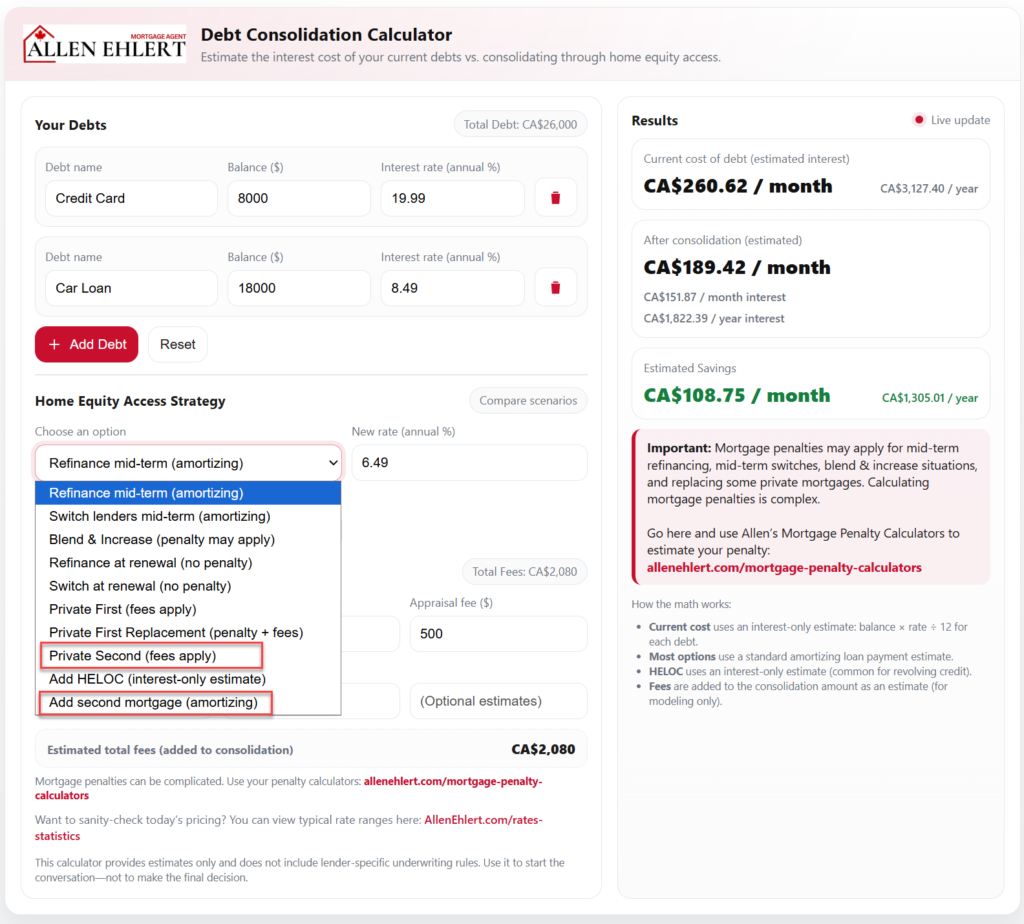
See the Debt Consolidation Calculator. In the ‘Home Equity Access Strategy’ panel, select either Private Second or Add Second Mortgage (amortizing) to discover the different types of fees depending on structure that could be applicable.
Second mortgages are best viewed as tools, not long-term foundations.
What Happens If You Skip First-Lender Permission
This is one of those questions where the legal answer and the practical outcome line up very tightly — and not in a good way.
Short answer:
You generally cannot safely or effectively place a second mortgage behind another lender’s first mortgage without a postponement agreement.
If it happens at all, it is almost always defective, unenforceable in practice, or immediately vulnerable.
Let’s unpack why.
What a postponement agreement actually does
A postponement agreement is not a courtesy document. It is the legal instrument that:
- Confirms priority on title
- Acknowledges the existence of the second lender
- Limits (or clarifies) the first lender’s rights ahead of the second
- Makes the second mortgage financeable and enforceable
Without it, the second lender has no protected priority — regardless of how the mortgage is registered.
What happens if a second mortgage is registered anyway
1. Registration does not equal enforceable priority
Land registry systems record documents; they do not validate lender consent.
So even if:
- The second mortgage appears on title
- The borrower signed valid documents
The first lender’s charge still dominates — especially if it is collateral.
2. The first lender can legally wipe out the second
Without a postponement agreement, the first lender can:
- Advance additional funds under a collateral charge
- Enforce default remedies
- Power of sale or foreclose
- Apply proceeds entirely to their own debt
The second lender may receive nothing, even if equity existed at the time of registration.
3. The second lender may have no right to notice
In many cases, without a postponement agreement:
- The first lender has no obligation to notify the second lender of default
- Enforcement can proceed without warning
- The second lender loses procedural protections
This is why sophisticated lenders simply won’t fund without consent.
4. Most lawyers will not close this deal
In real practice:
- The borrower’s lawyer will flag the issue
- The second lender’s lawyer will refuse to proceed
- Title insurers will decline coverage
If the deal closes anyway, it’s often:
- A rogue private lender
- A high-risk, high-rate transaction
- Or a structure that collapses at the first sign of trouble
Why collateral mortgages make this even worse
If the first mortgage is collateral:
- The registered amount often exceeds the current balance
- Future advances are permitted
- Priority is intentionally expansive
Without a postponement agreement, the second mortgage is not just junior — it is functionally unsecured.
From a risk standpoint, it behaves less like a mortgage and more like an unsecured loan with false comfort.
Regulatory and professional consequences
From a mortgage professional’s perspective, this structure raises serious red flags:
- Disclosure risk: Borrowers often don’t understand the implications
- Suitability concerns: The second mortgage may be illusory
- Enforcement risk: The lender cannot realistically recover funds
- Compliance exposure: Especially in regulated private lending
This is why reputable brokers avoid these deals entirely.
The professional takeaway
Putting a second mortgage behind another lender’s first without a postponement agreement is:
- Legally fragile
- Practically dangerous
- Professionally indefensible
If you ever hear:
“We’ll just register it — it should be fine”
That’s a signal to stop, not proceed.
What should be done instead
A competent mortgage strategy would explore:
- Obtaining first-lender consent properly
- Restructuring or refinancing the first mortgage
- Using a second lender that requires a postponement
- Timing equity access at renewal
- Considering a replacement or blended structure
This isn’t about creativity — it’s about respecting how mortgage priority actually works.
Second Mortgages vs Other Refinance Strategies
A second mortgage is not always the best move.
Alternatives include:
- Refinancing the first mortgage
- Blending and extending
- Replacing a collateral charge
- Using a HELOC
- Waiting for renewal
- Short-term bridge financing
A second mortgage makes sense when:
- You want to preserve a favourable first rate
- The need is temporary
- The equity is strong
- The exit is clear
- The structure is intentional
A Story From the Trenches
Imagine this.
Sam and Priya own a home valued at $1.2M. They owe $540,000 on a collateral mortgage with a major bank. Their rate is excellent, locked in two years ago.
Sam’s business needs $150,000 to bridge cash flow after a delayed contract. A refinance would trigger penalties and a higher rate.
A private lender offers a second mortgage—quick, interest-only, one-year term.
Here’s what goes right:
- Equity supports the loan
- The purpose is temporary
- The exit is planned
Here’s what nearly goes wrong:
- The bank’s collateral charge is registered at $900,000
- Without consent, the second lender would sit behind a charge that already fills title
- The deal almost closes without a postponement agreement
A professional intervention pauses the deal, secures consent, restructures the priority, and saves everyone from a legal mess.
Same numbers. Very different outcome.
Allen’s Final Thoughts
Second mortgages are not “bad” loans. They are advanced tools in a layered financial system.
When used thoughtfully, they:
- Preserve favourable first mortgages
- Solve timing problems
- Create flexibility
- Protect long-term strategy
When used carelessly, they:
- Create false security
- Expose lenders and borrowers
- Collapse under enforcement
- Damage professional credibility
This is where I come in.
As a mortgage agent, my role isn’t just to “find financing.” It’s to:
- Interpret lender policy
- Coordinate legal structure
- Stress-test exit plans
- Protect clients and referral partners from invisible risk
Whether you’re a financial professional advising a client, or a homeowner trying to make a smart decision under pressure, second mortgages demand structure, not shortcuts.
And that’s exactly what I help bring to the table.