…. Cracking the Code: Understanding the Different Types of Commercial Leases in Canada (and How They Can Make or Break a Deal)
When you’re diving into the world of commercial real estate — whether you’re a business owner looking for the perfect storefront or a realtor helping clients secure that next deal — the lease structure can make all the difference. Too often, clients focus solely on location, square footage, or price, while overlooking how the type of lease can impact their cash flow, responsibilities, and even financing options.
Think of your lease as the framework that supports your business operations. If it fits your goals, it strengthens your success. If it’s mismatched, it can quietly drain profits or flexibility.
A commercial mortgage is a loan secured by income-producing real estate — think retail plazas, industrial warehouses, or office buildings. The lender’s confidence in that property’s value and cash flow is largely built on the leases in place.
In this article, we’ll explore the main types of commercial leases in Canada, explain when each is best used, and show how you can apply this knowledge to real-world situations.
Topics I’ll Cover
Gross Lease (Full-Service Lease)
Net Lease (Single, Double, and Triple)
Modified Gross Lease (Hybrid Lease)
The Relationship Between Commercial Leases and Mortgages
Gross Lease – The “All-Inclusive” Deal
A gross lease is much like an all-inclusive vacation package — one price covers everything. You pay a fixed monthly rent, and the landlord takes care of property taxes, insurance, utilities, and maintenance.
For instance, if you lease office space in downtown Toronto at $35,000 per month under a gross lease, you know exactly what your monthly cost will be. No surprise tax bills or fluctuating utility charges.
Pros:
- Simple budgeting: predictable monthly costs.
- The landlord handles most operational headaches.
Cons:
- Higher base rent since the landlord absorbs the risk of rising expenses.
- You may pay a premium if actual expenses stay low.
- Less visibility of the actual cost compared to the base cost (TMI).
When to Use It:
Ideal for office tenants or smaller businesses that want predictable expenses and minimal management responsibilities.
Net Leases – Sharing the Load
If a gross lease is all-inclusive, a net lease is pay-as-you-go. Here, tenants take on some or all of the property’s operating expenses.
There are three variations:
Single Net Lease (N): Tenant pays rent plus property taxes.
Double Net Lease (NN): Tenant pays rent, taxes, and insurance.
Triple Net Lease (NNN): Tenant covers rent, taxes, insurance, and maintenance — everything except structural repairs.
For example, imagine leasing a small café in a suburban plaza under a triple net lease. You’d pay your base rent plus your share of taxes, insurance, and upkeep, while the landlord maintains the building’s structure.
Pros:
- Lower base rent compared to a gross lease.
- Transparent cost breakdown.
Cons:
- Total costs can fluctuate with tax or maintenance changes.
- More administrative responsibility for the tenant.
- Increasing visibility into the cost of maintaining the building leading to tenants who are longer term, more secure, and put a greater interest in the building.
When to Use It:
Common for retail, industrial, or warehouse tenants who want more control over property expenses.
Realtor Tip:
Help your commercial clients calculate their total occupancy cost — rent plus taxes, insurance, and utilities. It’s the only true measure of affordability.
Modified Gross Lease – The Best of Both Worlds
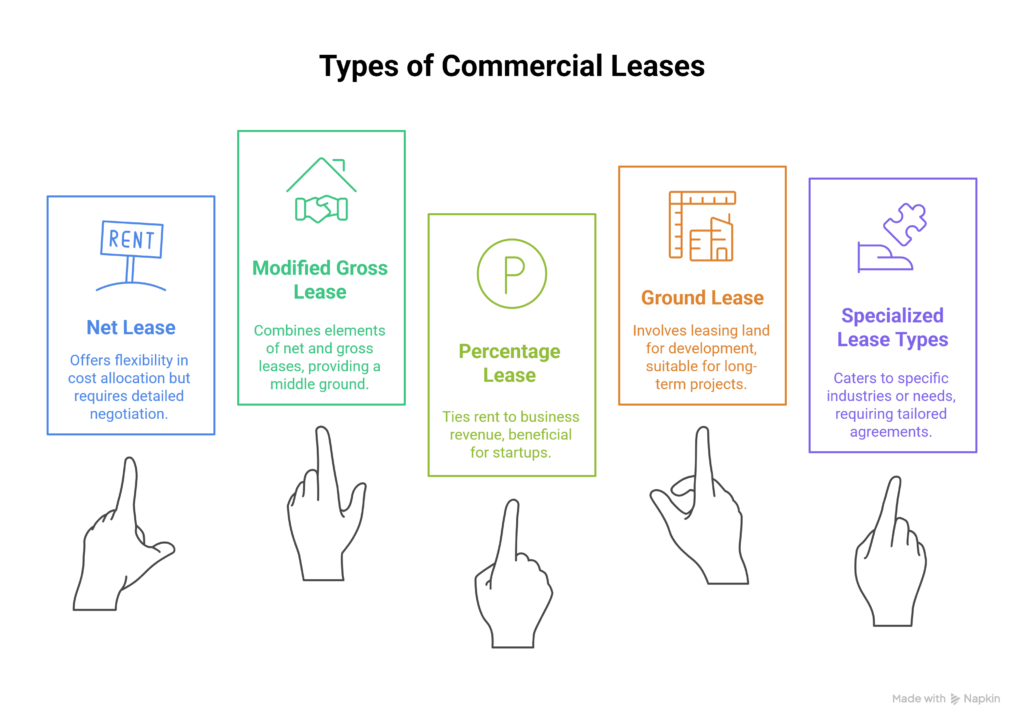
The modified gross lease strikes a balance between simplicity and control. The tenant pays a base rent and a proportionate share of specific expenses such as utilities, cleaning, or snow removal, while the landlord covers others like property taxes or insurance.
Imagine an interior design firm leasing space in a converted industrial building in Mississauga. They pay rent plus utilities and janitorial costs, but the landlord covers insurance and taxes.
Pros:
- Shared responsibility creates balance.
- Easier to budget than a full net lease.
Cons:
- Terms can vary widely and require careful review.
- Potential for confusion if expense-sharing is not clearly defined.
When to Use It:
Perfect for multi-tenant office or industrial properties where common areas and utilities are shared.
Percentage Lease – Sharing Success
A percentage lease ties rent to your business performance. The tenant pays a base rent plus a percentage of gross sales, often above a certain threshold.
For example, a clothing boutique in a busy mall might pay $2,000 per month plus six percent of sales above $50,000.
Pros:
- Lower base rent allows flexibility for new businesses.
- Aligns landlord and tenant interests — both benefit when sales increase.
Cons:
- Requires sharing revenue data with the landlord.
- Accounting and reporting can be more complex.
When to Use It:
Ideal for retail tenants in shopping centres or malls, particularly when sales fluctuate seasonally.
Story Example:
One of my clients opened a gourmet cookie shop in a suburban mall. Her first lease was a flat gross rent, which strained cash flow during slow months. When she renewed, we negotiated a percentage lease instead. Her base rent dropped, and she only paid more when her sales were sweet — literally. The flexibility allowed her to expand to two more locations.
Ground Lease – The Long Game
A ground lease involves leasing land rather than a building. The tenant builds their own structure and operates on the land for a long term, often 20 to 99 years.
For example, a fast-food chain might lease land along a highway and build its own restaurant. The land remains owned by the landlord, but the tenant controls the building during the lease term.
Pros:
- Lower upfront cost compared to purchasing land.
- Tenants have full operational control.
Cons:
- Improvements typically revert to the landlord at the end of the lease.
- Long-term commitment limits flexibility.
When to Use It:
Common for franchises, gas stations, or developers seeking prime locations without purchasing the land outright.
Specialized Leases – Tailored for Unique Situations
Sometimes, leases are customized to fit specific business or investment goals.
Step-Up Lease: Rent increases at set intervals, helping landlords offset inflation.
Indexed Lease: Rent adjusts according to an index like the Consumer Price Index (CPI).
Sale-Leaseback: An owner sells their property and leases it back to access capital while maintaining use of the space.
Build-to-Suit Lease: The landlord constructs a building to the tenant’s specifications, often for specialized operations.
These tailored arrangements are especially useful for expanding businesses or investors structuring deals around long-term stability.
The Relationship Between Commercial Leases and Mortgages
A commercial mortgage is a loan secured by income-producing real estate — think retail plazas, industrial warehouses, or office buildings. The lender’s confidence in that property’s value and cash flow is largely built on the leases in place.
In essence, the lease is the heartbeat of a commercial property’s financial health. It dictates how much income the property generates, how stable that income is, and how likely it is to continue over time.
A lender doesn’t just look at the borrower — they look at the tenants. A strong tenant with a long, stable lease can boost financing opportunities. Conversely, short-term or unstable tenants can weaken a property’s lending profile.
Allen’s Final Thoughts
Leases aren’t just legal documents; they’re strategic tools. The right lease can strengthen your business model, stabilize cash flow, and even improve your financing options. The wrong one can quietly drain profits and limit your growth.
If you’re a realtor, understanding lease structures can elevate your expertise. You’ll be able to guide clients toward smarter negotiations and recognize opportunities others miss — such as modifying a lease to balance short-term affordability with long-term flexibility.
If you’re a business owner or investor, don’t just focus on rent. Consider what’s included, what can change, and how the structure impacts your overall strategy.
As a mortgage agent, my role is to help you see how these lease terms connect with your financing options and investment goals. I can:
- Explain how different lease structures affect your mortgage eligibility or valuation.
- Help you plan financing for tenant improvements or property upgrades.
- Work with your realtor and financial planner to align your lease with your broader business or investment strategy.
Commercial leases can seem complex, but with the right guidance, they become powerful tools for growth. If you’re navigating one now — or preparing to — I’m here to help you make sure the lease you sign supports your long-term success, not just your short-term needs.