You’re thinking about buying a home—or maybe refinancing the one you’ve got. Exciting stuff! But then that phrase pops up: “mortgage stress test.” Suddenly it feels less like house-hunting and more like prepping for a pop quiz. Don’t worry—you’re not alone. Most buyers hit that moment of “what does this even mean for me?” That’s exactly why I built my Mortgage Stress Test Calculator. It doesn’t just crunch the numbers—it shows you how much you can really afford, factoring in your mortgage, your debts, and even your monthly costs. Think of it as your crystal ball before the bank pulls out theirs.
What I’ll Discuss in This Article
What the Stress-Test Calculator Actually Does – A simple explanation of how it works and why lenders use it.
Why This Matters for Your Home Search – How knowing your true qualifying amount can save you time, money, and stress.
How You Can Use the Calculator Yourself – Step-by-step on how to plug in your numbers and interpret the results.
A Real Story: From Confusion to Clarity – A true-to-life example of how the calculator helped buyers land their dream home.
What the Stress-Test Calculator Actually Does
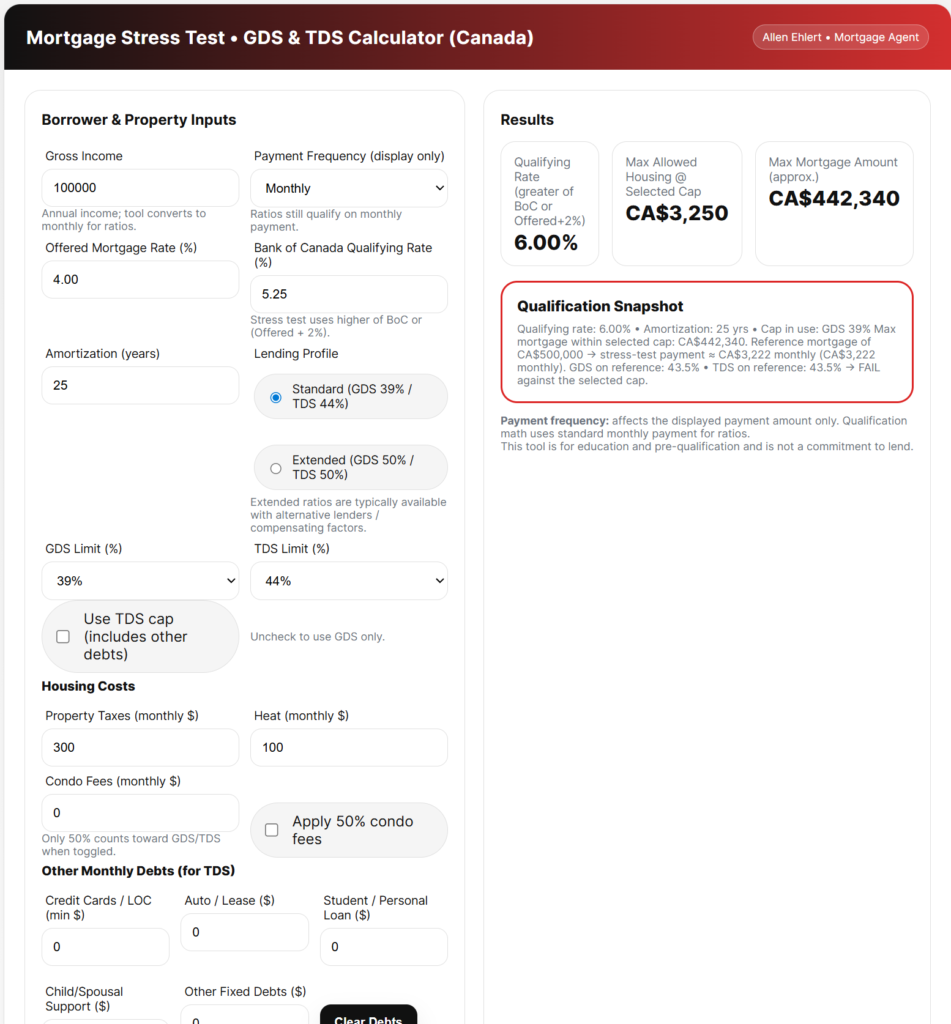
Here’s the deal: in Canada, lenders don’t qualify you at the rate you’re offered. They have to check if you can handle higher payments—either at the Bank of Canada’s benchmark (currently 5.25%) or your contract rate plus 2%, whichever is higher.
My calculator runs that exact scenario. Enter your details and it tells you two key things:
- Your maximum mortgage amount (the most you’d qualify for under stress test rules).
- Your estimated monthly cost (what that mortgage would feel like in your budget).
It doesn’t stop there. It also factors in your other debts—car loans, student loans, credit cards, lines of credit—because lenders always look at the whole picture. This way, you’re not just seeing a number tied to the house price, you’re seeing a number tied to your real life.
Why This Matters for Your Home Search
Here’s why this is so important: without considering your other debts, you could think you qualify for more than you really do. Imagine walking through homes, making plans, even writing an offer—only to learn the lender says “sorry, too much debt on the side.” That’s a heartbreak you don’t need.
With the calculator, you’ll know the real ceiling before you shop. That keeps your search focused, saves time, and avoids disappointment. Realtors love this because they can show you homes that are comfortably within your range, not just hopeful guesses.
How You Can Use the Calculator Yourself
Using the calculator is straightforward—here’s how to put it to work:
First: Enter the purchase price you’re eyeing.
Second: Add your down payment.
Third: Pick your amortization period (25 or 30 years are the usual suspects).
Fourth: Input your monthly housing costs like taxes and heat.
Fifth: Add in any other monthly debt payments you have—car loans, credit cards, student loans.
Hit calculate, and you’ll see exactly how much you qualify for, and what that will cost you each month. If it’s not quite where you want it to be, don’t panic—that’s where we get creative. Maybe you pay down a small loan, adjust the down payment, or tweak your price range. Instead of guessing, you’ll be making informed, confident moves.
A Real Story: From Confusion to Clarity
Take Sarah and Raj, for example. They were thrilled about a bungalow in Scarborough. On paper, it looked doable—but when we factored in Raj’s car loan, their qualifying amount dipped. At first, it felt like the dream was slipping away.
But with the calculator, we mapped it out. By extending the amortization and slightly increasing their down payment, the numbers clicked into place—even with the car loan in play. They didn’t just get the house; they got peace of mind knowing they weren’t over-stretching themselves. That’s the power of running the numbers the right way.
Allen’s Final Thoughts
Here’s the truth: the stress test isn’t just about the house you want—it’s about your whole financial picture. My calculator takes into account your mortgage, your debts, and your monthly costs, then shows you both your maximum mortgage amount and what it’ll feel like each month. It’s not about saying “no,” it’s about giving you the tools to plan smarter.
And remember—you’re not doing this alone. I’ll sit down with you, walk through the results, explain what they mean, and help you map out your options. Maybe that’s lowering a debt, adjusting your down payment, or strategizing around the right price point.
At the end of the day, this isn’t about passing a test—it’s about buying a home that feels right for you, both now and years from now. And I’d be honoured to help you make that happen.