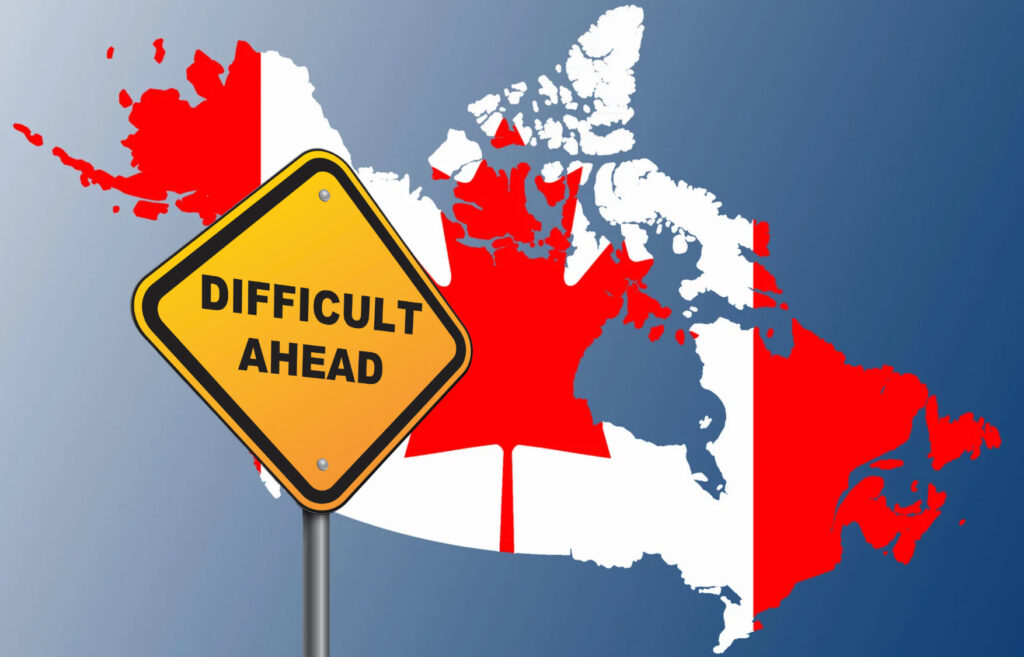
The US economy is outperforming its neighbour to the north, Canada. Despite facing similar challenges of high inflation and increased interest rates, the two economies have taken different paths. In this blog post, we explore the factors that have contributed to America’s success and Canada’s struggles.
High Household Debt Burden in Canada
One significant factor that has hindered the Canadian economy is the high household debt burden. Canadians carry a substantial amount of debt, which makes them more vulnerable to interest rate fluctuations. With mortgage cycles and a prevalence of variable-rate mortgages, exposure to higher interest rates has had a pronounced impact on Canadians.
Job Losses and Difficulty Finding Jobs in Canada
Canada has also faced challenges in its job market, with job losses and difficulties for newcomers to find employment. This has put a strain on the Canadian economy and contributed to its underperformance. Meanwhile, the US economy continues to experience growth and job creation, making it a more attractive destination for job seekers.
Rapid Government Spending in the US
One area where the US economy has gained an edge is through rapid government spending. The US government has been actively supporting the economy through increased spending, which has helped fuel growth and stimulate various sectors. On the other hand, the Canadian government has struggled to control its deficit and provide the same level of support.
Higher Productivity in the US
Another factor that sets the US apart from Canada is higher productivity. The US economy benefits from its higher productivity levels compared to Canada, which is currently experiencing weak productivity growth. This productivity gap has contributed to the divergent economic performance between the two countries.
Impact of High Interest Rates in Canada
The high interest rates in Canada have had a more significant impact due to the country’s high debt and the structure of its mortgage market. Canadians are more sensitive to interest rate changes, and the burden of debt has made it challenging for them to weather the higher rates. In comparison, the US economy has shown resilience and has been able to withstand the impact of higher interest rates.
Interest Rate Reductions on the Horizon
The good news for both countries is that interest rate reductions are expected in the near future. The Bank of Canada plans to start reducing interest rates before the middle of next year, providing relief for borrowers. Similarly, the U.S. Federal Reserve is projected to gradually reduce interest rates in the second half of 2024. These rate reductions will offer a reprieve and potentially help spur economic growth.
The US economy is currently thriving, while Canada faces challenges. The factors of high household debt, job losses, government spending, productivity, and the impact of high interest rates have all contributed to the contrasting performances. However, there is hope for improvement as both countries move towards interest rate reductions and the Canadian government takes steps to address its deficit. The US economy’s strong productivity levels and government support position it for continued success.