When it comes to mortgages and interest rates, small shifts can significantly impact financial outcomes. These changes are often measured in “basis points” (bps), a term frequently used but not always understood. For Canadian realtors, financial professionals, and homebuyers alike, understanding basis points is essential to navigating real estate finance successfully. A slight change in rates, even just a few basis points, can amount to substantial differences in mortgage payments or investment yields. Let me unravel what basis points are, why they matter, and how you can leverage this knowledge for better decision-making.
Why Basis Points Matter in Mortgages
Mortgage Applications of Basis Points
How Basis Points Affect the Mortgage Application Process
Industry Insights on Basis Points
Applying Your Basis Point Knowledge
What Are Basis Points?
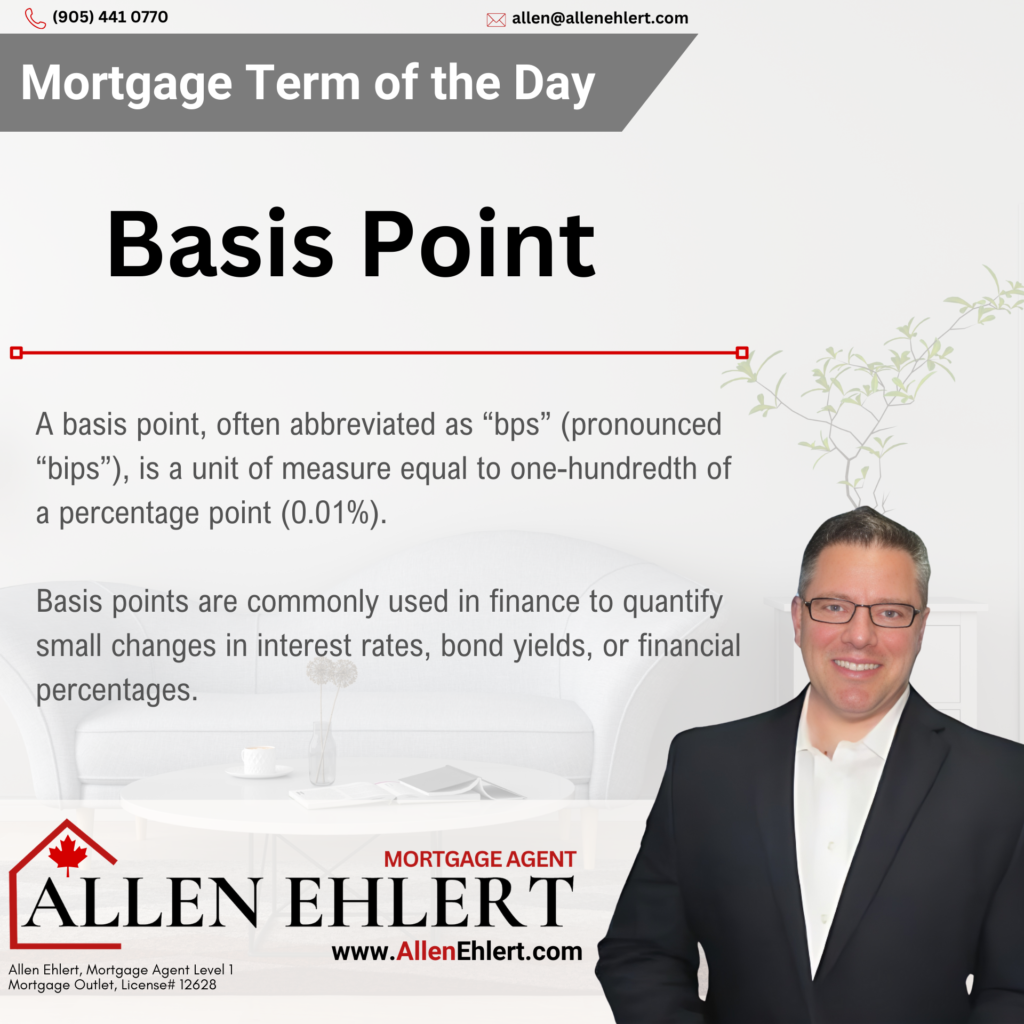
A basis point is a unit of measurement for interest rates and other percentages in finance, equal to 1/100th of a percent, or 0.01%. Put another way, 100 basis points equal one percentage point.
- Example: If an interest rate increases from 5.00% to 5.25%, that’s a 25 basis point change.
This measurement is useful because it provides a clear, standardized way to discuss small changes in rates without the ambiguity of decimals or fractional percentages. For example, saying “an increase of 0.25%” can sometimes cause confusion, but “an increase of 25 basis points” leaves no room for doubt.
Why Basis Points?
In mortgage and real estate finance, where rates can make or break a deal, precise language is crucial. Basis points prevent misunderstanding, especially when discussing minor adjustments with major financial impacts.
Why Basis Points Matter in Mortgages
A minor rate change can make a large financial difference when applied to the sizeable principal amount of a mortgage. Understanding basis points can help borrowers and industry professionals grasp how these seemingly small changes affect overall costs.
Example: Impact on Mortgage Payments
Consider a $500,000 mortgage loan on a 25-year term with an interest rate of 5%. The monthly payment would be approximately $2,908.
- Increase of 10 Basis Points (0.10%): If the interest rate rises to 5.10%, the payment increases to about $2,936, or $28 more per month. Over 25 years, this would add up to roughly $8,400.
- Decrease of 10 Basis Points (0.10%): A reduction to 4.90% lowers the payment to approximately $2,881, saving $27 monthly or around $8,100 over the loan’s life.
Such changes illustrate why even a few basis points are significant and why Canadian mortgage applicants should understand their implications.
Mortgage Applications of Basis Points
In regard to mortgages, here are 3 ways basis points can be applied:
Variable and Fixed Rate Adjustments
Mortgage rates fluctuate in response to market conditions, bond yields, and the Bank of Canada’s policy changes. A Bank of Canada rate adjustment of 25 basis points can affect both fixed and variable mortgage rates. Real estate and finance professionals pay close attention to these changes, knowing they can shift housing affordability and mortgage qualification outcomes.
- Example: The Bank of Canada raised its benchmark rate by 25 basis points, leading some lenders to adjust their mortgage rates accordingly. A 25 basis point increase on a $500,000 mortgage at 5% results in higher monthly payments of around $70.
Discounts and Incentives
Financial institutions may use basis points to offer discounts on mortgage rates. For instance, a lender may offer a “10 basis points off” promotion, meaning a reduction of 0.10% on the standard rate. While this sounds small, as the above example shows, it can amount to substantial savings over time.
- Example: A rate reduction of 15 basis points on a $600,000 mortgage can lower monthly payments by roughly $44, which translates to about $13,200 over the loan term.
Risk-Based Pricing and Loan Conditions
Mortgage pricing can also differ based on factors like credit scores, loan-to-value ratios, and loan types. A borrower with a higher credit score might receive a rate 20 basis points lower than someone with a lower score. Here, basis points offer a standardized way to differentiate pricing and adjust for risk.

How Basis Points Affect the Mortgage Application Process
When applying for a mortgage, basis points can affect the following:
- Qualification: Small rate differences influence the total cost of borrowing, potentially affecting the loan amount applicants qualify for.
- Down Payment and Affordability: A few basis points can mean the difference between a comfortable payment and one that strains finances. Knowing how rates fluctuate and how basis points are applied helps applicants make informed choices about down payments, loan terms, and budgeting.
Actionable Takeaways for Canadian Mortgage Applicants
- Monitor Rate Changes: Understanding that a 25 basis point rate increase can add tens of thousands of dollars over the life of a mortgage emphasizes the importance of timing.
- Ask About Basis Point Promotions: Sometimes, lenders offer reduced rates in basis points, which could improve affordability.
- Negotiate: Even a 5-10 basis point discount, achieved through negotiation or leveraging good credit, can save thousands over a loan’s term.
Industry Insights on Basis Points
Basis points are invaluable in the mortgage industry. They allow me to discuss rate changes accurately, which is critical for setting client expectations and planning for long-term costs.
Many Canadian buyers miss opportunities to save by failing to negotiate for small rate discounts. If I can negotiate a rate reduction of even 5 or 10 basis points, it can save you a substantial amount over the term of the loan. It’s always worth asking for an exception or some wiggle-room on a promotion; life’s a negotiation.
Applying Your Basis Point Knowledge
For real estate professionals, financial advisors, and homebuyers, understanding basis points can improve decision-making. Here’s how you can use this knowledge practically:
- For Realtors: Help clients understand the real impact of rate changes by explaining them in basis points. When discussing rate quotes, guide clients on how even minor rate differences affect their finances.
- For Financial Professionals: Use basis points to communicate mortgage changes to clients. Explain how incremental changes affect long-term costs to better support financial planning.
- For Mortgage Applicants: Ask me about rate changes and request clarity in terms of basis points. This will help you make informed comparisons between lenders and choose the best option for your budget.
Data Points and Statistics
- 50 Basis Points: This is a common adjustment level made by the Bank of Canada, equating to a 0.5% increase or decrease.
- $100,000 Mortgage Impact: On a 25-year mortgage of $100,000, a change of 10 basis points generally affects the monthly payment by approximately $5, or $1,500 over the term.
Summary
Understanding basis points helps demystify the complexities of mortgage rates and empowers Canadians to make more informed financial decisions. As seemingly minor as a few basis points may appear, they can lead to thousands of dollars in cost differences over the life of a mortgage. For those navigating the real estate market—whether as professionals or prospective homeowners—this understanding is invaluable.
Take action today by monitoring rate changes, negotiating terms, and using basis points as a tool to clarify and plan for the future. A clear grasp of these small but powerful increments can make a significant difference in achieving your real estate and financial goals.