Canadian REITs have faced challenges in the past year, but there is hope for a rebound. In this blog post, we dive deeper into the factors influencing the performance of Canadian REITs and explore why the sector needs more capital. From leasing spreads to market valuations, we’ll analyze the key drivers shaping the future of Canadian REITs.
Rent Recovery and Leasing Spreads
Following the rent increases during the pandemic, Canadian REITs are still catching up. Leasing spreads, which indicate the performance of REITs, are expected to be a positive indicator for growth. High leasing spreads suggest a favorable growth story for Canadian REITs as they continue to recover and thrive.
Canadian Apartments: Accelerating Fundamentals and Rent Growth
Canadian apartments are experiencing strong fundamentals and significant rent growth. The supply-demand imbalance in Canada is contributing to higher rents and favorable conditions for REITs operating in the residential space. One example is Boardwalk, which benefits from being in Alberta, a non-rent controlled market.
MTO: Quality Assets and Growth Potential
Despite underperformance in the market, MTO holds quality assets with strong growth potential. The company faced issues with acquisitions funded by variable rate debt, but these have now been replaced by cheaper long-term debt. With expectations of strong topline growth and wide cap rate spread to its peers, MTO is positioned for success.

Dream Industrial REIT: A Top Pick
Dream Industrial REIT stands out as a top pick in the Canadian REITs market. With an attractive valuation, this company has a large embedded market opportunity and strong operating performance. As a result, Dream Industrial REIT is expected to deliver positive growth and generate returns for its investors.
Valuations and Market Performance
Valuations of Canadian REITs are approaching levels similar to the value of the land on which their assets are located. However, the immediate operating performance is not expected to be outstanding despite the low valuations. On a positive note, there is an opportunity for a market rebound with a wider cap rate spread to financing costs.
Bullish Outlook: Seniors Living and Retail Space
The health care sector’s seniors living segment is expected to perform well due to positive demographics and strengthened fundamentals. Similarly, the retail space benefits from strong leasing spreads and population growth with no new retail space supply. Retail REITs are considered recession-resistant assets, although they may still be impacted by economic downturns.
Lower Interest Rates: A Positive Catalyst
Lower interest rates can be a positive catalyst for the Canadian Real Estate sector. As individuals seek alternatives to cash equivalents, the potential for investment in Real Estate increases when rates come down. With more capital flowing into the sector, growth opportunities and market stability can be expected.
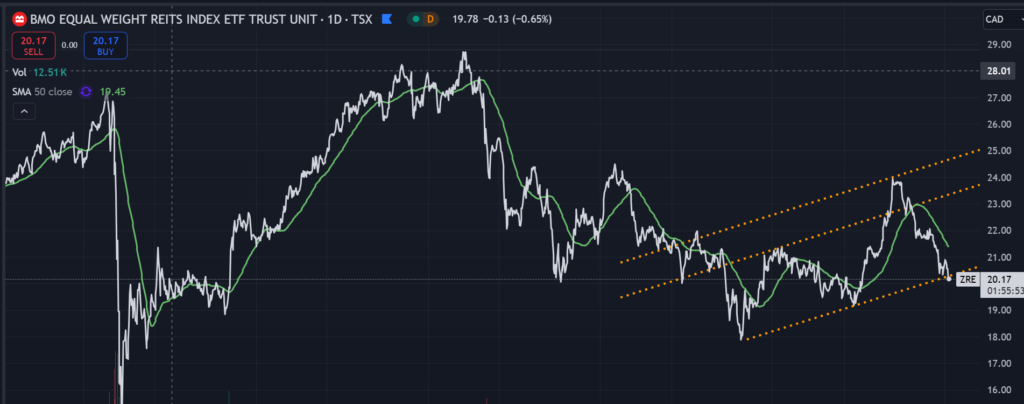
Below, the ZRE which tracks REITS in Canada and pays about a 5.25% dividend, is on a bullish uptrend presently. While office REITS are pulling down one sector of the REIT space, they appear to be buttoning. Apartment REITS are being hampered by the collapse of the condo space in Toronto and the subsequent drop in rents. However, REITS in the senior living space such as Chartwell, have long term moment beyond them as the benefit from Canada’s aging demographic and acute need for senior living.
Canadian REITs face challenges, but there is optimism for the future. With the right strategies and support, these REITs can thrive and deliver returns to investors. From rent recovery to market valuations, understanding the key drivers is essential for capitalizing on the opportunities in the Canadian Real Estate Investment Trust sector.