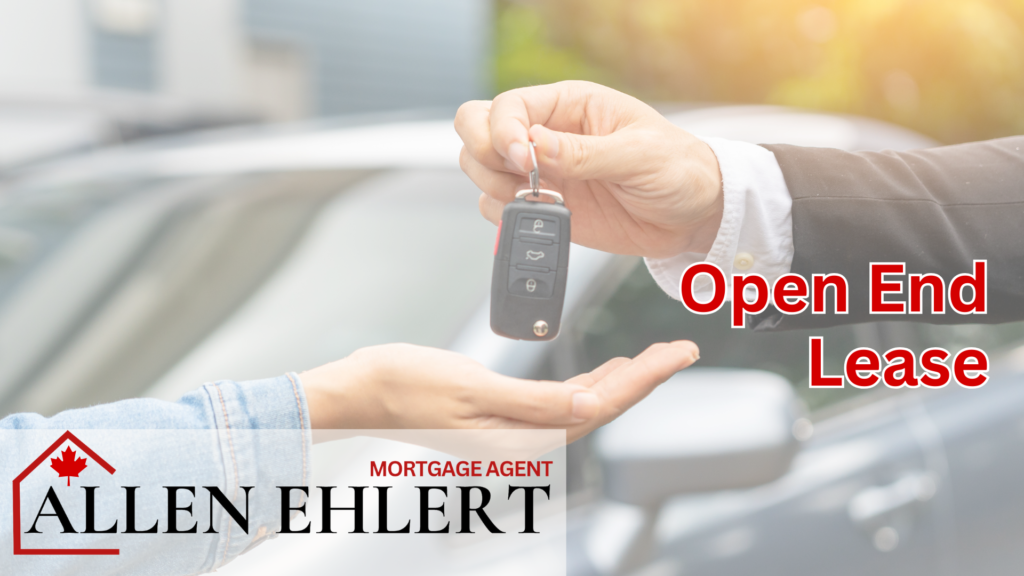
An open-end lease is a type of vehicle lease agreement where the lessee (the person leasing the vehicle) is responsible for the difference between the residual value of the vehicle (the estimated value of the vehicle at the end of the lease term) and the actual market value of the vehicle at the end of the lease. This type of lease is often used for commercial or business purposes, such as for fleet vehicles, rather than for personal vehicle leasing.
Comparison to Mortgage Products

Key Features of an Open-End Lease
An open-end lease has the following features:
- Residual Value
- Lessee’s Responsibility
- Flexibility
- End of Term Settlement
Residual Value
At the beginning of the lease, the lessor (the leasing company) estimates the residual value of the vehicle at the end of the lease term. This is the expected market value of the vehicle after depreciation.
Lessee’s Responsibility
If the actual market value of the vehicle at the end of the lease is lower than the residual value estimated at the beginning of the lease, the lessee is responsible for paying the difference. This could happen if the vehicle has higher-than-expected wear and tear, damage, or more kilometers driven than anticipated.
Flexibility
Open-end leases often provide more flexibility in terms of mileage and usage, making them attractive for businesses with varying needs. Unlike a closed-end lease, where exceeding the mileage limit results in penalties, an open-end lease adjusts the residual value based on actual usage.
End-of-Term Settlement
At the end of the lease, the vehicle is appraised to determine its actual market value. The lessee then either pays the difference if the market value is less than the residual value or receives a refund if the market value exceeds the residual value (though refunds are less common).
Open-End Lease and Mortgages
While open-end leases are primarily associated with vehicle leasing, understanding the concept can be useful when considering different types of financial agreements, including those related to mortgages. Here’s how it relates
Comparison to Mortgage Products
Although not directly related to mortgages, the concept of an open-end lease can be compared to certain mortgage products where the borrower bears more responsibility for the final outcome, such as variable-rate or adjustable-rate mortgages where the borrower’s payments may vary based on interest rates.
The concept can also be applied to new construction situations where a buyer puts a down payment on a to be built home or condo, only to discover on closing (often years later) that the market has declined, the new unit is appraised below the purchase price, and lenders will only provide a mortgage based on the present market price, not the higher price the purchaser signed the contract with the builder for. The result is the buyer needs to come up with the difference. Read more here.
Risk Management
Just as with an open-end lease, where the lessee assumes the risk of the vehicle’s value at the end of the lease term, borrowers of certain types of mortgages, such as variable-rate mortgages, assume the risk of changes in interest rates and how that might affect their overall payments.
Financial Planning
Both open-end leases and certain mortgage products require careful financial planning and an understanding of potential future liabilities. In an open-end lease, the lessee must be prepared to cover any potential shortfall if the vehicle’s value is less than expected. Similarly, mortgage borrowers must plan for possible changes in their payment obligations, especially with variable-rate or balloon payment mortgages.
Summary
In summary, an open-end lease in Canada is a vehicle lease where the lessee is responsible for any difference between the estimated residual value and the actual market value of the vehicle at the end of the lease term. While this concept is primarily relevant to vehicle leasing, it shares some similarities with financial products in the mortgage industry, particularly in how risk and responsibility are managed between the parties involved. Understanding open-end leases can provide insight into other financial agreements where future values and responsibilities are uncertain.