A rural property is not automatically a farm. For example, a detached home on five acres with a well, septic system and no meaningful farming operation may still qualify as a rural residential property. Conversely, substantial farming income, cultivated acreage, livestock facilities or specialized agricultural buildings could cause it to be treated as a farm or agricultural property, requiring different financing.
The key mortgage distinction is usually:
| Property type | Typical characterization |
|---|---|
| Country home on modest acreage | Rural residential |
| Home with extensive acreage but no farming | Rural residential or acreage property |
| Working farm or agricultural operation | Agricultural property |
| Seasonal cottage without year-round access | Recreational property |
| Mostly vacant land with a small or uninhabitable dwelling | Land financing rather than a conventional residential mortgage |
The practical definition is therefore: a property outside a conventional urban setting whose location, servicing, acreage or permitted use may affect its marketability and mortgage eligibility. A specific property should be reviewed using its address, zoning, acreage, services and intended use before deciding how a lender will classify it.
Mortgage lenders in Canada are often hesitant to finance properties in rural areas or properties with active farms for several reasons:
Marketability and Resale Value
Maintenance and Condition Issues
Economic Stability and Income Verification
Environmental and Regulatory Concerns
Marketability and Resale Value
Properties in rural areas or those associated with farming can be harder to sell. This reduces their marketability, which is a significant concern for lenders who need to consider the possibility of foreclosing and selling the property. Rural properties may also experience more significant fluctuations in value compared to urban properties.
Lenders in their mortgage product policies place limits on the size of property they will lend on. For example, a guideline will say that they will lend on a property up to 20 acres, but no income from the subject property (i.e., farming income) can be used in the mortgage application, and no value may be attributed to outbuildings (like a barn or stables). Some lenders will not allow properties of more than 5 acres, while others will go as high as 50 acres.
Loan-To-Value
Further, lenders often limit the loan-to-value of rural mortgages to 65% and sometimes up to 80% for properties of 10 acres or less. They will not put high-ratio mortgages (greater than 80%) on a rural property unless there is a negotiated exception. Many lenders simply will not do financing on agricultural-zoned properties.
Proximity to Population Centres
In mitigating risk, lenders put limits on the distance a rural property can be from a large population centre in their mortgage product guidelines. For example, a guideline may state that a residence must be within 50 km of a population of more than 50,000 people. Different lenders specify different distances within different population size centres. Some require the property to be within 100 km of the GTA/GVA. Some even go so far as to have a sliding scale: 100 km within 100,000, 50 km within 30,000 to 100,000, and 25 km of 10,000.
Property Appraisal Challenges
Appraising rural and farm properties can be complex due to their unique characteristics. This makes it difficult for lenders to determine an accurate value of the property, which is crucial for loan decision-making.
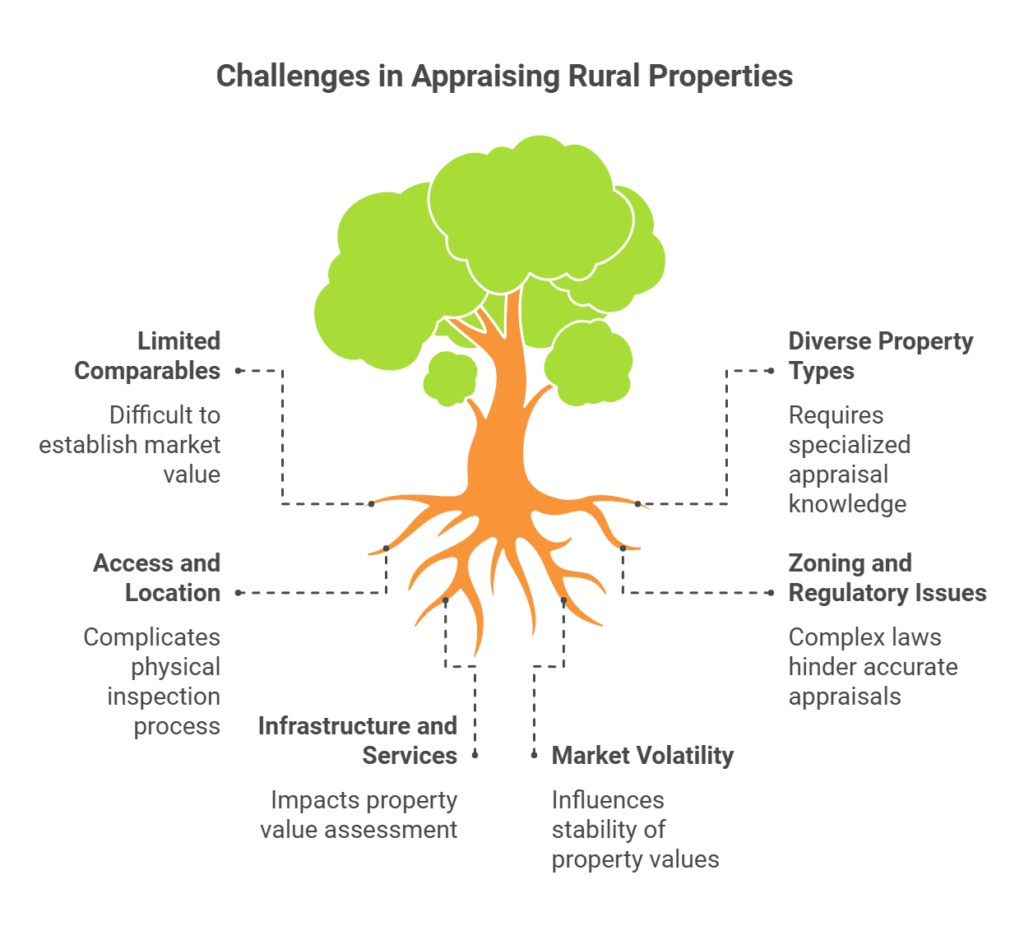
Here are some of the main challenges and the potential added costs associated with appraising rural properties:
- Limited Comparables
Rural areas often have fewer comparable property sales, which can make it difficult for appraisers to find similar properties to establish a market value. This lack of comparables can lead to more subjective assessments and potentially less accurate valuations. - Diverse Property Types
Rural properties can vary widely in terms of type, size, usage, and features (such as agricultural facilities, water rights, and natural resources). This diversity requires appraisers to have specialized knowledge and often to consider a broader range of factors in their evaluations. - Access and Location
Rural properties can be located in remote areas that are difficult to access, which can complicate the physical inspection process. Weather conditions and poor infrastructure can further hinder accessibility. - Zoning and Regulatory Issues
Rural properties may face complex zoning laws or environmental regulations, such as restrictions on land use, conservation rules, or development caps. Understanding these regulations is crucial for an accurate appraisal. - Infrastructure and Services
The availability of services such as water, sewage, electricity, and internet can significantly impact a rural property’s value. The lack or quality of these services needs to be carefully assessed during the appraisal process. - Market Volatility
The market for rural properties can be less liquid and more volatile than urban markets. Economic factors affecting agriculture, mining, or tourism can substantially influence rural property values.
Zoning and Use Restrictions
Rural and farm properties often come with specific zoning restrictions and usage rules that can complicate their future development or alteration. Such restrictions can affect the property’s value and potential for income generation, making them less attractive to lenders.
Zoning and use restrictions in rural areas can feel a little crazy. For example, one side of the street or concession may allow the owner to run a commercial business like autobody repair, offer roadside food, or well fireworks, while a property right across the street isn’t allowed to do anything.
Maintenance and Condition Issues
Properties in rural areas or farms may require more maintenance due to their size and the nature of the facilities. For instance, a farm property might include additional structures like barns, silos, or fencing, all of which require upkeep and can be costly to repair or replace.
Relatively simple maintenance requirements of a property, such as cutting the grass or shovelling the driveway, are a pretty straightforward thing for a home in a subdivision. However, when you have acres of grass to cut and a substantially long gravel driveway, regular home maintenance is no longer simple and usually requires the purchase of expensive equipment like a tractor.
Infrastructure and Services
Rural properties frequently lack access to essential services such as water, sewage, electricity, and the internet. This can make living in these areas less desirable and affect the property’s value and desirability.
As technology moves forward, access to the internet through satellite systems such as Starlink is linking rural properties closer to the modern world more than ever. Starlink is still in the process of expanding its satellite network. New satellites are regularly launched to improve coverage and capacity, which means that availability and service quality are continually evolving. For rural property owners in Canada interested in Starlink, it’s recommended to check the Starlink website directly for the most current information about service availability in their specific location. They can enter their address to see if service is currently offered or if they might need to join a waitlist.
Economic Stability and Income Verification
For properties with active farms, proving a stable income can be challenging, as farming income can be unpredictable and dependent on external factors like weather and market conditions. Lenders prefer borrowers with stable and predictable incomes for loan approval.
Fundamentally, it’s about looking at the farm as a manufacturing business, understanding the financial performance of the enterprise, and gaining a complete communicable assessment of the farm’s financial condition through a comprehensive net worth statement and cash flow projection.
There are always broader circumstances to consider to truly fill out the ‘big picture’. There needs to be an understanding of what has gone wrong and what has gone right, and putting in place a strategy to go forward.
Environmental and Regulatory Concerns
Farm properties may also face environmental regulations, potential contamination issues, or other regulatory challenges that can complicate their financing.
For example, A water potability test certificate is a document that certifies the safety and quality of drinking water, indicating that the water is free from contaminants and is safe for human consumption. This certificate is often required during real estate transactions, especially for properties with private water systems such as wells. A septic inspection certificate is a document that verifies the condition and proper functioning of a septic system. This certificate is often required during real estate transactions to assure buyers and lenders that the septic system is in good working order and complies with local regulations. A Road Access and Maintenance Agreement is a legal document that outlines the responsibilities and rights of property owners regarding the use, maintenance, and repair of a shared private road. This agreement is particularly important in rural areas or communities where access to properties is provided by private roads not maintained by municipal or government authorities.
… and so on.
Due to these factors, lenders might view rural or farm properties as higher-risk investments. When they do provide financing, it may come with higher interest rates or require a larger down payment to mitigate the risk. In some cases, specialized lenders or credit institutions that understand and cater to agricultural businesses might be more willing to finance such properties.