Did you know over 65% of Canadian homeowners have a mortgage? Many don’t know how important the mortgage discharge statement is. This document is key to ending your mortgage and settling your financial duties. As you near the end of your mortgage, it’s crucial to understand what this statement means.
A mortgage discharge statement (also known as a payout statement) is a detailed report from your lender. It shows the final amount you owe, any fees, and how to close your mortgage. It’s the official end of your mortgage, legally freeing you from your agreement. This document is vital for your financial freedom and clear ownership of your property. It outlines the exact amount required to fully pay off a mortgage as of a specific date. This statement is crucial when a borrower is refinancing, selling a property, or paying off a mortgage early.
This article will guide you through the mortgage discharge statement in Canada. You’ll learn how to get it and what it should include. You’ll also discover the differences between discharge and satisfaction, your lender’s duties, and legal aspects.
Key Takeaways
- A mortgage discharge statement is essential for formally completing your mortgage obligation.
- It includes the final balance due, fees, and specific instructions for the mortgage release.
- Understanding this document ensures a smooth transition to mortgage-free status.
- You need to be aware of the legal implications and your rights as a borrower in Canada.
- Proper handling of the mortgage discharge statement avoids common pitfalls like overlooking fees or failing to confirm receipt.
What is a Mortgage Discharge Statement?
A mortgage discharge statement is a key document that shows your home loan is finished. It proves you’ve paid off your mortgage fully. This document helps in many financial tasks, like selling your home, refinancing, or paying off your mortgage early.
Definition and Importance
The mortgage discharge statement confirms your loan is fully paid. When you settle your mortgage, your lender gives you a paid-in-full statement. This statement is crucial because it removes the lien on your property, giving you full ownership. The Financial Consumer Agency of Canada says getting this statement quickly is important to avoid legal issues or problems in future deals.
When You Need One
You’ll need a mortgage discharge form in several situations. First, when selling your home, it proves there are no debts left. Second, it’s needed for refinancing your mortgage. The Canadian Bankers Association says having a clear mortgage discharge form can speed up refinancing and get you better rates. Lastly, if you pay off your mortgage early, you need this statement to show all payments are made, avoiding any financial issues.
“Failing to secure a mortgage discharge statement promptly can result in unnecessary stress and potential delays in property transactions, making proactive financial planning essential,” recommends the Real Estate Council of Ontario.
In summary, understanding the mortgage discharge statement and when you need it helps you manage your property and finances confidently.
Process of Obtaining a Mortgage Discharge Statement
Getting a mortgage discharge statement is key when you’re wrapping up your property paperwork. This guide will help you through the request process. It makes sure you have everything you need.
Steps to Follow
To get your mortgage discharge statement, just follow these steps:
- Contact Your Lender: Call your lender, like Toronto-Dominion Bank or the Royal Bank of Canada, to start the request.
- Submit a Formal Request: Write a formal request, making sure to include all important details.
- Pay Discharge Fees: Be ready to pay any fees your lender might charge for the discharge.
- Request Confirmation: After you send it, ask for a confirmation receipt to know it’s being processed.
Required Documentation
Having the right documents ready will make the discharge process faster. Here’s a list of what you might need:
- Proof of Identity: A valid government ID like a passport or driver’s licence.
- Mortgage Documents: Copies of your mortgage agreement and recent statements.
- Loan Discharge Forms: Fill out any forms your lender needs for the discharge.
- Mortgage Satisfaction Letter: Your lender might ask for a letter saying the mortgage is paid off.
By following these steps and having all your documents ready, you can smoothly get a mortgage discharge statement. Make sure to request on time and keep in touch with your lender to avoid any hold-ups.
Key Components of a Mortgage Discharge Statement
Understanding a mortgage discharge statement is key to closing your mortgage account right. It lists the important details you need to check before you pay off your mortgage.
Outstanding Principal Balance
Your mortgage discharge statement shows the amount you still owe. This is crucial for figuring out how much you need to pay to clear your mortgage.
Accrued Interest
Interest accrued since the last payment.
Prepayment Penalties
Penalty fees for breaking the mortgage before the term ends. When reviewing the payout statement, prepayment penalties may be labelled as:
- “Prepayment Charge”
- “Mortgage Breakage Fee”
- “Interest Rate Differential (IRD) Penalty” (for fixed-rate mortgages)
- “Three Months’ Interest Penalty” (for variable-rate mortgages)
Fees and Charges
Administrative costs for closing the mortgage.
Total Amount Due
The full amount required to pay off your mortgage.
Valid Until Date
A deadline by which the amount must be paid.
Final Payment Instructions
The statement will tell you how and where to make your final payment. This part is important to ensure you pay your mortgage balance correctly. Paying attention to these instructions helps avoid any problems during the payoff process.
“Accurate comprehension of each component within your mortgage discharge statement is essential,” advises the Canadian Bankers Association. This ensures that you can effectively manage your mortgage settlement and avoid any complications during the process.
Reasons a Borrower Would Request a Payout Statement
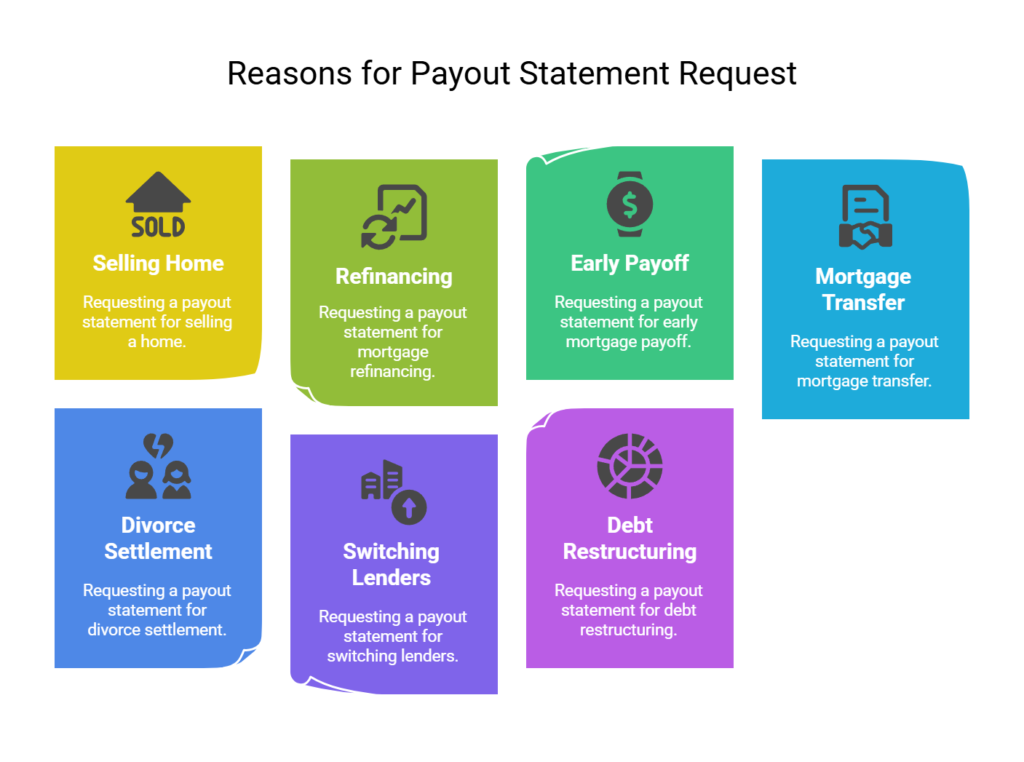
Whether you’re selling your home, refinancing for a better rate, or paying off your mortgage early, this statement ensures you have a clear understanding of the outstanding balance, including any interest, fees, or penalties. In some cases, such as divorce settlements or switching to a private lender, a payout statement is necessary to facilitate a smooth financial transition. Understanding when and why to request this document can help borrowers avoid unexpected costs and streamline major financial decisions.
- Selling a Home (Mortgage Discharge)
- Refinancing the Mortgage
- Paying Off the Mortgage Early (Prepayment or Lump-Sum Payoff)
- Mortgage Transfer or Porting
- Divorce or Separation Settlement
- Switching to a Private Lender or Alternative Financing
- Debt Restructuring or Paying Off a HELOC
Selling a Home (Mortgage Discharge)
When selling a property, the mortgage must be paid off before transferring ownership to the buyer. The payout statement provides the exact amount due to close the mortgage. It ensures that the seller knows how much of the sale proceeds will go toward paying off the loan.
Refinancing the Mortgage
If a borrower is switching lenders for better interest rates, terms, or to consolidate debt, they need a payout statement to close the existing mortgage.
The new lender may require this document to finalize the refinancing process.
Paying Off the Mortgage Early (Prepayment or Lump-Sum Payoff)
Some borrowers choose to pay off their mortgage early to save on interest.
The payout statement ensures they account for any prepayment penalties or discharge fees before making the final payment.
Mortgage Transfer or Porting
If a borrower is moving to a new home and transferring their existing mortgage to the new property, they may need a payout statement.
Some lenders require it to calculate the remaining balance and any associated fees.
Divorce or Separation Settlement
When a couple separates, one party may buy out the other’s share of the home.
A payout statement helps determine the exact amount needed to remove a borrower from the mortgage.
Switching to a Private Lender or Alternative Financing
If a borrower moves from a traditional lender to a private lender (e.g., for equity lending or alternative financing), a payout statement is required to clear the existing debt.
Debt Restructuring or Paying Off a HELOC
Borrowers restructuring their debt to consolidate loans or close a Home Equity Line of Credit (HELOC) may need a payout statement to settle outstanding balances.
Role of the Lender in the Discharge Process
Knowing the lender’s role in the loan discharge is key for a smooth mortgage closure. The lender must make sure all steps are done well and clearly. They check if the final payment is made and if all conditions are met, following Canadian rules.
Responsibilities
The lender’s job includes preparing and sending the mortgage discharge papers. They issue statements that show the total paid and any fees left. It’s also important to keep borrowers updated on what they need to do, to avoid delays.
According to the Office of the Superintendent of Financial Institutions, lenders must tell borrowers about any changes in the process. This is because of new rules.
Timeline for Discharge
The time it takes to discharge a loan can change a lot. It depends on the lender and how complex the mortgage is. Usually, after the final payment, the lender has a set time to close the mortgage.
The Financial Services Regulatory Authority of Ontario says to check with your lender about their specific times. This can be affected by how fast they work and if all documents are ready. Knowing this timeline is important for a quick and easy mortgage closure.
How to Use Your Mortgage Discharge Statement
After getting your mortgage discharge statement, it’s key to know how to use it right. This document is crucial for updating your land title records. You can do this through your Provincial Land Registry Office. Using the discharge statement correctly helps remove any liens efficiently.
You also need to confirm your mortgage is closed with banks and credit unions. Getting confirmation of mortgage closure solidifies your financial records. It also gives you peace of mind. Notify these institutions quickly to avoid any issues.
Keeping the mortgage discharge statement safe is also important. The Canada Mortgage and Housing Corporation suggests keeping it in a secure spot. It proves your mortgage is fully paid off. It’s useful in any future financial or legal issues.
Here’s a quick summary of what to do:
- Update land title records at your Provincial Land Registry Office.
- Remove any existing liens using the discharge statement.
- Inform banks and financial institutions to confirm mortgage closure.
- Safely store your mortgage discharge statement for future reference.
| Action | Purpose |
|---|---|
| Update Land Title Records | Reflects clear ownership and removes mortgage from title |
| Remove Liens | Ensures no claims against your property |
| Notify Financial Institutions | Confirms mortgage closure and final payment |
| Retain Discharge Statement | Serves as proof of mortgage completion for future use |
Common Mistakes to Avoid When Handling a Mortgage Discharge Statement
Managing your mortgage discharge statement requires careful attention to avoid common mistakes. These errors can lead to delays or financial issues. It’s important to check all details and confirm key points to prevent problems.
Overlooking Fees
One big mistake is forgetting to include all fees. Your mortgage discharge statement might have extra costs besides the main payment. Look for fees like administration charges, early repayment penalties, or discharge fees.
According to the Real Estate Council of Ontario, overlooking fees can lead to higher overall costs and potential complications in concluding your mortgage.
Not Confirming Receipt
Another mistake is not confirming that the lender got your discharge statement. After your last mortgage payment, make sure the lender processed it right. This step helps avoid legal problems or mistakes.
The Canadian Bar Association advises borrowers to obtain written confirmation from their lender, verifying that the mortgage has been fully discharged.
To avoid these errors, carefully check your statement and confirm with your lender. These steps help make the mortgage discharge process smoother and ensure a smooth transition.
Legal Considerations in a Mortgage Discharge
Understanding the legal side of a mortgage discharge is key. Canada’s laws cover many aspects of this process. They protect your rights and outline what you must do.
Regulatory Requirements
Canada’s mortgage discharge rules mix federal and provincial laws. The Department of Justice Canada sets national guidelines. Meanwhile, provinces have their own rules.
Each province has its own rules about paperwork and how fast things can move. For instance, in Ontario, the Financial Services Regulatory Authority of Ontario makes sure everyone follows the rules. They help borrowers understand their rights.
Your Rights and Obligations
You have certain rights as a borrower in Canada. You have the right to get a clear mortgage discharge statement. This statement should show any remaining balances and fees.
On the other hand, you must pay all fees and outstanding amounts on time. It’s your job to check the statement carefully and ask questions if you’re unsure. Knowing your rights helps the process go smoothly and legally.
In summary, knowing the legal side of a mortgage discharge is crucial. It helps the process go smoothly and protects your interests during this important financial change.
Conclusion
This guide has given you a detailed look at mortgage discharge statements. You now know what they are and why they’re important. You also know how to get one and what to do with it.
Managing your mortgage discharge well is key. By following the advice in this article, you can avoid problems. This ensures a smooth end to your mortgage.
Knowing your mortgage discharge statement is essential. It helps you end your mortgage legally and efficiently. This guide has given you the tools to do so, giving you peace of mind.
FAQ
What is a mortgage discharge statement?
A mortgage discharge statement marks the end of your mortgage deal. It shows the last amount you owe, any fees, and how to legally end your mortgage. You get it when you fully pay off your home loan.
Why is the mortgage discharge statement important?
The mortgage discharge statement is key because it proves your mortgage is paid off. It’s needed when selling your home, refinancing, or paying off early. It legally frees you from your mortgage debt.
When do you need a mortgage discharge statement?
You need it when you’ve paid off your mortgage, by selling, refinancing, or making the last payment. It confirms the lender has accepted the payment. It’s also for updating land titles and closing your mortgage account.
What are the steps to obtain a mortgage discharge statement?
To get a mortgage discharge statement, ask your lender. You’ll need to provide ID, mortgage papers, and any lender forms. Quick and clear communication with your lender helps.
What documents are required to get a mortgage discharge statement?
You’ll need ID, mortgage documents, and possibly a lender form. Check with your lender to avoid delays.
What are the key components of a mortgage discharge statement?
The statement includes the final mortgage balance, fees, and payment details. Knowing these helps close your mortgage account correctly.
What is the difference between mortgage discharge and mortgage satisfaction?
Mortgage discharge and satisfaction are often mixed up but differ legally. Discharge means your mortgage is paid off. Satisfaction means the mortgage terms are met and the lien is removed. Knowing the difference is important.
What are the lender’s responsibilities in the mortgage discharge process?
The lender must give the discharge statement, explain the balance, fees, and payment details. They also ensure the mortgage is legally discharged on time.
How can you use your mortgage discharge statement?
Use it to update land titles, remove liens, and confirm mortgage closure. Keep it for future records.
What common mistakes should you avoid when handling a mortgage discharge statement?
Avoid missing fees, not confirming the lender received the statement, and not updating land titles. These steps prevent problems.
What are the legal considerations in a mortgage discharge?
Legal aspects include knowing laws, your rights, and obligations. Being informed helps you handle the process legally and effectively.