When you take out a mortgage in Canada, you’re entering into a long-term financial commitment that involves repaying both the principal amount borrowed and the interest charged by the lender. Understanding the nuances of how mortgage payments are structured, including the distribution between principal and interest, as well as the compounding frequency, is crucial for any homeowner or potential homebuyer. And don’t forget to protect your home and your family through mortgage protection insurance.
Principal vs. Interest Payments
Consequences of Not Having Mortgage Protection
Cost of Mortgage Life Insurance
Cost of Mortgage Disability Insurance
Manulife’s Mortgage Protection Plan (MPP)
Principal vs. Interest Payments
Principal refers to the original amount of money borrowed from a lender to purchase a property. Each mortgage payment you make partially goes towards reducing this principal amount, which in turn reduces the balance on which interest is calculated.
Interest is the cost of borrowing money. It is calculated as a percentage of the principal and is the lender’s charge for lending you the funds. Interest rates can be fixed, meaning they stay the same throughout the term of the mortgage, or variable, meaning they can fluctuate with changes in market interest rates.
Monthly Payments: The total monthly mortgage payment is a sum of the principal and interest. At the beginning of the amortization period, a larger portion of your payment goes towards interest. As the mortgage balance decreases over time, the proportion of the payment covering interest diminishes while the portion reducing the principal increases. This is known as an amortizing loan, and it ensures that the loan is paid off by the end of the agreed term.
Amortization Schedule
An amortization schedule is a complete table of periodic loan payments, showing the amount of principal and the amount of interest that comprise each payment until the loan is paid off at the end of its term. Early in the schedule, the interest portion of each payment is high and the principal portion is low. As the loan matures, the interest portion decreases, and the principal portion increases.
Read More: Canada’s New 30-Year Mortgages
Read More: Canada’s Mortgage Rule Changes
Frequency of Compounding
In Canada, the law regarding the compounding frequency for mortgages is quite specific. The Interest Act of Canada mandates that interest on any mortgage loan must not be compounded at intervals more frequently than semi-annually. This means that while the interest can be calculated more frequently, it cannot be legally compounded (i.e., added to the principal) more than twice a year.
Key Points:
- Semi-Annual Compounding: Interest on a mortgage is added to the outstanding principal balance no more frequently than every six months. This is the maximum compounding frequency allowed by law.
- Payment Frequency: It’s important to distinguish between payment frequency and compounding frequency. While the law limits compounding frequency, payment frequencies can be more frequent, such as monthly, bi-weekly, or weekly. These payments go toward paying down the interest and principal, but the interest itself is only compounded semi-annually.
- Effect on Borrowers: This regulation is in place to protect consumers by preventing the rapid growth of debt due to more frequent compounding of interest.
By law, all mortgage lenders in Canada must adhere to this rule, ensuring a uniform approach to how mortgage debt is handled across the country. This standardization helps maintain fairness in lending practices and ensures that borrowers are not overly burdened by interest compounding.
Mortgage Payment Options
Canadian borrowers often have several choices regarding how often they make mortgage payments:
- Monthly Payments: Twelve payments per year.
- Semi-Monthly Payments: Twenty-four payments per year.
- Bi-weekly Payments: Twenty-six half-month payments per year.
- Weekly Payments: Fifty-two quarter-month payments per year.
Making more frequent payments (e.g., bi-weekly or weekly) can lead to paying off your mortgage sooner and saving on interest charges due to the more frequent application of payments to the principal.
Read More: More than Rate: Prepayment Privileges
Mortgage Protection
Mortgage life, disability, and critical illness insurance provide financial security for you and your family in the event of death, disability, or a critical illness. They ensure that your mortgage payments can continue to be made, safeguarding your family from losing their home if you can no longer provide financial support due to these unforeseen circumstances.
Disability and critical illness insurance are particularly important because they replace a portion of your income if you become unable to work. This helps to maintain your household’s standard of living and allows you to focus on recovery without the added stress of financial strain
Mortgage life insurance can pay off the remaining mortgage balance in the event of your death, relieving your family of a major financial obligation and helping to secure their long-term financial situation.
Consequences of Not Having Mortgage Protection
Mortgage life insurance, along with disability and critical illness insurance, play critical roles in comprehensive financial planning. They provide essential protection against some of the most significant risks to financial stability that individuals and families face. While not everyone will need to rely on these insurances, for those who do, they can make a substantial difference in managing difficult and unexpected situations.
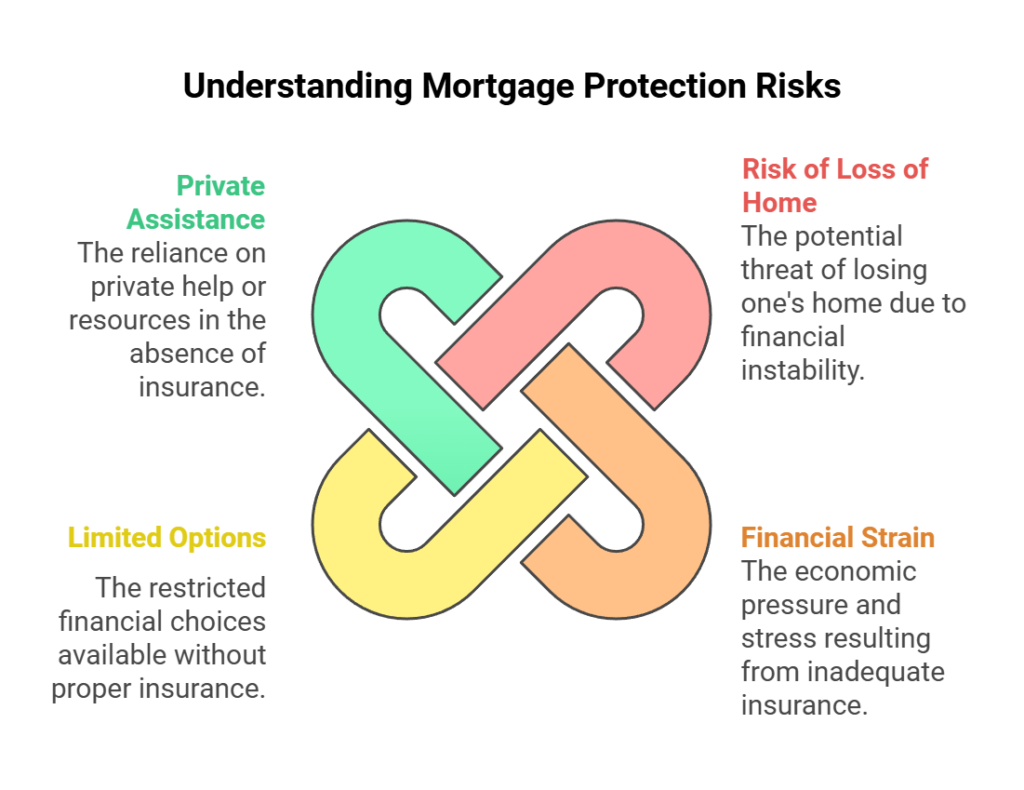
- Risk of Loss of Home
- Financial Strain
- Limited Options
- Private Assistance
Risk of Loss of Home
Without these insurance protections, if the primary breadwinner becomes unable to work, dies, or suffers from a critical illness, the family might struggle to keep up with mortgage payments. This can lead to foreclosure and the loss of the family home.
Financial Strain
The absence of these insurances can lead to significant financial strain, consumer proposal, or bankruptcy, especially if the household is unable to cope with the sudden loss of income while still needing to cover medical costs and everyday expenses.
Limited Options
Without insurance, families might be forced to rapidly sell assets, take out high-interest loans, take out a private mortgage, or drastically cut down on expenses. These actions can have long-term financial repercussions and might not even be viable solutions in time-sensitive situations.
Private Assistance
Families might need to seek financial help from relatives which may not be sufficient or immediately available to cover all necessary expenses. Co-signors and guarantors may be depended upon putting strain on households beyond the immediate household.
Cost of Mortgage Life Insurance
The cost of mortgage life insurance in Canada can vary widely depending on several factors, including the amount of the mortgage, the age and health of the insured, and the specific terms and conditions of the policy. Here’s a general breakdown of how costs can be influenced:
- Mortgage Amount: The premium is typically based on the balance of your mortgage. The higher your mortgage, the higher your insurance premium will be.
- Age: Premiums generally increase with the age of the insured. Younger applicants usually enjoy lower rates, while older homeowners might face significantly higher costs.
- Health: Healthier individuals can expect lower premiums. Some policies require medical exams or health questionnaires, and pre-existing conditions can lead to higher premiums.
- Term of the Policy: The length of the insurance coverage can also affect the cost. Some policies decrease in value as the mortgage balance decreases, which might reduce the premium over time.
- Coverage Type: Some policies offer level premiums that do not change during the term of the policy, whereas others might offer decreasing premiums as the mortgage balance reduces.
Average Costs
While specific costs can vary, typical premiums for mortgage life insurance can range anywhere from $10 to $100 per month, depending on the factors mentioned above. For a more accurate estimation:
- A healthy individual in their 30s might expect to pay around $20-$30 per month for a policy that covers a mortgage of $250,000.
- In contrast, an older individual or someone with health issues could see premiums significantly higher.
It’s essential to compare offers from different insurers, as rates and coverage can vary considerably. Additionally, it may be beneficial to consider alternatives like term life insurance, which can provide more flexibility and potentially more coverage for a comparable cost, affecting financial planning and family protection strategies in broader terms.
Cost of Mortgage Disability Insurance
Mortgage disability insurance is a type of policy designed to cover your mortgage payments in the event that you become disabled and are unable to work, ensuring that your mortgage obligations are met during a difficult time. This coverage is particularly critical for individuals who rely on their employment income to cover mortgage expenses and who do not have sufficient disability coverage through their employer or private plans.
How Mortgage Disability Insurance Works
When a policyholder becomes disabled and meets the terms of their insurance policy’s definition of disability, this insurance typically covers the mortgage payments for a specified period or up to a certain amount per month. The coverage often lasts until the policyholder can return to work, the mortgage is paid off, or the policy term expires.
Cost of Mortgage Disability Insurance in Canada
The cost of mortgage disability insurance can vary significantly based on several factors:
- Mortgage Amount: The higher the mortgage payment that needs to be covered, the higher the premium will be.
- Age and Health of the Insured: Premiums tend to be higher for older individuals and those with pre-existing health conditions.
- Occupation: The nature of the policyholder’s occupation can affect the cost, with higher-risk occupations commanding higher premiums.
- Coverage Details: The extent of coverage, including the maximum monthly benefit and the length of the benefit period, can influence the cost.
Average Premiums
Premiums for mortgage disability insurance can range widely, but as a general guideline:
- For a basic policy: Premiums might start from about $25 to $50 per month for a relatively healthy individual in their 30s or 40s covering a standard mortgage payment.
- For more comprehensive coverage: Premiums can be higher, potentially reaching $100 or more per month, especially if the coverage includes higher payments or longer benefit periods.
It’s important for individuals considering this type of insurance to compare different policies and insurers to find the right balance between coverage and cost. Additionally, reviewing other disability insurance options beyond just covering the mortgage can provide a broader safety net, as mortgage disability insurance only covers mortgage payments and not other living expenses.
Manulife’s Mortgage Protection Plan (MPP)
Manulife’s Mortgage Protection Plan (MPP) is a specific insurance product designed to cover mortgage liabilities in case of unexpected life events. The MPP offers a combination of coverages to help ensure that your mortgage payments can continue in case you are unable to make them due to death, disability, or critical illness. Here’s a breakdown of the types of coverage typically provided by Manulife MPP:
Life Insurance: This component pays off the remaining mortgage balance to the lender in the event of the insured’s death. It ensures that the surviving family members or beneficiaries can continue living in the home without the burden of mortgage payments.
Disability Insurance: If the insured becomes disabled and unable to work, this coverage provides a monthly benefit that is used to pay the mortgage. This benefit typically continues until the insured is able to return to work, the mortgage is paid off, or the benefit period expires (commonly up to a certain age limit).
Critical Illness Insurance: This provides a lump-sum payment if the insured is diagnosed with a covered critical illness (such as cancer, heart attack, or stroke). The funds from this payment can be used to pay off or reduce the mortgage, thereby lowering monthly obligations or completely settling the mortgage.
Additional Features and Benefits
- Portability: Manulife’s MPP can be transferred to a new mortgage without the need for re-qualification, making it convenient if you move or refinance your home.
- Flexible Coverage: The policy allows for adjustments in coverage amounts as your mortgage balance changes.
- Joint Coverage: Options are available for co-borrowers to be insured under the same policy, often with a discount on premiums for joint-life coverage compared to two individual policies.
The cost of coverage under Manulife’s Mortgage Protection Plan depends on several factors including the insured’s age, health, smoking status, the amount of the mortgage, and the length of the mortgage amortization.
Read More: Why Life Insurance May be the Best Mortgage Insurance
Summary
Understanding the breakdown of principal and interest in your mortgage payments, and the additional cost of mortgage protection insurance, how these proportions change over time, and how interest is compounded are essential aspects of managing your mortgage costs effectively. By choosing a payment schedule that allows for more frequent payments, you can potentially shorten the life of your mortgage and save money on interest, thereby gaining equity in your home faster. Always consult with Allen Ehlert to explore options that best suit your financial goals and circumstances.