In today’s market, potential homebuyers are not only dealing with high property prices but also facing increasingly stringent lending criteria, brought about by measures such as anti-money laundering legislation, higher loan amounts, and extended loan ratios. The current reality for many Canadians is a complex financial profile, uncertain employment, and varied income streams, all of which make qualifying for a mortgage more challenging. However, the good news is that a wide variety of mortgage programs exist to cater to different borrower needs, making homeownership an attainable goal for many.
Key Features of Mortgage Programs
Examples of Popular Mortgage Programs in Canada
Programs and the Challenges They Overcome

What is a Mortgage Program?
A mortgage program refers to a specific type of mortgage product designed to meet the needs of different borrowers. These programs are tailored to accommodate a variety of financial situations, employment types, and unique circumstances, making it easier for individuals to qualify for and obtain a mortgage.
Why Mortgage Programs
The traditional, one-size-fits-all mortgage approach often overlooks unique financial circumstances. With programs specifically designed for newcomers to Canada, healthcare professionals, self-employed individuals, and more, there’s an option for almost every type of borrower. By understanding these programs, realtors, financial professionals, and potential homebuyers can explore the most suitable solutions for their financial situations.
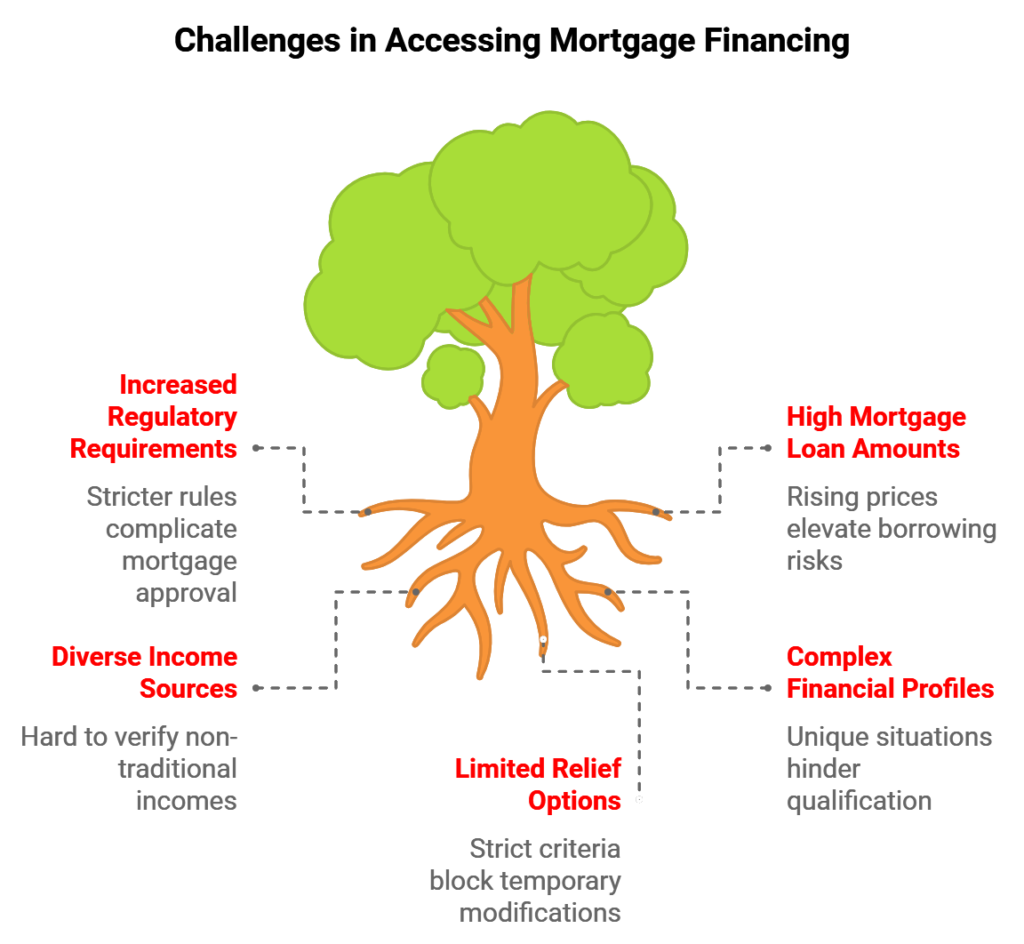
Traditional strict mortgage qualification criteria and expanding regulations have made accessing mortgage financing more difficult. Some of the most common pain points faced by potential homebuyers include:
- Increased Regulatory Requirements
- High Mortgage Loan Amounts
- Diverse Income Sources
- Complex Financial Profiles
- Limited Relief Options
Increased Regulatory Requirements
Regulations such as anti-money laundering measures have made the mortgage process more rigorous, requiring borrowers to provide extensive documentation. Canada has a big problem with money laundering, and many have argued that authorities have been slow to respond. In response, regulators have introduced new and expanding requirements to address these concerns.
High Mortgage Loan Amounts
Rising home prices lead to larger mortgage requirements, which in turn makes meeting debt-service ratios more challenging. Increased mortgage loan amounts mean more risk for lenders. This leads lenders to be increasingly more conservative in granting mortgages.
Diverse Income Sources
Many Canadians have diverse income sources, including self-employment, gig work, bonuses, and commissions, which can be difficult to document and verify. Large institutional lenders like to have very efficient and simple processes to automate the underwriting of mortgages as much as possible because it makes auditing simpler and lowers costs. Unfortunately, that means borrowers who are equally capable of making their mortgage payments, often even more so, are unable to borrow from lenders who take much more of a ‘check the box’ approach to lending.
Complex Financial Profiles
Applicants with unique financial situations, such as foreign income, fluctuating earnings, or business ownership, often struggle to qualify for conventional mortgages. People have much more complex financial profiles today. Instead of one credit card, they have many. Instead of buying a car, they lease or finance. People even lease and/or finance their furnaces and hot water tanks. People live in many different family formations; some are partners, others are common law, some are separated, some are single, some are divorced, and some are even married. Added to this complexity is an increasingly complex tax situation, and so on. In short, life is more financially complicated today, and lenders generally don’t like complicated; for them, it just means more can go wrong.
Limited Relief Options
Borrowers experiencing sudden financial hardship often find it challenging to qualify for temporary loan modifications due to strict lender criteria. Mortgage lenders are in the business of lending out money for people to buy a home, not getting involved in restructuring client’s bruised financial situation like a credit counsellor. Mortgage programs provide the tools mortgage agents can use to financially engineer unique solutions to help people get back on their feet.
Key Features of Mortgage Programs
Mortgage programs generally have the following characteristics that allow them to focus on meeting the unique needs of particular clients. These include:
- Tailored Criteria
- Flexibility in Documentation
- Lender Specialization
- Government-Initiated Programs
Tailored Criteria
Each program has different qualification criteria, down payment requirements, and interest rate options to suit specific borrower profiles.
Flexibility in Documentation
Many programs accept alternative forms of documentation, such as bank statements, rental payment history, or foreign credit reports, making it easier for people with non-traditional income sources or limited credit history to qualify. Some lenders market some mortgage programs as “Low-Doc” or “No-Doc”, others almost completely disregard a borrower’s credit score, while others allow borrowers to have quite high levels of debt.
Lender Specialization
Some mortgage programs are offered by specific lenders who specialize in serving particular borrower groups, such as newcomers, healthcare professionals, self-employed individuals, military personnel, or first-time homebuyers.
Government-Initiated Programs
While not a lender-determined program, government mortgage programs, like the First-Time Home Buyer Incentive (FTHBI) or Home Buyers’ Plan (HBP), are government-sponsored and aim to make homeownership more affordable by providing incentives, tax breaks, or down payment assistance. Like lender-sponsored programs, government programs establish unique criteria, additional flexibility, and borrower support to enable Canadians to access housing they otherwise could not acquire without government programs.
Examples of Popular Mortgage Programs in Canada
There are dozens and dozens of mortgage products available. To differentiate themselves in the mortgage marketplace, different lenders tend to specialize in different types of mortgage programs and emphasize the ones that most closely align with their overall lending strategy. Mortgage programs ensure that Canadians, regardless of their employment status or financial background, or financial position have access to home financing options that meet their needs.
Just a few of the available mortgage programs include:
- Newcomer to Canada Program
- Self-Employed Mortgage Program
- Reverse Mortgage Program
- Extended Ratio Program
- Non-Resident Program
- Professional Program
- Purchase Plus Improvement Program
- Net Worth Program
- Flex Down Program
- Military Mortgage Program
…. And many, many more!

Programs and the Challenges They Overcome
Mortgage programs in Canada cater to a wide range of borrower profiles, helping individuals achieve homeownership despite challenges. Here’s a look at some of the most prominent mortgage programs available:
Newcomer to Canada Program
- Overview: Designed for individuals who have recently immigrated to Canada and may not yet have a strong Canadian credit history.
- Key Benefits: Lenders may consider international credit history, rental payment history, and alternative credit sources. This program typically allows for lower down payments and more lenient income verification.
- Real-World Example: A newcomer who has secured a job in Canada but lacks a Canadian credit history may be eligible for this program, making homeownership accessible sooner than expected.
Healthcare Professional Mortgage Program
- Overview: Tailored for healthcare professionals, including doctors, nurses, pharmacists, and others working in the healthcare sector.
- Key Benefits: Due to stable income prospects, lenders may offer higher loan amounts, lower down payment options, and more flexible debt-service ratios.
- Real-World Example: A newly graduated doctor with substantial student debt but excellent earning potential might qualify for this program, which considers future earning capacity.
Self-Employed Mortgage Program
- Overview: Suited for individuals running their own businesses or working as independent contractors, whose income may fluctuate.
- Key Benefits: Lenders often accept alternative documentation, such as business financial statements, contracts, and tax filings, instead of traditional T4s.
- Real-World Example: A successful freelance photographer with a growing client base can use this program to purchase a home, despite not having the traditional income verification documents.
Flex Down Program
- Overview: Allows borrowers to use borrowed funds for the down payment, such as lines of credit, credit cards, or personal loans.
- Key Benefits: It enables homebuyers to enter the market sooner, even if they haven’t saved up the entire down payment amount.
- Real-World Example: A young professional with good credit but limited savings can access a flex down program to secure a home sooner.
Military Mortgage Program
- Overview: Specially crafted for Canadian military personnel, including veterans.
- Key Benefits: Offers flexible down payment options, relocation benefits, and easier qualification criteria due to the nature of military income.
- Real-World Example: A member of the Canadian Forces relocating to a new base can leverage this program to purchase a home with minimal stress.
Non-Resident Mortgage Program
- Overview: Targets non-residents interested in purchasing property in Canada, such as foreign investors or family members living abroad.
- Key Benefits: Typically, these programs allow for higher down payments (often 35% or more) and require proof of income and foreign credit history.
- Real-World Example: A Canadian living abroad who wishes to maintain a property in Canada can use this program to secure a mortgage, provided they meet the required down payment.
Purchase Plus Improvement Program
- Overview: Ideal for homebuyers planning to purchase a property that requires renovations or upgrades.
- Key Benefits: Allows buyers to include the cost of improvements in their mortgage, making it easier to finance both the purchase and renovation of a home.
- Real-World Example: A couple purchasing an older home in need of a kitchen renovation can use this program to finance the cost of the renovation as part of the mortgage.
Data Points and Statistics
- According to a recent report by the Canadian Real Estate Association (CREA), more than 30% of Canadians have diverse income sources, making it essential to have flexible mortgage options.
- Immigration, Refugees and Citizenship Canada (IRCC) estimates that more than 400,000 newcomers arrive in Canada annually, many of whom are potential homebuyers seeking specialized mortgage programs.
- A study by the Canadian Federation of Independent Business (CFIB) indicates that nearly 15% of Canada’s workforce is self-employed, emphasizing the importance of self-employed mortgage programs.
- The number of Canadians working in the gig economy or having a side hustle is increasing with 28% of people participating in the gig economy and 87% of Canadians admit to working a side gig at one point in their career
- 22% do it for fun, 29% pursue a passion, 36% learn new skills to use at their other job, 52% earn extra money for expenses, and 59% earn extra money to pay bills and increase savings.
- 80% of newcomers to Canada buy their first home within five years of arriving, highlighting the importance of programs like the newcomer mortgage the Canadian workforce, which is self-employed, and flexible mortgage programs are crucial for this demographic.
Summary
If you’re a prospective borrower, reach out to a licensed mortgage agent to discuss which specialized program might be best for you. Only a mortgage agent like me has access to a broad selection of mortgage programs. For realtors and financial advisors, staying informed about these programs allows you to better serve your clients. By understanding that there is a mortgage program for almost everyone, the fear that ‘you can never afford a home’ can be taken away and the hope of homeownership can be restored.