In today’s financial and real estate environment, traditional lending guidelines can often exclude qualified borrowers, creating an important role for Mortgage Investment Entities (MIEs). As a mortgage agent frequently collaborating with financial planners, accountants, and real estate professionals, I regularly field questions about what MIEs are, how they function, and why they matter. Understanding these entities can significantly enhance your advisory services, providing valuable opportunities for both you and your clients.
Understanding Mortgage Investment Entities
Key Features of Mortgage Investment Entities
MIEs vs MIC: How Do Investors Choose?
Benefits and Risks of Investing in MIEs
Considerations for Financial Planners
Important Considerations for Accountants
Understanding Mortgage Investment Entities
Mortgage Investment Entities, or MIEs, are specialized financial vehicles designed to pool investor funds and lend those funds out as mortgages secured by Canadian real estate. Primarily operating as private lenders, these entities cater to borrowers who might not qualify under conventional banking standards. Although various structures exist, the most commonly encountered forms are Mortgage Investment Corporations (MICs), Mutual Fund Trusts, and Limited Partnerships.
An MIE’s fundamental model is straightforward: investors contribute capital, the entity lends this capital secured by property, and borrowers repay loans with interest. The income generated from these loans flows back directly to investors, often through regular distributions.
Key Features of Mortgage Investment Entities
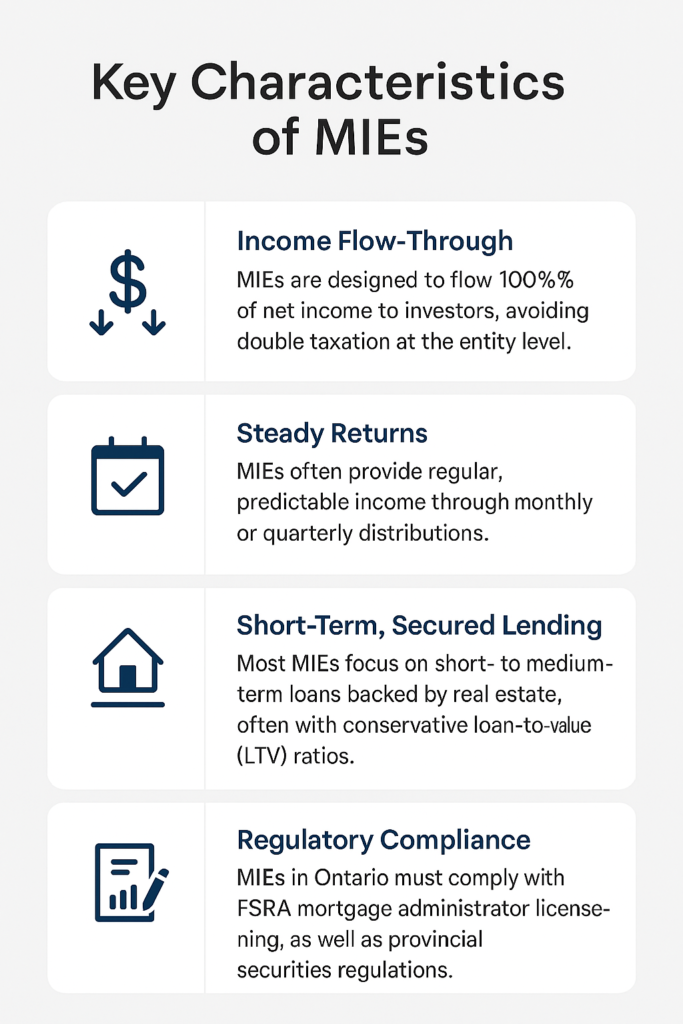
Mortgage Investment Entities typically share several common attributes. They are structured as flow-through vehicles, meaning they distribute all their net income directly to investors, avoiding corporate-level taxation. Investors often receive predictable returns distributed monthly or quarterly, making MIEs particularly attractive to individuals seeking steady income streams.
Additionally, most MIEs concentrate on short-to-medium term loans secured by real estate assets. They usually adopt conservative lending practices, maintaining moderate loan-to-value ratios to mitigate risk. Units or shares of MIEs are generally issued privately through exempt market dealers and may require certain investor eligibility criteria.
Is a MIE a MIC?
A Mortgage Investment Corporation (MIC) and a Mortgage Investment Entity (MIE) are related but not the same — all MICs are MIEs, but not all MIEs are MICs.
A Mortgage Investment Entity is a broad category defined under the Income Tax Act (Canada). It refers to any entity whose primary purpose is investing in or holding mortgages. The term includes several legal structures, such as:
- Mortgage Investment Corporations (MICs)
- Mutual Fund Trusts (MFTs)
- Limited Partnerships (LPs)
- Corporations or other investment vehicles that manage mortgage portfolios
An MIE is essentially a tax designation and structural category.
Alternatively, a MIC is a specific type of MIE defined under Section 130.1 of the Income Tax Act. It is a Canadian corporation that meets a strict set of rules and qualifies for special tax treatment, notably:
- It must invest only in Canadian real estate-secured mortgages or related instruments.
- It must distribute 100% of its net income to shareholders (so it pays no corporate income tax).
- It must have at least 20 shareholders and no shareholder can own more than 25% of the equity.
- It is restricted from owning real estate directly, except in limited foreclosure circumstances.
- It can be held in registered accounts (RRSP, TFSA, RESP, etc.) if properly structured.
MICs are the most common and popular type of MIE because they offer transparency, regular income, and favourable tax treatment.
Summary Comparison
| Feature | MIE (Mortgage Investment Entity) | MIC (Mortgage Investment Corporation) |
|---|---|---|
| Legal Structure | Broad – includes LPs, trusts, corps | Specific corporate structure |
| Defined In | General term in the Income Tax Act | Section 130.1 of the Income Tax Act |
| Taxation | Flow-through, varies by structure | Flow-through, tax-exempt at corporate level |
| Investment Eligibility | May or may not qualify for RRSP/TFSA | Usually qualifies for registered plans |
| Governance Requirements | Varies | Minimum 20 shareholders, ownership limits |
| Popularity | Less known to public | Widely recognized and regulated |
Think of MIE as the category and MIC as a subtype within that category. If you’re advising clients, MICs are often the most accessible and well-regulated form of MIE — ideal for conservative investors, registered accounts, or short-to-medium-term fixed-income strategies.
MIEs vs MIC: How Do Investors Choose?
Investors typically choose the right Mortgage Investment Entity (MIE) or Mortgage Investment Corporation (MIC) based on a combination of risk tolerance, investment goals, tax planning needs, and due diligence on the entity itself. Since MIEs vary in structure, risk profile, and management style, selecting the right one requires a thoughtful, strategic approach.
Here’s how most investors — especially those working with financial planners or tax advisors — go about it:
Clarifying Investment Objectives
The first step is always defining why the investor is considering a MIE or MIC. Is the goal:
- Income generation (e.g., for retirement)?
- Capital preservation with moderate returns?
- Portfolio diversification beyond stocks and bonds?
- Short- to medium-term parking of capital?
For example, a retired client may prioritize steady monthly cash flow, while a business owner may be more focused on maximizing yield inside a corporate investment account.
Understanding Risk Appetite
MIEs vary widely in terms of the types of mortgages they hold:
- Conservative MICs may fund first mortgages on urban residential homes with low loan-to-value (LTV) ratios.
- Aggressive MIEs may lend second-position mortgages on development land, or higher-LTV commercial loans.
A conservative investor may prefer a fund that sticks to first mortgages under 70% LTV, whereas a more growth-oriented investor may accept higher risk for double-digit returns.
Risk indicators include:
- LTV ratios across the portfolio
- Proportion of second or subordinate mortgages
- Geographic concentration
- Borrower profile (prime vs. subprime)
- Default history and recovery process
Evaluating the Track Record and Transparency
A seasoned investor (or their advisor) will scrutinize:
- Years in operation and management’s lending experience
- Historical returns — are they consistent and realistic?
- Loss record — how have defaults been managed in the past?
- Transparency — does the MIE provide detailed reporting (monthly/quarterly updates, audited financials)?
- Liquidity — is redemption allowed monthly, quarterly, or locked in?
Illustrative Example:
An MIE offering 10%+ returns with no defaults over several years may sound attractive, but without transparency or audited statements, it could signal a red flag.
Ensuring Regulatory Compliance
Investors often check if the MIE or MIC is:
- Properly structured under Section 130.1 (if a MIC)
- Managed by a licensed mortgage administrator
- Distributed through a registered exempt market dealer (EMD)
- Eligible for registered plans like RRSPs or TFSAs (if that’s a goal)
This is critical for investors looking to place funds in tax-sheltered environments, or those relying on third-party administration.
Tax Planning Considerations
The tax profile of the investor often determines where and how they invest in an MIE:
- High-income earners might prefer placing MIE investments inside a TFSA or RRSP to shelter the interest income.
- Corporations may use a MIC to earn interest income and defer or split income.
- Investors in high-tax provinces may seek MIEs that pay monthly to match their cash flow needs, while managing tax exposure.
An accountant or tax advisor will often recommend a MIC that fits the investor’s marginal tax rate, legal structure, and long-term planning horizon.
Minimum Investment and Liquidity Needs
Most MIEs require a minimum investment, typically starting at $10,000 to $50,000. Liquidity varies — some allow redemptions monthly or quarterly, while others require 12+ months’ notice or only redeem annually.
Investors who need quick access to capital may prioritize funds with shorter redemption windows.
Third-Party Advice and Comparison
Experienced investors will often:
- Compare offerings across multiple MIEs;
- Use due diligence packages provided by exempt market dealers;
- Engage their financial advisor, accountant, or lawyer to review offering memoranda and subscription agreements.
Choosing the right MIE or MIC is not about chasing yield — it’s about matching the fund’s structure, strategy, and risk profile with the investor’s unique needs. For those advising clients — whether you’re a financial planner, accountant, or realtor with high-net-worth contacts — understanding these decision-making criteria allows you to make smarter, more strategic referrals that build trust and drive value.
Benefits and Risks of Investing in MIEs
Mortgage Investment Entities offer several compelling advantages. Investors commonly experience attractive yields, ranging from 6% to 10% annually, sometimes even higher depending on the risk profile of the underlying loans. These entities allow for portfolio diversification, providing exposure to real estate without the responsibilities and volatility associated with direct property ownership. Moreover, many MIEs qualify as investments for RRSPs, TFSAs, and RESPs, offering tax-efficient growth opportunities.
However, potential investors should also consider the inherent risks. Like all lending activities, MIEs carry borrower default risks. In addition, because MIE investments are not publicly traded, investors may face liquidity constraints, meaning it may not always be easy or quick to liquidate their investments. Real estate market fluctuations can impact valuations significantly, and rising interest rates can affect the performance of fixed-rate mortgage portfolios.
Considerations for Financial Planners
Financial planners seeking stable investment returns for their clients may find MIEs particularly beneficial. These entities can significantly enhance income-oriented portfolios, especially for retirees or clients looking for consistent cash flows. For example, a retired client with $250,000 in a locked-in retirement account might choose to invest in a Mortgage Investment Corporation offering an 8% annual yield, translating into $20,000 annually—considerably higher than conventional fixed-income alternatives such as GICs or bonds.
MIEs can provide financial planners a meaningful way to diversify client assets and protect client wealth, especially in volatile or low-interest-rate environments.
Important Considerations for Accountants
Accountants play a crucial role in advising clients on the tax and reporting implications of investing in MIEs. Interest income from these entities typically arrives in the form of T5 slips, and investors must declare it as taxable income unless the investments are within registered plans. For corporate clients, strategically utilizing MIE investments can also be beneficial in tax planning contexts.
Moreover, accountants should carefully evaluate whether a particular MIE qualifies as an eligible investment for registered accounts. Valuation considerations for private units or shares at the fiscal year-end must be appropriately addressed to ensure accurate financial reporting.
Insights for Realtors
For realtors, understanding Mortgage Investment Entities can significantly enhance their ability to close challenging deals. Clients who are self-employed, recently relocated, or experiencing credit challenges can often secure necessary financing through MIEs. Realtors who grasp how MIEs function can assist buyers in successfully navigating alternative financing options, thereby facilitating property transactions that traditional lenders might otherwise decline.
For instance, consider a scenario where a self-employed client with significant home equity lacks traditional documented income and faces rejection from banks. A MIC could offer an interim, interest-only mortgage, allowing the client to complete their property purchase promptly, with the potential to refinance later through traditional channels.
READ MORE
Investing in Mortgage Investment Entities
The Mortgage Investment Entity Client
Summary
Mortgage Investment Entities are increasingly prominent in Canada’s financial and real estate markets, representing valuable opportunities for investors and borrowers alike. Whether you’re providing portfolio advice, managing complex tax strategies, or navigating challenging property transactions, a thorough understanding of MIEs can substantially elevate your professional offerings.
As a mortgage agent specializing in these matters, I encourage financial planners, accountants, and realtors to explore Mortgage Investment Entities as viable tools to support and grow client relationships. If you require further insights or personalized client strategies involving MIEs, I welcome the opportunity to collaborate closely with you.