… Use the BRRRR Analyzer and Stop Guessing
BRRRR stands for Buy, Rehab, Rent, Refinance, Repeat.
It’s one of the most powerful real estate investing strategies available—but only when each step is executed with insight. The problem is, most people focus on the buy and the rent… and gloss over the refinance, which is where the entire strategy either succeeds or collapses.
If you’ve ever looked at a BRRRR deal and thought, “Yeah… this should work,” you’re not alone. Most investors—and even experienced realtors—lean on rough estimates, back-of-the-napkin math, or overly simplistic calculators. And that’s exactly where deals quietly fall apart.
Let’s start with clarity.
The truth is, BRRRR isn’t just about buying right—it’s about structuring the entire lifecycle of the deal. From acquisition to refinance, from capital recovery to long-term performance, every step matters.
That’s where my BRRRR Analyzer changes the game.
This isn’t another rent-minus-expenses calculator. It’s a full deal-structure engine—built to show you not just whether a deal looks good, but whether it actually works under real-world conditions.
What You’ll Learn in This Article
This Isn’t a Calculator — It’s a Deal Structuring Tool
Why This Analyzer Is Different
It Models Refinance Property (This is Huge)
It Forces You to Face Peak Cash Exposure
It Doesn’t Just Show Profit: It Shows Fragility
Different Users, Different Power
How to Use the Analyzer Properly
A Story: When “Looks Good” Isn’t Good Enough
How Realtors Can Use This With Clients
How Clients Can Use This to Make Better Decisions
This Isn’t a Calculator — It’s a Deal Structuring Tool
Most tools out there do one thing:
They tell you cash flow.
That’s helpful—but it’s incomplete.
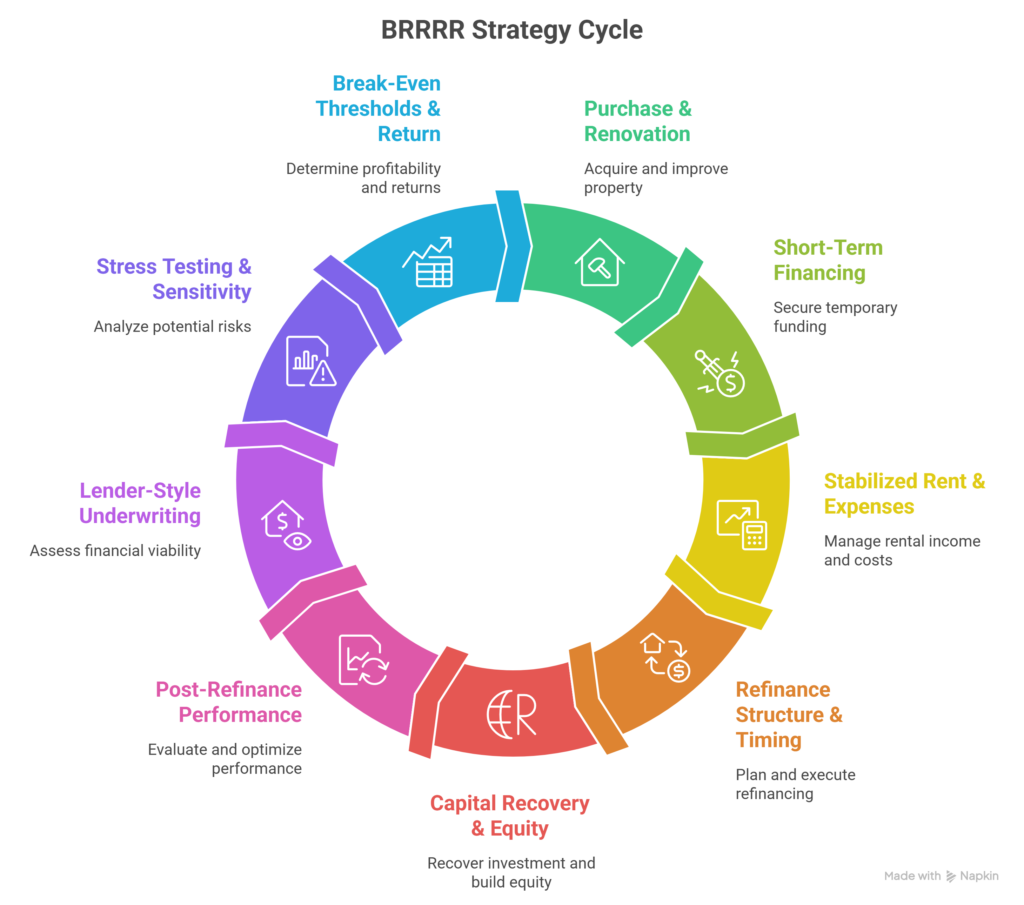
The BRRRR Analyzer goes much deeper. It connects the full chain:
- Purchase + renovation costs
- Short-term financing and carrying costs
- Stabilized rent and operating expenses
- Refinance structure and timing
- Capital recovery and remaining equity
- Post-refinance performance
- Lender-style underwriting (DSCR)
- Stress testing and sensitivity
- Break-even thresholds and total return
Instead of asking:
“Does this property cash flow?”
You’re now asking:
“Does this deal survive reality?”
And that’s a completely different question.
Why This Analyzer Is Different
It Separates Investor Reality from Lender Reality
Most investors run optimistic numbers.
Lenders don’t.
This analyzer gives you both:
- Property (Actual) View → what the deal really produces
- Lender-Style View → what a lender might accept
That includes:
- Rent haircuts
- Expense floors
- Optional hard cost layering
- DSCR screening
So instead of being surprised at refinance…
you already know where the deal stands.
It Models the Refinance Properly (This Is Huge)
Most calculators treat refinance like a checkbox.
This one treats it like what it actually is:
the defining moment of the BRRRR strategy.
You can model:
- Refinance timing (Year 1 → Year 5)
- Projected ARV growth
- Rent growth tied to timing
- Actual payoff balances
- Refinance costs
- Net cash-out proceeds
That means you can answer:
- Should I refinance in Year 1… or wait until Year 3?
- Will I actually pull my money out?
- What’s left in the deal after everything settles?
It Forces You to Face Peak Cash Exposure
Here’s something most investors underestimate:
It’s not just how much you invest…
it’s how much cash is tied up before refinance.
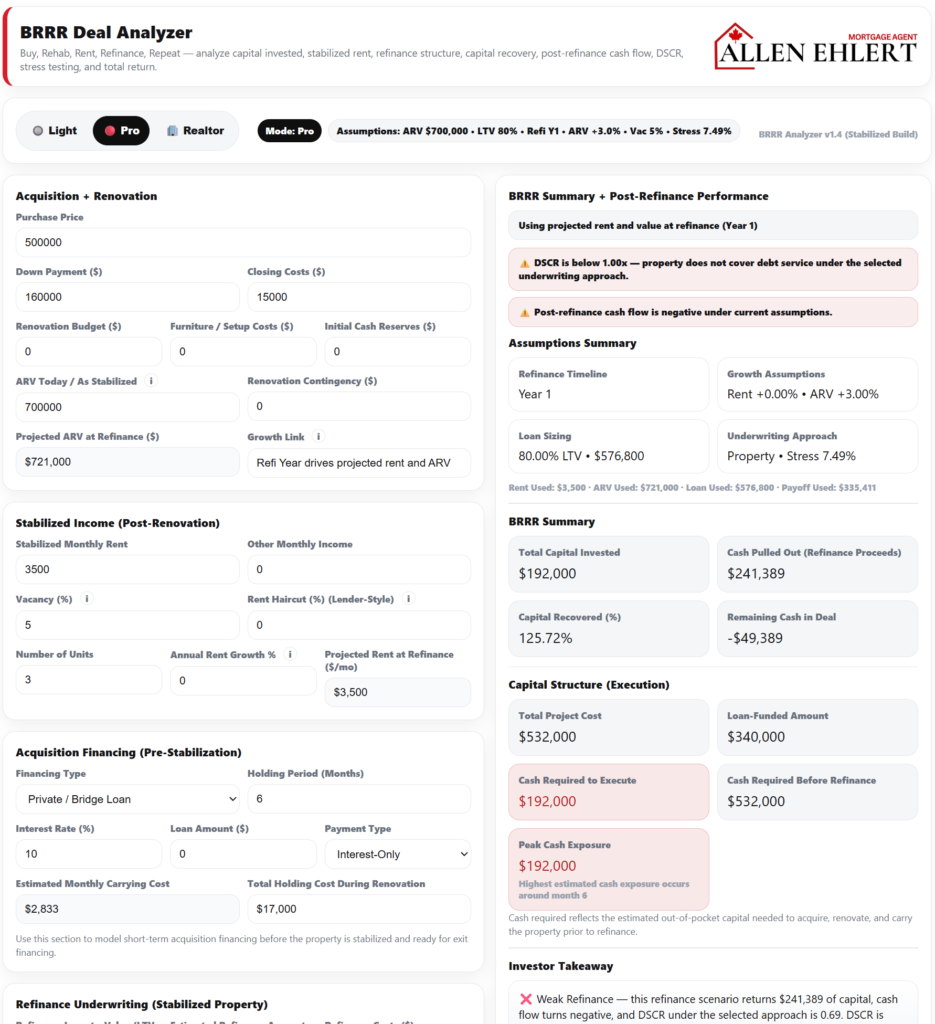
This analyzer explicitly shows:
- Cash required to execute
- Cash required before refinance
- Peak cash exposure
That’s real-world investing.
Because a deal that looks great on paper can still fail if you run out of liquidity halfway through.
It Doesn’t Just Show Profit — It Shows Fragility
This is where it really shines.
With built-in:
- Stress testing (rate increases)
- Rent drops
- Vacancy increases
- Expense inflation
You can see how quickly a deal breaks.
Because let’s be honest—
deals don’t fail in perfect conditions.
They fail when:
- rates move
- tenants turn
- costs creep up
This tool shows you that before you commit.
Different Users, Different Power
For Investors: Clarity Over Confidence
As an investor, your biggest risk isn’t bad deals—it’s misunderstood deals.
This analyzer helps you:
- See how much capital you actually recover
- Understand what’s left in the deal
- Evaluate real cash-on-cash return
- Stress test your assumptions
Instead of saying:
“I think this works…”
You can say:
“I know exactly how this performs in multiple scenarios.”
For Realtors: Turn Conversations into Authority
Imagine sitting with a client and instead of saying:
“This could be a great BRRRR…”
You show them:
- Cash-out projections
- DSCR viability
- Break-even rent
- Stress-tested performance
Now you’re not just showing properties—
you’re guiding investment decisions.
That’s how you differentiate yourself instantly.
For Real Estate / Financial Analysts: From Assumptions to Structured Insight
If you approach deals from an analytical or advisory perspective, this tool becomes a framework for disciplined evaluation, not just a calculator.
You can use it to:
- Build structured investment scenarios
- Compare refinance timing strategies (Year 1 vs 3 vs 5)
- Evaluate capital efficiency and recovery rates
- Analyze sensitivity to macro variables like rates and rents
- Translate deal assumptions into measurable outputs
Instead of presenting static projections, you’re now presenting dynamic scenarios.
For example:
An analyst reviewing a multi-unit BRRRR deal might:
- Run a base case with current assumptions
- Layer in lender-style DSCR adjustments
- Apply stress testing (rate + vacancy)
- Compare outcomes across refinance timelines
Now the conversation shifts from:
“Here’s what we think will happen…”
to:
“Here’s how this deal behaves under multiple conditions.”
That’s a completely different level of insight—and credibility.
How to Use the Analyzer Properly
When you sit down with a deal, follow this flow:
- First, input acquisition and renovation costs
- Second, enter stabilized rent and realistic vacancy
- Third, model your short-term financing and holding period
- Fourth, define ARV and select your refinance timing
- Fifth, input operating expenses (itemized or ratio)
- Sixth, structure the refinance and payoff
- Seventh, review capital recovery and cash left in the deal
- Eighth, evaluate DSCR and lender-style results
- Ninth, apply stress testing and sensitivity
- Tenth, compare refinance timing scenarios
If you skip steps, you’ll get incomplete answers.
A Story: When “Looks Good” Isn’t Good Enough
I had a client—let’s call him Jason.
He brought me a BRRRR deal and said:
“Allen, this one’s a no-brainer.”
On paper:
- Strong rent
- Solid ARV
- Good neighborhood
But when we ran it through the analyzer:
- The refinance proceeds were lower than expected
- DSCR barely cleared lender thresholds
- A 1% rate increase pushed it negative
- Peak cash exposure was higher than he was comfortable with
Same deal.
Different clarity.
Jason didn’t kill the deal—he restructured it:
- Adjusted renovation scope
- Negotiated purchase price
- Waited longer before refinance
Result?
A deal that didn’t just “look good”…
it actually worked.
How Realtors Can Use This With Clients
Picture this scenario:
You’re showing a duplex to a client interested in BRRRR.
Instead of just talking features, you say:
“Let’s run this through a BRRRR Analyzer and see what it actually does.”
You walk them through:
- Purchase → renovation → refinance
- Cash-out potential
- Remaining capital
- Cash flow
- Stress scenarios
Now your client isn’t guessing.
They’re making a data-backed decision—with you as the trusted guide.
How Clients Can Use This to Make Better Decisions
Clients can use this tool to:
- Compare multiple properties objectively
- Understand risk before committing
- Avoid overleveraging
- Plan capital requirements realistically
- Decide whether to hold, refinance, or walk away
It turns emotion-driven decisions into structured ones.
Allen’s Final Thoughts
At the end of the day, BRRRR isn’t about finding deals—it’s about understanding them properly.
This analyzer gives you something most investors don’t have:
Clarity across the entire deal lifecycle.
It forces you to:
- Think like an investor
- See like a lender
- Stress like reality
And when all three align—that’s when you know you’ve got something solid.
How I Help You Take This Further
As a mortgage agent, I don’t just help you get financing—I help you structure deals that actually work.
I can help you:
- Review your BRRRR deals using this analyzer
- Identify refinance risks before they become problems
- Structure financing strategies (A, Alt, Private, Bridge)
- Improve DSCR positioning
- Optimize refinance timing
- Work with realtors and planners to build stronger deals
If you’re looking at a BRRRR deal and want a second set of expert eyes on it—
I’m here to help you break it down, pressure test it, and move forward with confidence.