As a mortgage agent, I’ve had countless heart-to-heart conversations with homebuyers, especially first-time buyers, who’ve walked away from a bidding war feeling discouraged, defeated, and more than a little frustrated. They saw a home listed within their budget, got excited, toured it, maybe even mentally moved in… only to see it sell for $150,000 more than the asking price. If this sounds familiar, you’re not alone.
Buying your first home should feel exciting—it’s a milestone worth celebrating. But in many parts of Canada, especially in competitive markets like the GTA, the listing practices used by some sellers and realtors can make the process feel like an emotional rollercoaster. One of the most frustrating tactics? The “list low, sell high” strategy.
Allow me to break it down—and let’s also talk about why, even though this strategy can be emotionally exhausting, it doesn’t mean you’re being misled or taken advantage of.
What is the List Low, Sell High Strategy?
Why Homes Are Listed Below Market Price
The Emotional Toll on First-Time Buyers
How to Navigate This as a First-Time Buyer
What is the List Low, Sell High Strategy?
The “list low, sell high” strategy is a real estate marketing approach where a home is intentionally listed below its estimated market value to attract a large number of buyers and generate competitive offers—often resulting in the property selling for significantly more than the asking price.
Here’s how it works:
- The seller and their realtor set an asking price that’s deliberately lower than what the home is actually worth in the current market.
- This creates a sense of urgency and opportunity—especially among first-time buyers who believe the home may be within reach.
- The listing attracts more showings, more attention online, and more buyer interest overall.
- Often, there is a set “offer day” during which the seller’s agent collects all submitted offers at once.
- Because multiple buyers are now competing, the property is often sold in a bidding war, which can push the sale price well above the original list price.
Why Homes Are Listed Below Market Price
When a home is intentionally listed below what it’s likely to sell for, the goal is simple: attract attention. The lower the price, the bigger the buyer pool. That means more showings, more interest, and, ideally, more offers. When multiple buyers compete, emotions take over, and people often offer more than they intended just to “win.”
This strategy is especially common in hot markets, and unfortunately, it works—often very well. The home may be listed at $749,000, but the sellers and their realtor know full well that it’s going to sell in the $900,000s. That listing price? It was never a reflection of the true market value—it was bait.
The Emotional Toll on First-Time Buyers
For a first-time buyer, especially someone who’s scrimped and saved for years to pull together a down payment, this practice can feel cruel.
You see the listing price and do the math. Working together, I get you a pre-approval or rate hold (same thing) with the lender who is right for you. You go to the open house or see the house with your realtor. You fall in love. You make an offer—maybe even over asking—and still, it’s not enough. The house sells for far more than you expected, and you’re left feeling like homeownership is slipping further and further away.
And then it happens again. And again.
I get it. I’ve sat across from clients who ask, “How is this even allowed?” or “What’s the point of a list price if it means nothing?” “Isn’t this bait-and-switch”? And those are fair questions. This strategy feels misleading, and while it’s not illegal, it can certainly feel unfair—especially to buyers trying to make informed, rational decisions.
Market Value Always Wins
Here’s the part that’s important to remember: Regardless of the pricing strategy used, every home sells for its true market value.
Market value isn’t what a seller wants or what a buyer hopes for. It’s what a qualified buyer is willing to pay in an open market, given full information and enough time. If a home sells for $950,000, that is its market value—because someone was willing to pay that price, and no one bid higher.
Whether a home is listed at $999,000 or $699,000 doesn’t actually affect what it’s worth. The market determines that. The frustration comes when the list price gives you false hope.
How to Navigate ‘List Low, Sell High’ as a First-Time Buyer
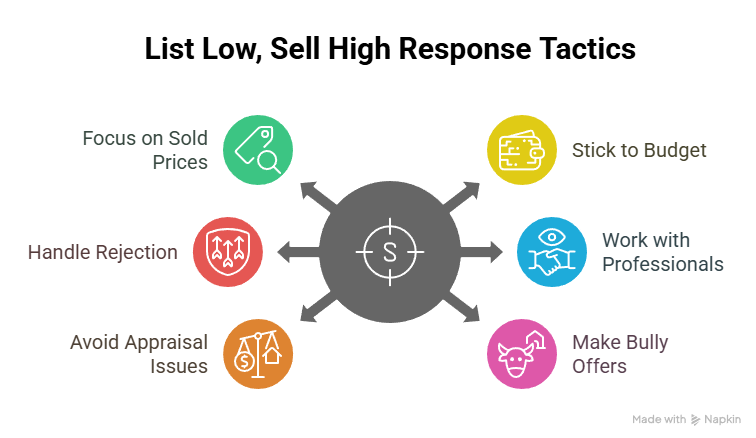
Here are a few ways you can protect your sanity (and your wallet) while shopping in a market that uses this strategy:
- Focus on Sold Prices, Not List Prices
- Know Your Budget and Stick to It
- Don’t Let Rejection Get Personal
- Work With Professionals Who Have Your Back
- Appraisal Nightmare: Don’t Get Carried Away
- Make a ‘Bully Offer’
Focus on Sold Prices, Not List Prices
Your realtor should help you look at what similar homes have sold for—not what they’re listed at. That’s where the truth lies. If the last three homes on the street sold for $950,000, and you see a similar one listed at $799,000, assume that’s the floor—not the ceiling.
Know Your Budget and Stick to It
It’s easy to get caught up in the heat of a bidding war. Let’s work together and set a firm maximum budget and don’t deviate from it—no matter how emotionally attached you get to a property. Remember, other homes will come on the market too. Patience, preparation, and diligences are key.
Don’t Let Rejection Get Personal
It’s not you. Truly. In a market with multiple offers, you might have the perfect offer—and someone else might still outbid you with an unconditional offer, a crazy offer, or deeper pockets. That doesn’t mean you won’t find your home. It just means the right one hasn’t come along yet. I always say, your home picks you.
Work With Professionals Who Have Your Back
A good mortgage agent and realtor can help you spot underpricing tactics, estimate likely sale prices, and prepare a winning offer when the time is right. It’s not just about the money—it’s about the strategy, too.
Appraisal Nightmare: Don’t Get Carried Away
Don’t win the battle and lose the war! It’s not enough to win the bidding war only to lose the house and worse when you’ve paid too much over market, the lender’s appraisal comes up short, and the lender pulls financing. Remember, your mortgage is based on the lender’s appraisal, not what you paid for the home. Now what are you going to do? You quickly learn a pre-approval doesn’t actually pre-approve you for anything; it’s just a rate hold.
So stick to your budget and stick to your game plan. Work with me so that you don’t win the house but lose the mortgage financing.
Make a ‘Bully Offer’
Making a bully offer—also called a pre-emptive offer—is a bold move in a competitive real estate market. It’s when a buyer submits a strong offer before the scheduled offer presentation date in hopes of convincing the seller to accept it early and avoid a bidding war.
It can work, but it needs to be executed strategically, quickly, and professionally.
Here’s how the process works from beginning to end:
Before you even think about a bully offer, make sure you:
- Have a firm mortgage pre-approval in hand
- Know your maximum budget
- Understand the risks of going in firm (with no financing or inspection conditions)
You’ll be moving fast, so financial certainty is essential. As your mortgage agent, I can help ensure you’re 100% ready to act.
Bully offers only work if the seller is caught off guard—in a good way. You typically:
- Submit the offer within 24-48 hours of the listing going live
- Include a short irrevocable period (e.g., 4-6 hours) to force a quick decision
- Don’t give the seller or other buyers time to regroup
Speed is your advantage here, so preparation is key.
Bully offers are most effective when:
- The property is clearly underpriced (List low, sell high)
- You have no major conditions
- You’re comfortable being firm and aggressive
For first-time buyers, it’s a high-risk, high-reward strategy. But with the right team—an experienced mortgage agent and a savvy realtor—you can make it work.
You’re Not Alone in This
Every homebuyer has a story of the one that got away. But the buyers who stay the course, stay realistic, and stay educated are the ones who eventually succeed. Every battle is won before it is ever fought. I’ve worked with dozens of first-time buyers who lost out on homes they loved, only to find one that was better, more affordable, and didn’t require them to throw all their savings into a blind bidding war.
The market can be tough, but it’s not unbeatable. And when you finally get the keys to a home that’s yours—one that fits your budget and your needs—it will all have been worth it.
Summary
If you’re feeling frustrated by the buying process, especially around the way homes are priced and sold, let’s talk. As a mortgage agent I can help you make sense of your numbers and create a game plan that keeps you informed, prepared, and optimistic—even in a market that sometimes feels like it’s stacked against you.
You’ve got this. And I’ve got your back.