Foreign buyers who have paid the 25% Non-Resident Speculation Tax (NRST) may be eligible for a full rebate if they meet specific residency, employment, or education requirements within a set period. The Ontario government provides these rebates to encourage long-term residency and economic contribution while ensuring the tax primarily affects speculative investors rather than legitimate immigrants or workers.
Who is Eligible for an NRST Rebate?
NRST Rebate Option 1: Becoming a Permanent Resident
NRST Rebate Option 2: Full-Time Employment in Ontario
NRST Rebate Option 3: Full-Time Student in Ontario
How to Apply for an NRST Rebate
Common Reasons for NRST Rebate Denials
Impact of the NRST Rebate on Foreign Buyers
Who is Eligible for an NRST Rebate?
To qualify for an NRST rebate, the foreign buyer must meet one of the following criteria within four years of purchasing the property:
Becoming a Permanent Resident (PR) of Canada.
Working Full-Time in Ontario for at least one year.
Studying Full-Time in Ontario for at least two consecutive years.
If a buyer meets any of these conditions, they can apply for a full refund of the 25% NRST paid.
NRST Rebate Option 1: Becoming a Permanent Resident
One of the most straightforward ways to obtain an NRST rebate is by obtaining Canadian permanent residency (PR) within four years of purchasing the property.
Eligibility Criteria:
- The buyer must have applied for and received PR status within four years of the purchase date.
- The applicant must continue to hold ownership of the property when applying for the rebate.
- The property must have been used as their principal residence since purchase.
Example Scenario:
- A foreign buyer purchases a $800,000 home in Ontario and pays $200,000 in NRST (25%).
- Within three years, they obtain permanent residency and apply for a rebate.
- The Ontario government refunds the entire $200,000 since they met the eligibility conditions.
Key Considerations:
- Timing is crucial—PR status must be achieved within four years of the purchase.
- If PR is still being processed after four years, the rebate may be denied.
- Proof of occupancy and residency is required.
NRST Rebate Option 2: Full-Time Employment in Ontario
Foreign buyers can also qualify for an NRST rebate by proving they have worked full-time in Ontario for at least one continuous year after purchasing the property.
Eligibility Criteria:
- The applicant must have been employed full-time (30+ hours per week) for a Canadian employer in Ontario.
- The employment must have been continuous for at least one year.
- The buyer must have used the property as their primary residence.
Example Scenario:
- A foreign buyer purchases a $600,000 property in Ontario and pays $150,000 in NRST.
- They secure a full-time job in Toronto, earning $90,000 per year.
- After one year of continuous employment, they apply for the rebate and receive the full $150,000 refund.
Key Considerations:
- Self-employed individuals do NOT qualify for this rebate.
- Employment must be verified through pay stubs, tax filings, and employer letters.
- Gaps in employment (even short ones) can result in a denial of the rebate application.
NRST Rebate Option 3: Full-Time Student in Ontario
International students may be eligible for an NRST rebate if they have studied full-time for at least two consecutive years at an approved Ontario post-secondary institution.
Eligibility Criteria:
- The applicant must have been enrolled full-time in an approved program.
- The study period must be at least two consecutive years after the purchase.
- The property must have been used as the student’s primary residence during this time.
Example Scenario:
- An international student purchases a $500,000 condo in Ontario and pays $125,000 in NRST.
- They complete a two-year Master’s degree at the University of Toronto.
- They apply for the rebate and receive the full $125,000 refund.
Key Considerations:
- Only approved institutions qualify (universities, community colleges, and some private colleges).
- Part-time students do not qualify.
- Proof of enrollment (transcripts, tuition receipts) is required.
How to Apply for an NRST Rebate
Once eligibility criteria are met, foreign buyers can apply for the rebate by following these steps:
Step 1: Gather Required Documents
- Copy of the property deed or purchase agreement
- Proof of NRST payment (tax receipt from closing)
- Supporting documents based on the rebate category:
- Permanent Residents: PR confirmation, residency documents
- Workers: Employment letters, pay stubs, tax filings
- Students: Enrollment letters, transcripts, tuition receipts
Step 2: Submit the Rebate Application
- Applications must be sent to the Ontario Ministry of Finance.
- Forms can be downloaded from the Ontario government website.
- All applications must be submitted within four years of the purchase date.
Step 3: Wait for Processing
- The government typically processes applications within 4-6 months.
- If additional documentation is needed, delays may occur.
Common Reasons for NRST Rebate Denials
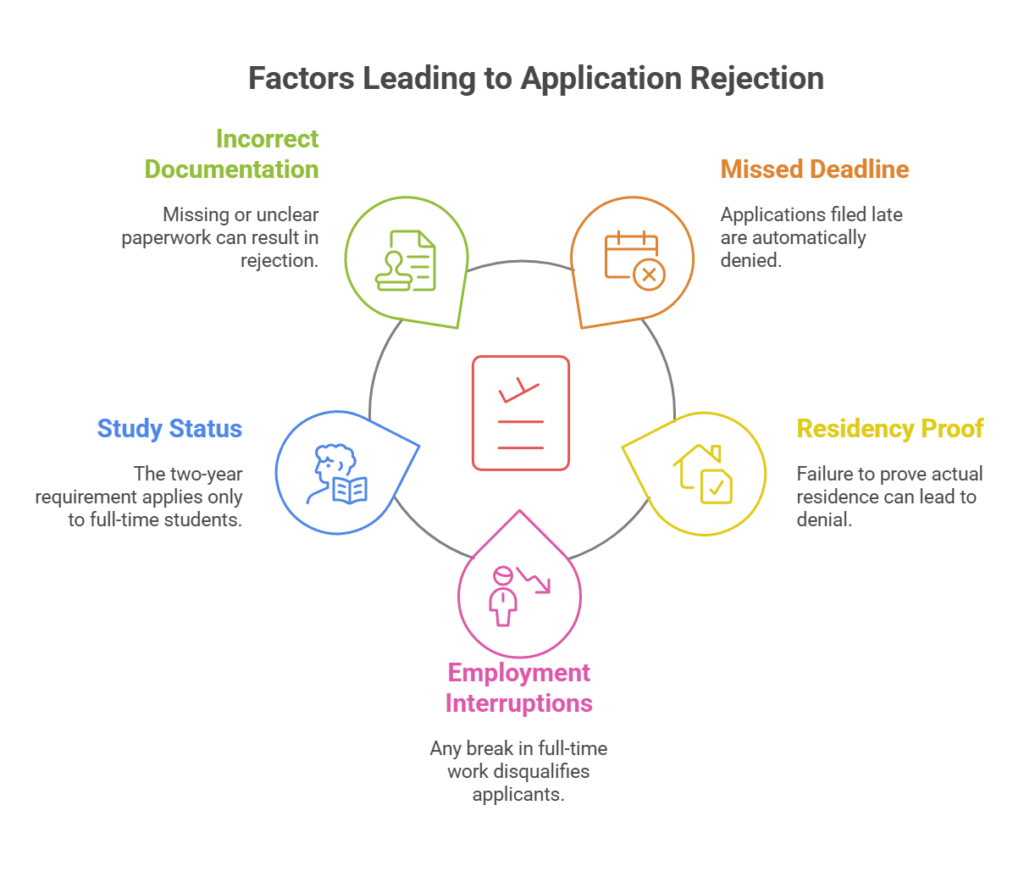
Not all applications are approved. Some common reasons for rejection include:
- Missed the four-year deadline – Applications filed late are automatically denied.
- Failure to prove residency – If the buyer did not actually live in the home, the rebate may be denied.
- Employment interruptions – Any break in full-time work can disqualify the applicant.
- Part-time study status – The two-year requirement applies only to full-time students.
- Incorrect documentation – Missing or unclear paperwork can result in rejection.
TIP: Buyers should consult a real estate lawyer to ensure they meet all criteria before applying.
Impact of the NRST Rebate on Foreign Buyers
The availability of an NRST rebate makes Ontario more attractive to long-term foreign residents who intend to live, work, or study in Canada. However, speculative investors do not benefit, which aligns with the tax’s purpose of discouraging short-term foreign speculation.
- Encourages foreign talent and skilled workers to settle in Ontario.
- Helps international students transition to homeownership.
- Prevents short-term speculation while rewarding long-term commitment.
At the same time, the strict eligibility requirements mean that only a small percentage of foreign buyers actually receive a rebate.
READ MORE
Understanding Ontario’s Non-Resident Sales Tax
Understanding the Federal Ban on Foreign Buyers
Non-Resident Speculation Tax and Mortgage
Non-Resident Speculation Tax Rebate
Summary
The NRST rebate program provides an opportunity for foreign buyers who have contributed to Ontario’s economy to recoup their tax costs—but only if they meet specific residency, employment, or education requirements.
Key Takeaways:
- Foreign buyers must live in the home and meet eligibility within four years.
- Permanent residents, full-time workers, and students can apply for rebates.
- Applications must be submitted on time with proper documentation.
For foreign buyers considering an Ontario property purchase, understanding the NRST rebate options before closing a deal can help with financial planning and investment strategy.