Home buying is a naturally expensive thing to be doing. You not only have to pay for the house, but you have substantial closing costs as well. You might want to make your new house ‘home ready’ by getting a few new pieces of furniture and don’t forget new window coverings like blinds, drapes, and curtains (never cheap). Wouldn’t it be nice to get a few thousand dollars back when you fund your mortgage to cover these costs?
Sounds great right?
Thinking about a cash back mortgage? A mortgage with cash back gives you a tax-free sum when you close. This can be very tempting.
But there’s more to think about. The quick cash benefit might come with a higher cost. You might pay more in interest over time. Knowing this can help you decide if it fits your financial plans.
Pros and Cons of Cash Back Mortgages
High Ratio and Cash Back Mortgages
Key Takeaways
- A cash back mortgage provides a tax-free lump sum at mortgage closure.
- This type of mortgage is useful for covering initial costs such as furniture and closing fees.
- A mortgage with cashback often comes with higher interest rates.
- Understanding the long-term financial implications is crucial before committing.
- This mortgage type may be ideal if you need immediate financial relief at the expense of higher costs over time.
Reality Check
A cash back mortgage is a mortgage where the lender offers to give you ‘cash back’ when you close or fund your mortgage. In exchange for this cash back (because there is nothing free in this world), the lender, usually a bank because they are the ones who are big on ‘cash backs’, charges you a higher interest rate on your mortgage (told you nothing is for free). You can use this money to pay for your closing costs, make purchases for your new home, pay down the principal of your mortgage with your cash back funds (if allowed), or even invest the cash for a higher rate than what you pay on your mortgage.
To my mind, cash back isn’t getting free cash or a cash rebate for getting your mortgage with a particular bank or even switching or refinancing with them (they have cash backs for those too). A cash back is a way to give you money now that the bank will recoup over the term of your mortgage, so it is not free money or a rebate by any means.
You have to start by doing the math, comparing interest cost on you’re a mortgage without cash back, then comparing interest cost of the mortgage over the term with cash back. Generally, a cash back mortgage has interest rates approximately .5% to 2% higher than a no cash back mortgage.
Cash Back Example
Let’s say a bank is offering a client a $2,100 cash back on a $700,000 5-year fixed mortgage at 5.2%, or a non cash back mortgage at 4.5%. Which is the better deal? Which should you take?
Interest Expense: cash back mortgage………..………………. $170,560.42
Interest Expense: non-cash back mortgage …………..……. $147,033.37
Difference between mortgages? ………………………….…….. $ 23,527.05
Cash back ……………………………………………………………..………$2,100
Advantage Non-Cash Back Mortgage by $21,427.05
When you do the math, you usually find that the cash back mortgage is not the best option.
Now to be fair, many will advise their clients to put the cash back they receive upon funding against the principal of their mortgage (if the mortgage product will allow them) thereby lowering the total interest expense over the term of the mortgage. However, you’ll usually find that doesn’t move the number much:
Interest Expense: cash back mortgage (cash back applied against principal)…. $169,853.82
Lender Example
See the following rate table from a Prime lender below:
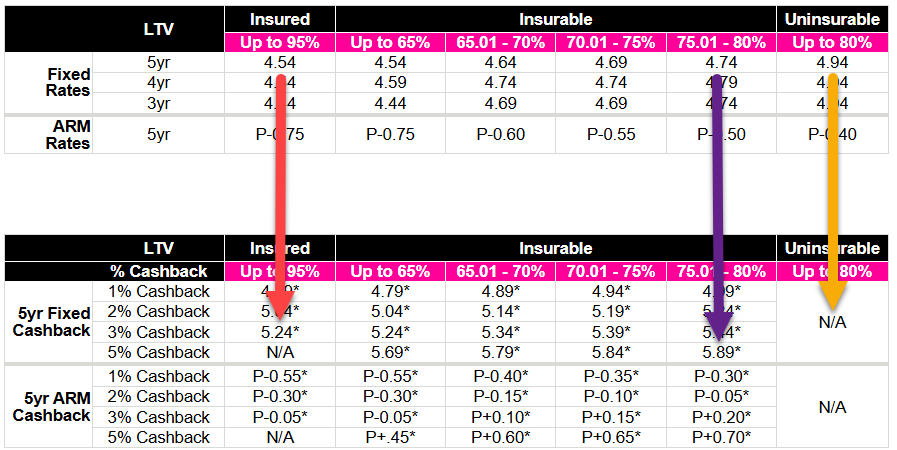
(Red Arrow) Notice how an insured, 5 year fixed mortgage at up to 95% loan-to-value (LTV) is offered at 4.54%, but when 3% cashback is requested, the rate goes to 5.24%.
(Purple Arrow) Notice how an insurable, 5 year fixed mortgage between 75 to 80% LTV is offered at 4.74%, but when 5% cashback is requested, the rate goes to 5.89%.
(Yellow Arrow) Notice how an uninsurable, 5 year fixed mortgage up to 80% LTV is offered at 4.94%, but when any cashback is requested, nothing is offered by the lender; they won’t do a cashback on an uninsurable mortgage.
Risk
If something happens in your life and you need to break the mortgage before the term ends, you will have to repay some but frequently all of the cash back. If you’ve already applied it to the principal, you’ll need other funds to cover the repayment.
What this means is that you will have paid a higher interest rate for a cash back that you’ll have to give back. So, it is a double the loss, double the pain.
Banks know that approximately 60% of Canadians break their mortgage before the end of their term, with the average break occurring around the 36-month mark. Consequently, lenders work this reality (a reality most Canadians never consider because they think it won’t happen to them) into their calculations. Cash back is a great-sounding offering to their customers; the name sounds like you are getting a rebate just because you got a mortgage with a particular bank. Unfortunately, customers end up paying a higher interest rate on a cash back mortgage that many, if not most, will have to give back on top of mortgage penalties for breaking the mortgage.
Know the risk!
Pros and Cons of Cash Back Mortgages
Thinking about a cash back mortgage can change how you manage your money and meet urgent needs. But, like any financial product, it has its good and bad sides. Let’s explore both to help you decide wisely.
Advantages
One big plus of choosing the best cash back mortgage is getting money right away. This is great for those who need cash for home fixes, moving costs, or other urgent money needs. Also, these mortgages often have lower interest rates than other loans, saving you money in the long run.
- Immediate availability of cash upon mortgage approval.
- Lower interest rates compared to personal loans or credit card advances.
- Flexibility to use the cash for various purposes, such as home improvements or debt consolidation.
Disadvantages
However, cash back mortgages also have downsides. They usually come with higher mortgage rates. This means you’ll likely pay more each month over time. Plus, you need a solid credit score to qualify, and there are conditions to repay the cashback if you sell or refinance early.
- Higher mortgage rates compared to standard mortgages.
- Stringent qualification criteria, requiring an excellent credit score.
- Obligations to repay the received cashback if you break the mortgage contract early.
Knowing the pros and cons of a cash back mortgage helps you see if it fits your financial plan. Whether for quick cash or cash back refinancing, weighing these points helps you choose the right mortgage for you.
Alternatives to Cash Back Mortgages
There are other options besides cash back mortgages. For example, the RRSP Home Buyers’ Plan lets you use up to $60,000 from your RRSPs for a home. You won’t pay taxes on it, but you must repay it within a certain time.
Another choice is the readvanceable mortgage. It’s a mix of a mortgage and a home equity line of credit (HELOC). This lets you borrow from your home’s equity as you pay down your mortgage. It might be cheaper than a cash back mortgage.
Here’s a table to help you see the differences:
| Type | Interest Rates | Immediate Cash Benefits | Long-term Costs |
| Cash Back Mortgage | Higher | Yes | Greater |
| Standard Mortgage | Lower | No | Lesser |
| RRSP Home Buyers’ Plan | N/A | Conditional | Potentially Lower |
| Readvanceable Mortgage | Variable | No | Moderate |
When looking at cash back mortgage rates, think about both now and later. Consider your needs and get advice. This way, you can pick the mortgage that fits your goals best.
Cash Back Mortgage Eligibility Criteria
When looking into a cash back mortgage, knowing the eligibility criteria is key. Your credit score is a big deal. Lenders want higher scores for cash back mortgages because they’re taking on more risk. A good credit history shows you can handle debt well.
The down payment is also important. You might need to put down more money than usual. This helps lower the lender’s risk and can get you better terms.
Lenders also check your financial health. They look at your income and how much debt you have. Having a steady income and not too much debt can help you get a cash back mortgage. Here’s what you need to know:
| Eligibility Criteria | Details |
| Credit Score | Higher credit scores (typically 700+) |
| Down Payment | Potentially higher than traditional mortgages |
| Income Stability | Consistent and reliable income sources |
| Debt-to-Income Ratio | Lower ratios preferred by lenders |
Understanding and meeting these criteria can boost your chances of getting a cash back mortgage. This unique product can offer big benefits. Make sure your financial profile is strong and attractive to lenders.
High Ratio and Cash Back Mortgages
It’s possible to get a cash-back mortgage in Canada even if your mortgage requires mortgage default insurance (e.g., CMHC, Sagen, or Canada Guaranty). However, there are specific factors and limitations to consider:
- Mortgage Default Insurance
- Cash Back on Insured Mortgages
- Conditions from Insurers
Mortgage Default Insurance
Mortgage default insurance is required for high-ratio mortgages where the down payment is less than 20% of the purchase price. The insurance premium is added to the mortgage balance and amortized over the term.
Cash Back on Insured Mortgages
Lenders offering cash-back mortgages can do so for insured mortgages, but the cash back is typically calculated as a percentage of the base loan amount before the insurance premium is added.
Conditions from Insurers
Mortgage insurers (e.g., CMHC, Sagen, or Canada Guaranty) generally allow cash-back mortgages as long as the borrower meets the eligibility requirements.
The cash-back amount cannot be used as part of the minimum down payment but can be used for closing costs, renovations, or other expenses.
Key Considerations:
- As with all cash-back mortgages, the interest rate will typically be higher than a standard fixed or variable-rate mortgage. This can increase the overall cost of borrowing.
- If you break the mortgage early, the lender may require you to repay all or part of the cash-back amount.
- Some lenders may have specific restrictions or conditions for cash-back mortgages on insured loans. For example, certain lenders may limit the cash-back percentage for insured mortgages.
- The slightly higher interest rate and added insurance premium may impact your debt service ratios, which are crucial for qualification.
The cash back would not affect the down payment requirement but can help with other costs. For example, in Ontario, there is provincial sales tax on the insurance premium. Funds from the cash back can be used to pay for the provincial sales tax as it cannot be added to the mortgage and must be paid at closing.
Cash-back mortgages are possible with insured mortgages in Canada. It’s essential to assess the higher interest cost and confirm terms with both your lender and the mortgage insurer.
Summary
We live in a time where affordability is the challenge of the day. Many buyers, especially first-time buyers really have to stretch to be able to buy their first home. In some situations, a cash back mortgage does provide the solution to get a client into a home, especially if there are no more sources of funds to access to pay for closing costs.
In most cases, it all comes down to doing the math. Frequently, a cash back mortgage is the more expensive option when one looks at the rate difference between cash back/rebate mortgages and regular mortgages.
Consider all options when determining which mortgage is right for you.