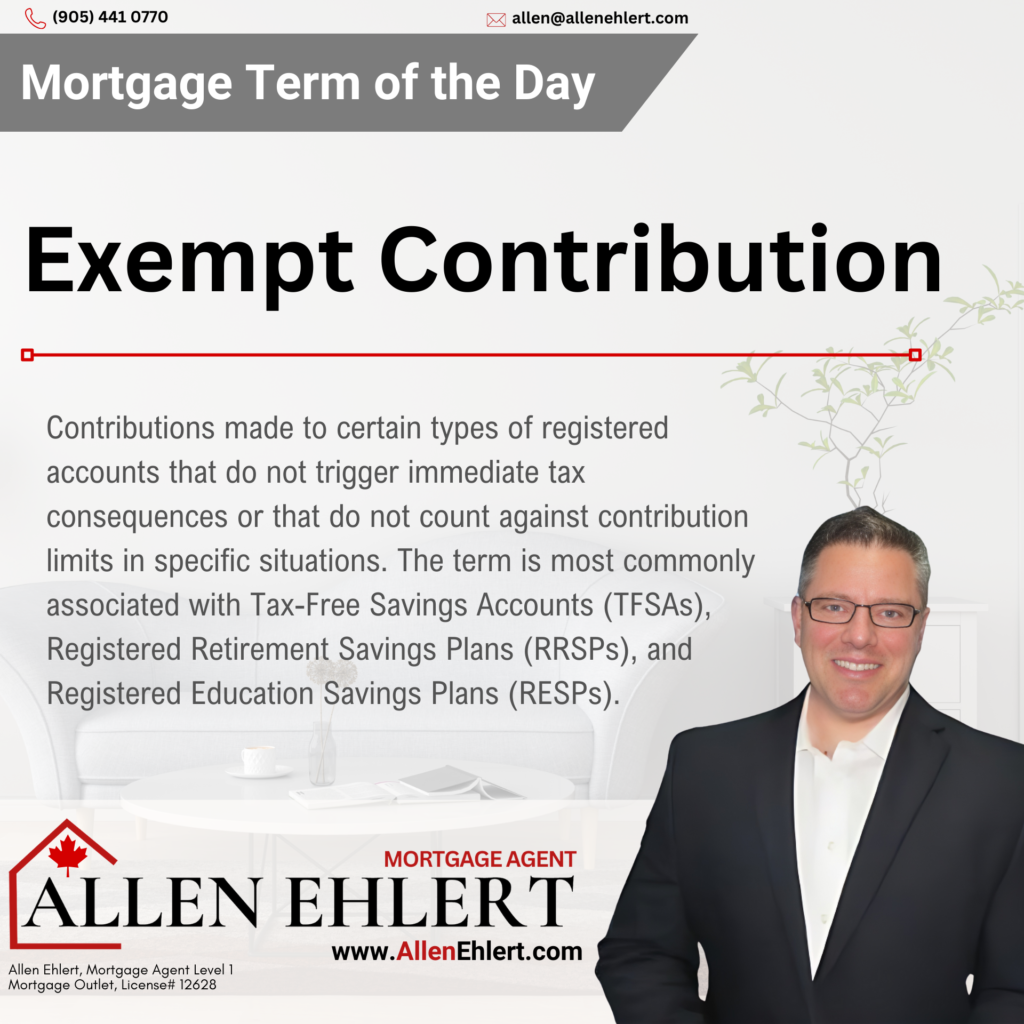
In Canada, an exempt contribution typically refers to contributions made to certain types of registered accounts that do not trigger immediate tax consequences or that do not count against contribution limits in specific situations. The term is most commonly associated with Tax-Free Savings Accounts (TFSAs), Registered Retirement Savings Plans (RRSPs), and Registered Education Savings Plans (RESPs).
Exempt Contributions in Various Contexts
Exempt Contributions and Mortgages
Exempt Contributions in Various Contexts
- TFSA (Tax-Free Savings Account)
- RRSP (Registered Retirement Savings Plan)
- RESP (Registered Education Savings Plan)
TFSA (Tax-Free Savings Account)
Generally, contributions to a TFSA are subject to annual limits. However, if you withdraw funds from a TFSA, the amount you withdraw is added back to your contribution room in the following year, effectively making it an “exempt contribution” when re-contributed.
RRSP (Registered Retirement Savings Plan)
In certain cases, contributions to an RRSP are considered “exempt” if they are made as part of specific programs, such as the Home Buyers’ Plan (HBP) or the Lifelong Learning Plan (LLP). Under the HBP, for example, you can withdraw up to $35,000 from your RRSP (if you are purchasing with a spouse or partner, both of you can each withdraw up to $35,000 for a combined total of $70,000) to purchase your first home, and you must repay this amount over 15 years. These repayments are considered “exempt contributions” because they do not count against your annual RRSP contribution limit.
RESP (Registered Education Savings Plan)
In an RESP, “exempt contributions” could refer to the rollover of funds from one RESP to another under specific conditions, such as when changing the beneficiary, without affecting the overall contribution limits.
Exempt Contributions and Mortgages
Exempt contributions can be directly or indirectly related to mortgages in several important ways
Home Buyers’ Plan (HBP) and RRSP Exempt Contributions
The HBP allows first-time homebuyers to withdraw up to $35,000 from their RRSP without immediate tax consequences, as long as the amount is repaid over time. The repayments are exempt contributions because they do not reduce your RRSP contribution room for that year. This mechanism can provide a significant source of funding for a down payment on a home, making it easier to secure a mortgage and potentially reduce the mortgage amount.
- TFSA Withdrawals and Re-Contributions
- Leveraging RRSPs for Mortgage Payments
- Estate Planning and Mortgage Payoff
- Tax Efficiency and Mortgage Affordability
TFSA Withdrawals and Re-Contributions
If you withdraw funds from your TFSA to use towards a mortgage down payment or other housing expenses, you can re-contribute the withdrawn amount in the following calendar year without losing your contribution room. This feature allows for flexible financial planning when managing mortgage-related expenses and long-term savings goals.
Leveraging RRSPs for Mortgage Payments
While direct RRSP withdrawals (outside of programs like the HBP) are generally taxable, understanding exempt contributions under the HBP can help first-time homebuyers manage their mortgage more effectively. By using RRSP savings for a down payment and then making exempt contributions to repay the amount, homeowners can strategically manage their finances to optimize their tax situation and mortgage obligations.
Estate Planning and Mortgage Payoff
In estate planning, the concept of exempt contributions can also relate to the management of registered accounts when paying off a mortgage. For example, strategic use of RRSPs or TFSAs, including understanding exempt contributions, can help ensure that funds are available to pay off a mortgage or reduce debt burdens for beneficiaries.
Tax Efficiency and Mortgage Affordability
Understanding the rules around exempt contributions can help individuals maximize their tax efficiency, which in turn can free up more funds for mortgage payments. This can be particularly important when planning large purchases like a home, where leveraging every available financial advantage can improve affordability and reduce long-term costs.
Summary
In Canada, exempt contributions refer to specific contributions made to registered accounts like RRSPs, TFSAs, or RESPs that either do not trigger tax consequences or do not count against annual contribution limits under certain conditions. In relation to mortgages, exempt contributions can play a crucial role in home buying, particularly through programs like the Home Buyers’ Plan, which allows first-time homebuyers to use RRSP savings for a down payment and then repay those amounts as exempt contributions. Understanding how to use exempt contributions effectively can help manage mortgage costs, enhance tax efficiency, and support long-term financial planning for homeownership.