… What Residential Mortgage Lenders Disallow Second Mortgagees
When borrowers or even brokers ask:
“Which lenders don’t allow second mortgages?”
They’re asking the wrong question.
Because in residential lending, the reality is this:
It’s not just the lender—it’s the loan type, the insurance status, and the mortgage contract that determine whether a second mortgage is allowed.
And in many cases, second mortgages are not just discouraged…
They are explicitly prohibited.
Allow me to get into it:
Insured Mortgages: Absolute “No”
First Mortgage Contract Restrictions (The Real Gatekeeper)
Major Banks (Schedule A Lenders): Practical “No”
“Silent Seconds”: Completely Illegal
HELOC and Collateral Charge Structures
When Consent Is Required (And Often Denied)
The Underlying Reason: Risk Hierarchy
When Lenders Are Most Likely to Say “No”
The Exception: When Second Mortgages Are Allowed

The Core Rule
Before we even get into lender categories, understand this:
A second mortgage is not automatically allowed just because you have equity.
Most first mortgages include legal clauses that:
- Restrict additional financing
- Require lender consent
- Or prohibit secondary encumbrances entirely
If you ignore that:
- You can trigger default on your first mortgage
- The lender can demand full repayment
This isn’t theory—this is how the contracts are written.
FSRA Enforcement
The Financial Services Regulatory Authority of Ontario (FSRA) reported in a recent Enforcement Annual Report, cited enforcement action outcomes for Forest City Funding Inc. (FCF) and William Handsaeme. During a supervisory examination, FSRA determined that FCF knowingly assisted borrowers in obtaining a second mortgage that contravened the terms and conditions of the first mortgage FSRA also determined that second mortgages were being used to pay back supposedly “gifted” down payments, contrary to the terms of the first mortgage commitments. The issue was communicated to FCF, but was not resolved when a follow-up examination was conducted.
In another enforcement action outcome, Jaswinder Dhanoa was a mortgage agent who submitted fraudulent downpayment and income verification documents to a lender on multiple occasions. Additionally, some properties had second mortgages contrary to the terms of the first mortgage and for amounts consistent with the fraudulent down payment. Ms Dhanoa received fees for these mortgages paid to her personal corporation outside of her authorizing mortgage brokerage. Following a settlement and the expiration of Ms Dhanoa’s licence, FSRA imposed AMPs totalling $52,000, reflecting the entire monetary gain.
Source: www.fsrao.ca
Insured Mortgages: Absolute “No”
This is the clearest category.
If the mortgage is insured:
- High-ratio (less than 20% down)
- Backed by insurers like:
- CMHC
- Sagen
- Canada Guaranty
Second mortgages are effectively not allowed
Why?
Because:
- The insurer must control risk completely
- The first mortgage must remain the sole secured position
- Additional registered debt increases default exposure
Even though second mortgages exist as a concept, insured structures are built to prevent layered risk.
First Mortgage Contract Restrictions (The Real Gatekeeper)
This is where most deals get blocked.
Even if a lender “technically allows” second mortgages, the mortgage agreement may not.
Most residential mortgage contracts include:
- “No further encumbrance” clauses
- Requirements for lender approval
- Restrictions on additional secured borrowing
Which means:
You must get consent from the first lender before adding a second mortgage.
If you don’t:
- It can be considered a breach
- It can trigger default
- The lender can “call” the mortgage
That’s not a grey area—it’s black and white.
Major Banks (Schedule A Lenders): Practical “No”
Let’s talk about behaviour—not marketing.
The major banks:
- RBC
- TD
- BMO
- Scotiabank
- CIBC
Will often say:
“Second mortgages may be allowed with consent”
But in practice:
They rarely approve them
Why?
Because from the bank’s perspective:
- They lose control over collateral
- Combined leverage increases risk
- Another lender is now behind them on title
And remember:
The first mortgage lender gets paid first in a default scenario.
Banks want to keep it that way—with no complications.
“Silent Seconds”: Completely Illegal
This is critical.
A silent second mortgage (undisclosed secondary financing): Is illegal in Canada
Why?
- The first lender must be aware of all secured debt
- Undisclosed borrowing distorts qualification
- It creates systemic risk
This is not just a policy issue—it’s a legal one.
HELOC and Collateral Charge Structures
This is where things get more nuanced.
Some lenders structure mortgages as:
- Collateral charges
- Readvanceable products (e.g., mortgage + HELOC)
In these cases:
The lender often locks down the title
Meaning:
- No additional lenders can register behind them
- They control all future borrowing
Even if it’s not explicitly stated, the structure itself:
Effectively disallows second mortgages
When Consent Is Required (And Often Denied)
Even in cases where second mortgages are possible:
You will often need:
- Written consent from the first lender
- Full disclosure of terms
- Approval of the new structure
And here’s the reality:
Consent is frequently denied
Because the lender is asking:
- Does this increase default risk?
- Does this weaken our position?
If the answer is yes:
The deal stops there
The Underlying Reason: Risk Hierarchy
Everything comes back to one concept:
Priority of repayment
- First mortgage = paid first
- Second mortgage = paid second
If the property is sold under distress:
- The first lender is protected
- The second lender takes the loss
That’s why second mortgages are considered higher risk and priced accordingly. (Canada)
And that’s why first lenders are extremely protective of their position.
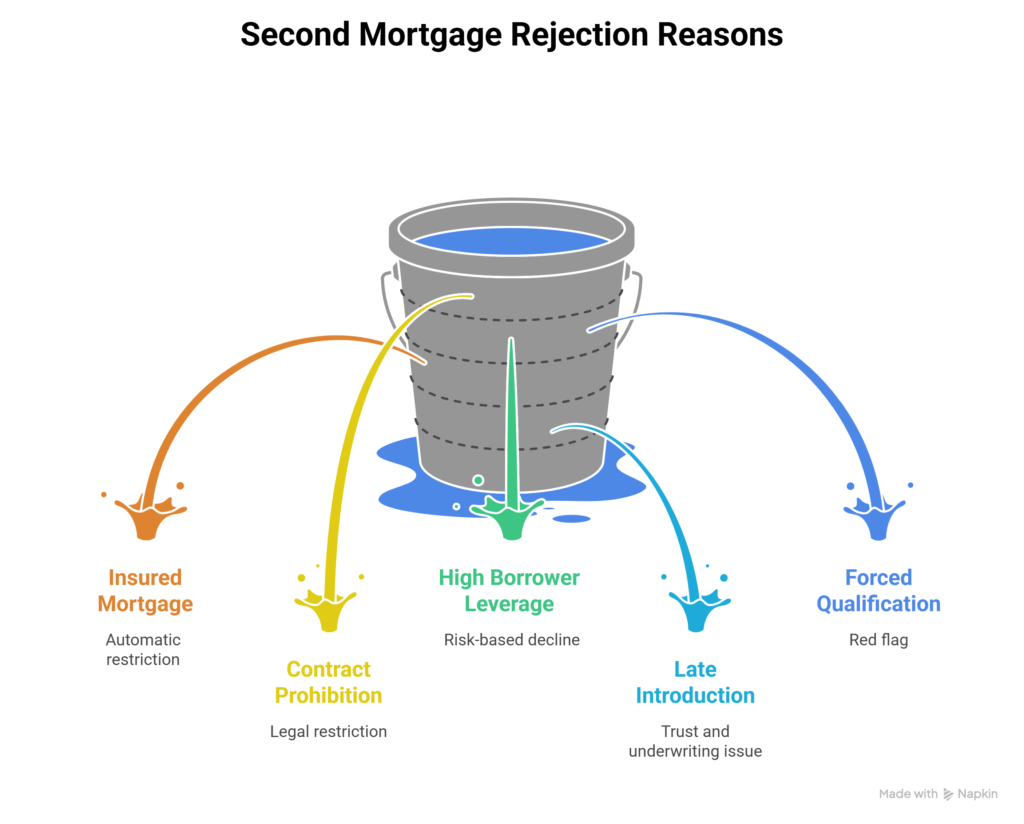
When Lenders Are Most Likely to Say “No”
Across all residential lending, second mortgages are typically disallowed when:
1. The mortgage is insured
→ Automatic restriction
2. The mortgage contract prohibits it
→ Legal restriction
3. The borrower is already highly leveraged
→ Risk-based decline
4. The second mortgage is introduced late
→ Trust and underwriting issue
5. The structure appears to “force qualification”
→ Red flag
The Exception: When Second Mortgages Are Allowed
To be clear, they are not always disallowed.
They are possible when:
- The first lender consents
- The borrower has strong equity
- Combined LTV remains within acceptable limits (often ≤80%)
- The structure is disclosed upfront
- The purpose makes sense
But notice the pattern:
These are controlled, structured scenarios—not default options
The Real Takeaway
The industry often frames this as:
“Which lenders allow second mortgages?”
But the truth is:
Most residential lenders disallow second mortgages by default—unless the structure fits their risk model perfectly.
Allen’s Final Thoughts
Second mortgages are not just about access to equity.
They are about:
- Legal structure
- Lender priority
- Risk control
And in residential lending, the first mortgage lender:
Always comes first—by design, by contract, and by enforcement.